WatchPAT Home Sleep Test With Insomnia
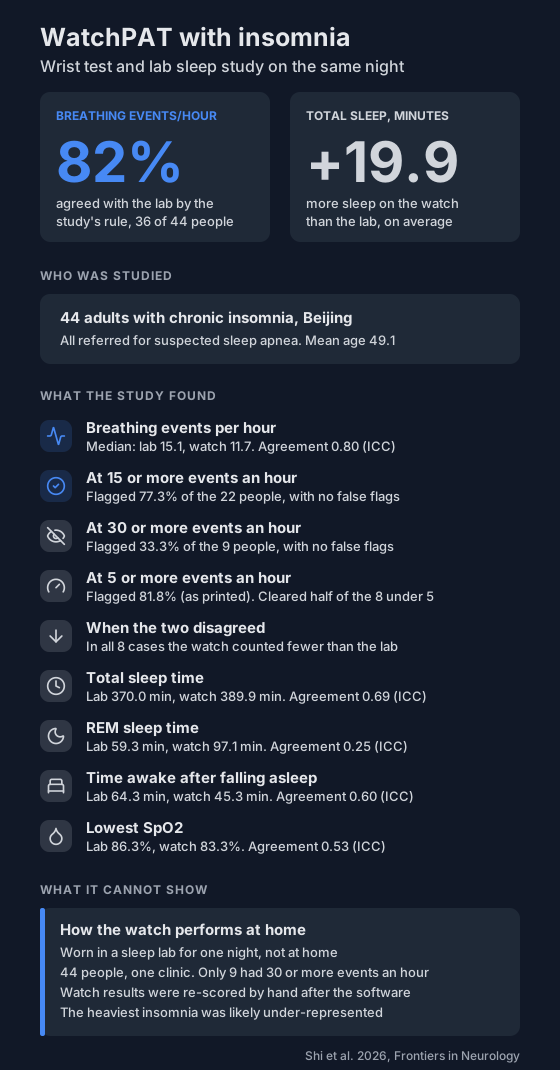
A 2026 study had 44 adults with chronic insomnia wear a WatchPAT during a lab sleep study. Its breathing event count agreed with the lab's for 82% of them by the study's rule, but it overestimated total sleep by 19.9 minutes and REM sleep by 37.2 minutes.
Most home sleep tests have no brain-wave sensors, so they estimate when you're asleep. That's a weak spot if you have insomnia and lie awake and still for long stretches.
A 2026 study checked how one wrist-worn test, the WatchPAT 200, held up in people with chronic insomnia. Its breathing event count stayed close to the lab's for most people. Its sleep time and REM time did not.
Who was studied?
- 50 adults with chronic insomnia, referred to a sleep breathing clinic in Beijing for suspected sleep apnea.
- 44 were analysed. Four were dropped for technical faults and two for recordings under 4 hours.
- Mean age 49.1, and 41% were women.
- Each wore the WatchPAT during one full night of a lab sleep study, so both recorded the same sleep.
- The watch software scored each recording first, then a scorer who had not seen the lab result went over it by hand.
The WatchPAT is a wrist unit with a finger probe that reads oxygen and the pulse signal in the fingertip, plus a small chest sensor for snoring and body position.
Did the breathing numbers match the lab?
Mostly, and when they didn't, the watch read low.
- The study counted the two as agreeing when the events-per-hour figures were within 10 of each other, or both were 40 or more.
- By that rule they agreed for 36 of 44 people (82%).
- In the other 8, the watch counted fewer events than the lab every time.
- Median events per hour: 15.1 in the lab, 11.7 on the watch.
How well did it sort people at the usual cut-offs?
- 15 or more events an hour: the watch flagged 77.3% of the 22 people the lab found, with no false flags.
- 30 or more: it flagged 33.3% of the 9 people, with no false flags.
- 5 or more: the paper's table says it flagged 81.8% of the 36 people the lab found, though that share of 36 isn't a whole number of people. Of the 8 people under 5, it cleared half.
The authors put it this way: about one in four people at 15 or more events an hour may be missed or placed in a lower band by the watch.
What about sleep time and REM?
This is where insomnia showed.
- Total sleep: 370.0 minutes in the lab, 389.9 on the watch. That's 19.9 minutes more on average, and the 95% range for one person ran from 48.1 minutes under to 87.9 minutes over.
- Time awake after falling asleep: 64.3 minutes in the lab, 45.3 on the watch.
- REM sleep: 59.3 minutes in the lab, 97.1 on the watch. The paper reports the average gap as 37.2 minutes.
- Lowest SpO2: 86.3% in the lab, 83.3% on the watch.
On a 0 to 1 agreement scale (ICC), breathing events scored 0.80, total sleep 0.69 and REM sleep 0.25. The authors rate 0.25 as poor.
Why would a wrist device count extra sleep? The authors' explanation is that people with insomnia lie awake with very little wrist movement, and a motion sensor reads that as sleep.
Does the extra sleep explain the low event count?
Not on its own. Events per hour is events divided by hours asleep, so extra sleep time pulls the figure down.
In 6 of the 8 people where the watch read low, it had also counted too much sleep. The authors recalculated the figure to allow for the extra sleep time. The watch still read low in 5 of those 6.
They suggest reading low may be a feature of the method itself. An earlier study they cite also found the watch under-counted far more often than it over-counted.
What can't it show?
- How the watch performs at home. It was worn in a sleep lab for one night.
- Much about the top end. Only 9 people had 30 or more events an hour.
- The heaviest insomnia. People came to the clinic mainly for suspected sleep apnea, so the authors say the worst insomnia was likely under-represented.
- Other causes of broken sleep. Restless legs and limb movements in sleep were not checked for.
- Minute-by-minute accuracy. Sleep and wake were compared as nightly totals only.
It's a small study from one clinic, and the authors call it preliminary. Funding was from Chinese hospital and university research grants, and the authors declare no conflicts of interest.
What can you take from it?
- If you have insomnia, read the sleep time and sleep stages from a wrist or finger device as rough estimates. For more, see how accurate smart rings are at sleep stages and wearables for insomnia.
- A per-hour figure depends on how much sleep the device thinks you got. That applies to any tracker that works out sleep from movement.
- A home result that comes back low doesn't settle things if you still feel unrefreshed. That's worth raising with your doctor.
- One night is one night. See multi-night tracking vs one sleep study and how many hours a home sleep test needs.
Not a medical device. Does not diagnose, treat or prevent any condition. Discuss results and changes with a clinician.
References
- Shi C, Luo J, Huang R, Xiao Y. Performance of wrist-worn home sleep apnea testing (watch-PAT) among individuals with chronic insomnia: a comparative study with polysomnography. Frontiers in Neurology. 2026;17:1817165. doi:10.3389/fneur.2026.1817165