How Many Hours Does a Home Sleep Test Need?
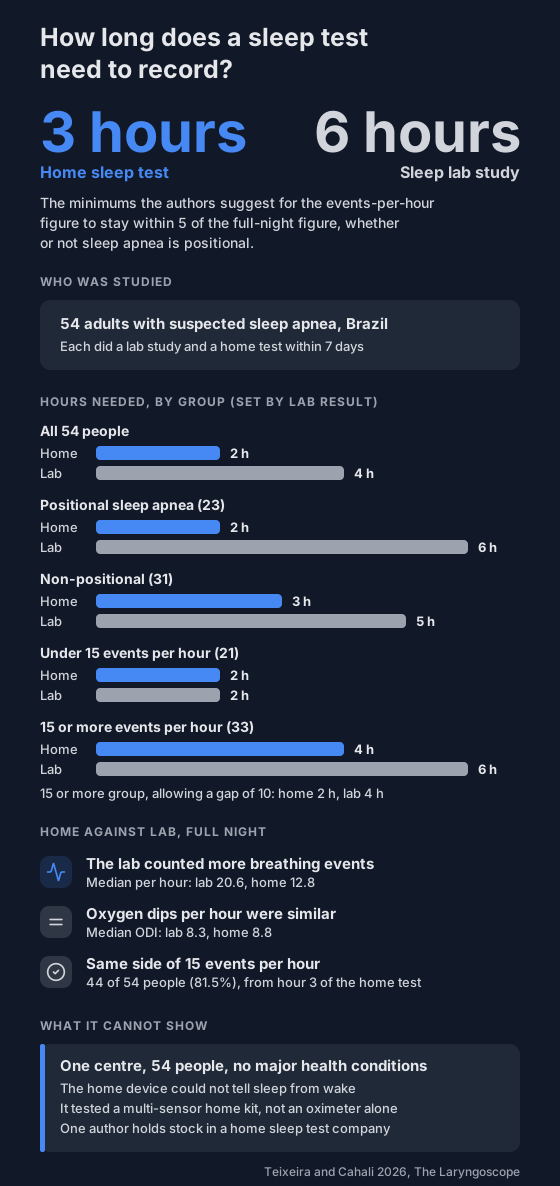
A 2026 trial had 54 adults do a home sleep test and a sleep lab study. The home test's result settled after 2 to 4 hours of recording, the lab study's after 2 to 6.
A sensor falls off at 3am, or you give up and pull the kit off early. Is the home sleep test still usable?
The American Academy of Sleep Medicine asks for at least 4 hours of recording. The authors of a 2026 trial point out that the evidence behind that number is rated very low. So they measured it.
Who was in the study?
- 54 adults in Sao Paulo, Brazil, referred for a sleep study with at least one complaint such as habitual snoring or drowsiness.
- 62 started and 54 finished both tests.
- Average age 42.7, and 75.9% were men.
- Each did two tests no more than 7 days apart, in random order: a full sleep lab study and an unsupervised home sleep test.
- The home kit had a nasal airflow sensor, chest and belly straps, a pulse oximeter and a body position sensor.
- People with major heart, lung or nerve and muscle disease, a past stroke, long-term opioid use or bad insomnia were left out.
How did they work out the hours?
Each recording was cut off at 1 hour, 2 hours, 3 hours and so on. At each cut-off they counted breathing events per hour so far.
The minimum recording time was the point where that figure got within 5 events per hour of the full-night figure, and stayed there.
So how many hours?
For all 54 people together:
- Home test: 2 hours.
- Sleep lab: 4 hours.
It changed with the group (groups were set by the full-night lab result):
- Positional sleep apnea (at least twice as many events on the back as off it, 23 people): home 2 hours, lab 6 hours.
- Non-positional (31 people): home 3 hours, lab 5 hours.
- Under 15 events per hour (21 people): 2 hours for both.
- 15 or more events per hour (33 people): home 4 hours, lab 6 hours.
For that last group, the authors also tried a looser rule of within 10 events per hour. That gave 2 hours at home and 4 in the lab.
Their conclusion: 3 hours for a home test and 6 hours for a lab study cover both position groups. Note that the 15-or-more group needed 4 hours at home under the stricter rule.
Why was the lab slower to settle?
The authors didn't expect it, and they offer three possible reasons:
- Head sensors in the lab may keep the head facing up, while at home you can turn your head with your chest still on your back.
- The lab also counts events that end in a brief awakening, and those may bunch up late in the night.
- People sleep less steadily in a lab.
None of these was tested in the study. Time spent on the back did not differ significantly between the two tests.
For more on position, see back vs side sleeping.
Did the home test and the lab agree?
Not fully.
- The lab counted more breathing events: a median of 20.6 per hour against 12.8 at home.
- Oxygen dips per hour were similar: a median ODI of 8.3 in the lab and 8.8 at home, with no statistically significant difference.
- For people under 15 events per hour, the two tests were within 5 of each other from 4 hours on.
- For people at 15 or more, the full-night gap averaged 15.7 events per hour (median 10.6).
- 7 of those 33 people landed in a lower band on the home test than in the lab.
- From hour 3 of the home test, 44 of 54 people (81.5%) fell on the same side of 15 events per hour as in the lab.
The authors put the gap down to the home kit: it counts per hour of recording, not per hour of sleep, and it can't see events that end in an awakening without an oxygen dip.
What can't it show?
- One centre and 54 people.
- The results apply to people with suspected sleep apnea and no major other conditions, insomnia included.
- The authors didn't look at sleep apnea that happens mostly in REM sleep, which comes late in the night.
- "Enough hours" means close to the same test's full-night figure, not close to the lab result.
- One author owns a sleep lab, and the other holds stock in a company that sells a home sleep test (not the one used here).
What does this mean for your own recordings?
A home sleep test is a multi-sensor kit read by a clinician. A ring or fingertip oximeter on its own is not a sleep study, and this trial didn't test one.
Two things carry over:
- The oxygen dip count showed no statistically significant difference between home and lab.
- A short night isn't automatically a wasted one, but whether a test needs repeating is your clinician's call.
If your own recording has holes in it, see gaps in O2Ring data. One night is also only one night: here's how many nights to record.
Not a medical device. Does not diagnose, treat or prevent any condition. Discuss results and changes with a clinician.
References
- Teixeira RCP, Cahali MB. Evaluating Sleep Apnea: In-Lab Versus at-Home Recording Time and the Impact of Positional Disease. The Laryngoscope. 2026;136(8):3639-3647. doi:10.1002/lary.70517