Positional Sleep Apnea and Daytime Sleepiness
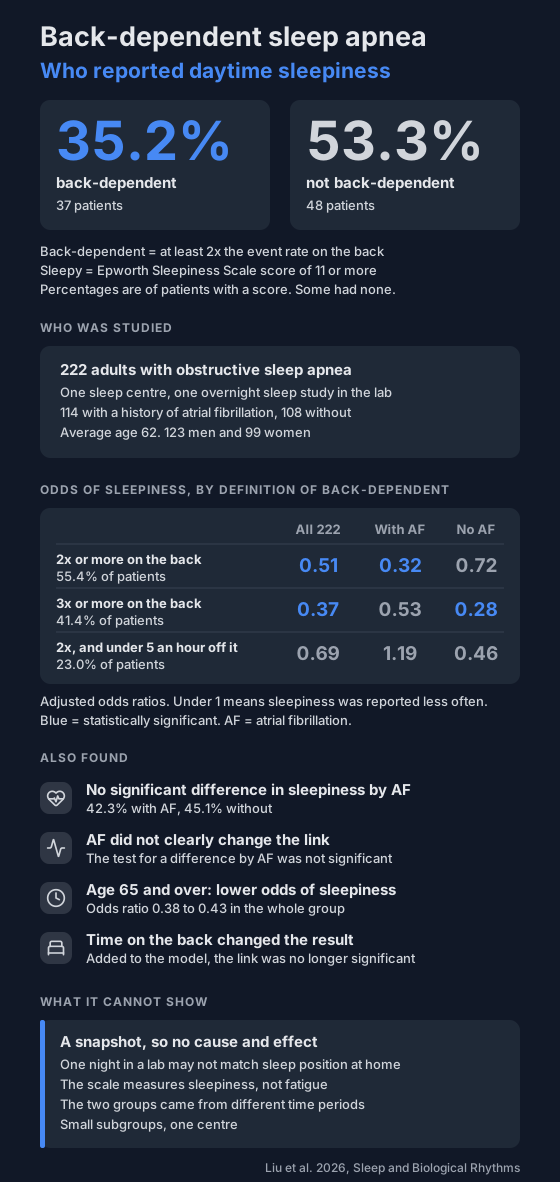
A study of 222 sleep clinic patients: of those with a sleepiness score, 35% with back-dependent sleep apnea reported daytime sleepiness, against 53% of the rest. The result shifted with the definition.
Daytime sleepiness is the symptom most people link to sleep apnea. A study published in August 2026 found it was reported less often by patients whose breathing events happened mostly on their back.
It also found the answer depends on how you define "mostly on their back".
Who was studied?
- 222 adults who had an overnight sleep study in the lab at one academic sleep centre.
- All had obstructive sleep apnea: at least 5 breathing events per hour.
- 114 had a history of atrial fibrillation (AF), an irregular heart rhythm. 108 did not.
- Average age was 62. 123 were men and 99 were women.
- Everyone slept at least 30 minutes on their back and 30 minutes off it, so the two could be compared.
Sleepiness was measured with the Epworth Sleepiness Scale. A score of 11 or more counted as excessive daytime sleepiness. Scores were missing for some of the 222 patients, so the sleepiness percentages below are out of those who had one, not out of 222.
What counts as positional?
Positional sleep apnea means more breathing events per hour on your back than in other positions. There's no single agreed cut-off, so the study used three:
- Conventional: at least twice the rate on the back. 55.4% of patients met it.
- Stricter: at least three times the rate on the back. 41.4% met it.
- Strictest: at least twice the rate on the back, and under 5 events per hour off the back. 23.0% met it.
For more on how common this pattern is, see positional sleep apnea in 12,000 patients.
What did it find?
Using the conventional definition:
- 35.2% of positional patients reported excessive daytime sleepiness (37 patients).
- 53.3% of the other patients did (48 patients).
- Across everyone with a score, 43.6% did (85 patients).
After adjusting for age, sex, BMI, high blood pressure, diabetes, sleep time and events-per-hour band, the odds of sleepiness were about half in the positional group (odds ratio 0.51, 95% CI 0.26 to 0.98).
With the stricter definition the odds ratio was lower still (0.37, 95% CI 0.18 to 0.74). With the strictest one it was not statistically significant after adjustment (odds ratio 0.69, 95% CI 0.30 to 1.55).
Two other results:
- Being 65 or over was linked to lower odds of sleepiness in every model for the whole group.
- When the authors added time spent on the back to the model, the link between positional sleep apnea and sleepiness was no longer significant. They say that may be because the two measures overlap.
Did atrial fibrillation change it?
Not clearly.
- There was no statistically significant difference in sleepiness with AF (42.3%) and without (45.1%).
- With AF, the conventional definition was linked to lower odds of sleepiness (odds ratio 0.32, 95% CI 0.11 to 0.90). The stricter one was not, after adjustment.
- Without AF, it was the other way round. The stricter definition was linked to lower odds (odds ratio 0.28, 95% CI 0.10 to 0.75). The conventional one was not.
- The strictest definition was not significant in either group after adjustment.
- The formal test of whether AF changed the link was not statistically significant for any definition.
The authors read this as a link that looks stronger with AF. Their own test doesn't confirm that, and they call their explanation speculative.
Why might positional patients be less sleepy?
The study wasn't designed to answer that. The authors offer four possibilities:
- Time off the back gives stretches of less disturbed sleep.
- Earlier research ties the positional pattern to shorter events and smaller oxygen dips. In this study, positional patients also had fewer events overall: 19.4 per hour on average, against 28.0.
- A sleep lab's wires can keep people on their back more than at home, so the lab count may overstate a positional patient's usual night.
- People may learn to stay off their back.
What can't it show?
- It's a cross-section from one centre, so it can't show cause and effect.
- Position was measured on one night in a lab, which may not match how you sleep at home.
- The Epworth scale measures sleepiness, not fatigue. The authors note that people with AF more often report fatigue.
- The AF group was collected over 8 years (2011 to 2019) and the comparison group over 6 months in 2017.
- The two groups differed in age, blood pressure history and events per hour.
- The subgroups were small. Only 51 patients met the strictest definition.
What can you do with it?
Not feeling sleepy doesn't tell you much about your breathing at night. The authors make that point for people with AF and a positional pattern: low sleepiness shouldn't be read as a sign that the sleep apnea is minor.
- If you snore or someone has seen you stop breathing, tell your doctor, even if you feel alert in the day.
- For other research on this, see sleep apnea without sleepiness.
- To see whether position lines up with your own overnight oxygen, compare back and side sleeping.
A home oximeter isn't a sleep study, and it doesn't count breathing events.
Not a medical device. Does not diagnose, treat or prevent any condition. Discuss results and changes with a clinician.
References
- Liu X, Stafford P, Bilchick K, Mazimba S, Logan J, Cho Y, Patel P, Walker M, Healy W, Kwon Y. Relationship between Positional Obstructive Sleep Apnea and Excessive Daytime Sleepiness in Patients with Atrial Fibrillation. Sleep and Biological Rhythms. 2026. Online ahead of print, 21 August 2026. doi:10.1007/s41105-026-00678-0