Does a Back-Sleeping Alarm Cut Snoring?
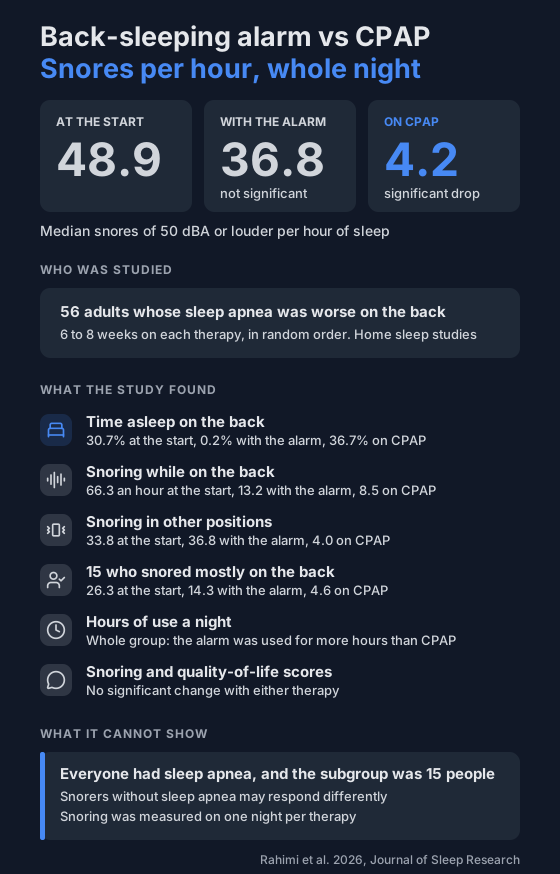
A crossover trial of 56 adults compared a vibrating back-sleeping alarm with CPAP. The alarm nearly ended back sleeping, but whole-night snoring only fell on CPAP.
Snoring is usually louder on your back, so a device that buzzes when you roll onto it sounds like an obvious fix. A trial published in the Journal of Sleep Research in 2026 measured whether it works.
The alarm did its job: people almost stopped sleeping on their backs. But snoring over the whole night didn't fall significantly, because most of them snored just as much in other positions.
Who was in the study?
- 56 adults from an Australian trial of people with back-dependent sleep apnea.
- Back-dependent meant more than 10 breathing events per hour overall, and at least twice as many on the back as in other positions.
- Most were middle-aged men carrying extra weight. The average age was about 53.
- This is a second analysis of data from an earlier trial, which compared the alarm with CPAP for daytime sleepiness.
What did they do?
- Each person used a chest-worn alarm for 6 to 8 weeks and CPAP for 6 to 8 weeks, in random order.
- The alarm vibrates after five seconds on the back and stops when you turn.
- A home sleep study with a microphone was done at the start and in the last week of each therapy.
- Software counted every snore of 50 dBA or louder, sorted into soft, medium and loud.
Did the alarm cut snoring?
Not over the whole night. These are median snores per hour of sleep:
- At the start: 48.9
- With the alarm: 36.8, not a statistically significant change (p = 0.651)
- On CPAP: 4.2, a significant drop (p < 0.001)
The alarm did change position. Back sleeping went from a median 30.7% of sleep time to 0.2%. On CPAP it was 36.7%, which the paper reports as unchanged.
So why didn't snoring follow?
- While on the back, snoring fell with both: 66.3 an hour at the start, 13.2 with the alarm and 8.5 on CPAP.
- In other positions, it was 33.8 at the start and 36.8 with the alarm. On CPAP it was 4.0.
- With the alarm, people spent almost the whole night in the positions where their snoring hadn't changed.
CPAP didn't end snoring either. The authors note some was left, including loud snoring, particularly on the back. They suggest mask leak as one possible reason.
Who did the alarm work for?
The people who snored mostly on their backs.
- 15 of the 56 snored at least twice as often on their backs as in other positions.
- In that group, the alarm cut back sleeping from 42.0% of sleep time to 12.2%.
- Whole-night snoring fell from 26.3 an hour to 14.3 with the alarm, and to 4.6 on CPAP.
- Both drops were statistically significant.
- The drop was larger and more consistent on CPAP. Only CPAP significantly lowered soft and medium snoring over the whole night.
- Snoring off the back fell significantly on CPAP (8.3 to 4.3) but not with the alarm (11.4).
The takeaway from the authors: having sleep apnea that's worse on your back doesn't mean your snoring is. Only about one in four of these patients had both.
For more on position and breathing, see positional sleep apnea in 12,000 patients.
Did people notice a difference?
Not on the questionnaires.
- Scores on a snoring scale and a quality-of-life scale didn't change significantly with either therapy.
- That held for the whole group and for the 15 back snorers.
- The authors say the short therapy periods, the small sample or differences in how people perceive snoring may explain it.
People did use the alarm for more hours a night than CPAP. In their discussion, the authors say use in the 15 back snorers was no different from CPAP. The paper shows this in a chart and doesn't print the hours.
What doesn't it tell you?
- Snorers without sleep apnea. Everyone here had sleep apnea. The authors say results may differ in people who only snore.
- Much about the subgroup. It was 15 people, and the authors flag low statistical power.
- Typical nights. Snoring was measured on one sleep study night per therapy.
- Other devices. One alarm was tested. The authors expect similar results from others that keep people off their backs, but didn't test them.
- What counts as a problem. The authors say there's no agreed definition of problem snoring.
What can you do with this?
Before assuming position is the answer, find out whether your snoring depends on it. A snoring app or a partner can tell you if it's as loud on your side as on your back.
If you record overnight oxygen, you can compare back and side nights the same way.
Loud snoring with pauses in breathing or daytime exhaustion is worth a visit to your doctor. See snoring vs sleep apnea for the signs.
Not a medical device. Does not diagnose, treat or prevent any condition. Discuss results and changes with a clinician.
References
- Rahimi MM, Vakulin A, Stevens D, Catcheside PG. A Comparison of Snoring Changes With a Supine-Avoidance Alarm Device Compared to Constant Positive Airway Pressure Treatment in Patients With Supine-Predominant OSA. Journal of Sleep Research. 2026;35(1):e70128. doi:10.1111/jsr.70128
- Rahimi MM, Vakulin A, McEvoy RD, Barnes M, Quinn SJ, Mercer JD, O'Grady A, Antic NA, Catcheside PG. Comparative Effectiveness of Supine Avoidance versus Continuous Positive Airway Pressure for Treating Supine-isolated Sleep Apnea: A Clinical Trial. Annals of the American Thoracic Society. 2024;21(2):308-316. doi:10.1513/AnnalsATS.202309-753OC