Positional Therapy vs Mouthpiece vs CPAP
A 2026 analysis pooled 18 trials and 1,520 adults with sleep apnea. CPAP cut breathing events the most, and mouthpieces and positional therapy came out close to each other.
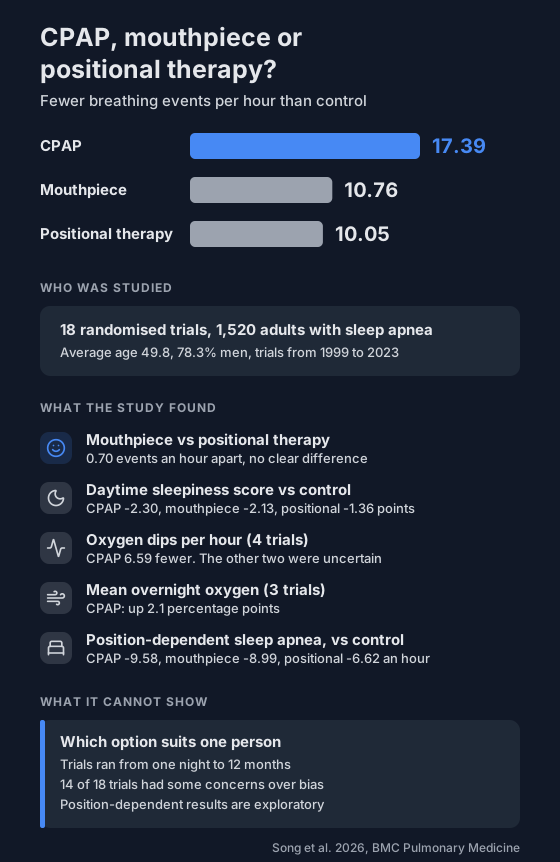
CPAP is the usual first choice for obstructive sleep apnea. Mouthpieces and positional therapy are two non-surgical alternatives.
A 2026 analysis pooled 18 randomised trials to compare all three at once. CPAP cut breathing events the most. The mouthpiece and positional therapy came out close to each other.
What was compared?
- CPAP. A machine that keeps the airway open with air pressure. Two trials used the auto-adjusting kind.
- Mouthpiece. A custom-fitted device from a dentist that holds the lower jaw forward. The paper calls it oral appliance therapy.
- Positional therapy. Anything that keeps you off your back: a tennis ball sewn into nightwear, or a device on the chest or neck that vibrates when you roll over.
- Control. No therapy, a sham device, or sleep advice only.
The oxygen-dip comparison also included overnight oxygen through a nasal tube.
This was a network meta-analysis. It combines trials that compared the options directly with trials that compared each one against a control.
Who was in the trials?
- 18 randomised trials with 1,520 adults, published between 1999 and 2023.
- Average age 49.8, and 78.3% were men.
- Average BMI in the trials ranged from 24.7 to 31.0.
- Average breathing events at the start ranged from 13 to 62.3 per hour.
- The trials ran from a single night to 12 months.
Which one cut breathing events the most?
Against control, across 17 trials and 1,471 people:
- CPAP: 17.39 fewer events per hour.
- Mouthpiece: 10.76 fewer.
- Positional therapy: 10.05 fewer.
Compared with each other:
- CPAP was 6.59 events per hour ahead of the mouthpiece and 7.28 ahead of positional therapy.
- The mouthpiece and positional therapy were 0.70 apart, with a range of -2.89 to 4.45.
That range includes zero, so the analysis couldn't separate the two. The authors say this shows uncertainty, not proof that they're equal.
For a second review of the first two, see CPAP vs a mouthpiece.
Did people feel less sleepy?
Eleven trials with 984 people reported the Epworth Sleepiness Scale, which runs from 0 to 24.
- CPAP: 2.30 points lower than control.
- Mouthpiece: 2.13 points lower.
- Positional therapy: 1.36 points lower, with a range that included zero.
The authors say a change of 2 to 3 points is the smallest most people would notice. CPAP and the mouthpiece only just reached it. The gaps between the three options were all under 1 point, and none was statistically clear.
What about oxygen dips?
Only 4 trials with 476 people reported the oxygen desaturation index (ODI).
- CPAP: 6.59 fewer dips per hour than control.
- Positional therapy: 6.64 fewer, but the range ran from -15.52 to 2.16.
- Mouthpiece: 2.20 fewer, with a range from -7.12 to 2.87.
Only the CPAP result was statistically clear. In 3 trials, mean overnight oxygen was 2.1 percentage points higher on CPAP than on control.
The trials didn't all count dips the same way. Some used a 3% drop and some a 4% drop, which the authors list as a limitation. What counts as an oxygen dip explains the difference.
What if your sleep apnea depends on position?
Position-dependent sleep apnea usually means at least twice as many breathing events on your back as in other positions. Eight trials with 496 people looked at this group.
Against control:
- CPAP: 9.58 fewer events per hour.
- Mouthpiece: 8.99 fewer, with a range from -18.66 to 0.33.
- Positional therapy: 6.62 fewer.
CPAP had a 59% probability of ranking first and the mouthpiece 40%. Positional therapy most often ranked third.
Sleepiness scores in this group came from 5 trials with 284 people. None of the three options was clearly different from control.
The authors call this subgroup exploratory, because the trials defined position-dependent in different ways.
For how common the pattern is, see positional sleep apnea in 12,000 patients.
What doesn't it tell you?
- What suits you. These are averages across trials. The authors say the choice depends on the person, their preferences and what they can tolerate.
- The long run. Most trials were short, and some lasted one or two nights. That says little about whether people keep using a device. For that, see sticking with CPAP.
- Which device. Positional therapy ranged from a tennis ball to electronic trainers, and mouthpieces varied in design. There were too few trials to compare types.
- A blinded result. 14 of the 18 trials had some concerns over bias and 2 were rated high risk, mostly because you can't hide which device someone is wearing. That matters most for the sleepiness scores.
- A complete picture. For breathing events, smaller trials tended to report bigger effects. The authors say that may mean some trials with weaker results were never published, but they can't confirm it.
The paper also has loose ends. It sets a minimum follow-up of 4 weeks, but its own table lists trials of one or two nights. The sample sizes in that table don't add up to 1,520.
What can you do with this?
Which therapy to use is a decision for you and your doctor.
What you can do at home is record what happens:
- Compare your overnight oxygen on back and side sleeping.
- If you're already on CPAP, see tracking your oxygen alongside CPAP.
- Put two nights side by side with the compare nights tool.
- Share the recordings with your doctor.
A home oximeter isn't a sleep study, and it doesn't count breathing events.
Not a medical device. Does not diagnose, treat or prevent any condition. Discuss results and changes with a clinician.
References
- Song GQ, Zhou S, He TL, Ji KJ, Duan YM, Hu GQ. Individualized treatment selection for obstructive sleep apnea: network meta-analysis focusing on position dependent patients. BMC Pulmonary Medicine. 2026;26(1):228. doi:10.1186/s12890-026-04268-1