Almonds and Sleep Quality: A 5-Month Trial
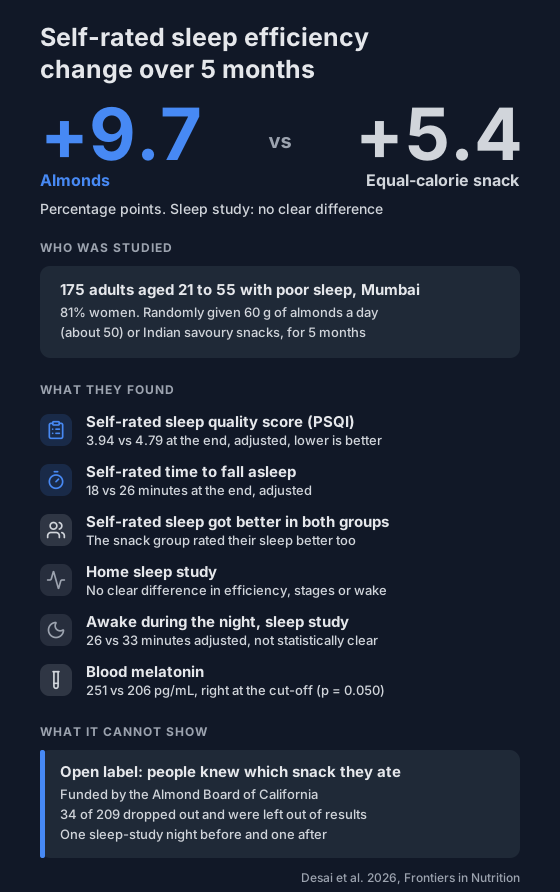
175 adults with poor sleep ate almonds or an equal-calorie snack every day for 5 months. Self-rated sleep went up more with almonds, but home sleep-study measures mostly showed no clear difference between the groups.
Almonds come up a lot in "foods for better sleep" lists, because they contain magnesium, tryptophan and a little melatonin. Most of the evidence so far came from short or small studies.
A randomised trial published in July 2026 gave adults with poor sleep almonds or a different snack every day for 5 months. It measured sleep two ways: how people rated it, and a home sleep study. The two didn't agree.
Who was in the trial?
- 175 adults aged 21 to 55 in Mumbai, India, who finished the trial.
- 81% were women, average age 39, average BMI about 27.
- All had poor sleep on a standard sleep quality questionnaire (the PSQI), or a lot of daytime sleepiness.
- People with sleep disorders, regular sleep pills, night shifts or major mental health conditions were left out.
- Everyone had a home sleep study first, and 9 people with more than 30 breathing events per hour were sent to a sleep specialist instead.
What did they eat?
- Almond group (88 people): 60 g of raw almonds a day, about 50 nuts, split between a mid-morning and an evening snack.
- Snack group (87 people): Indian savoury snacks like khakra, chivda, cookies and crackers, matched for calories and protein.
- Both groups were told to skip other nuts, avoid regular caffeine and alcohol, and otherwise eat as usual.
- Everyone who finished ate at least 80% of what they were given.
What changed?
Self-rated sleep went up in both groups. It went up a bit more with almonds:
- Sleep efficiency (share of time in bed spent asleep, as people reported it): up 9.7 percentage points with almonds and 5.4 with the snack.
- Overall sleep quality score: after adjusting for starting scores and sex, 3.94 with almonds and 4.79 with the snack at the end. Lower is better. Without that adjustment, the difference in how much the score dropped wasn't statistically clear.
- Time to fall asleep, as people reported it: 18 minutes with almonds and 26 with the snack at the end, adjusted. The unadjusted drop (14 vs 11 minutes) wasn't statistically different.
- Daytime sleepiness and sleep length: no clear difference between the groups.
What did the sleep study show?
Not much.
- No clear difference in sleep efficiency, time to fall asleep, time awake, or time in each sleep stage.
- Time awake during the night was 26 minutes with almonds and 33 with the snack at the end, adjusted, but that wasn't statistically clear.
- Among people whose self-rated score dropped by 3 points or more (62.5% with almonds, 54.0% with the snack), time awake on the sleep study barely changed with almonds and rose by about 12 minutes with the snack. That's a subgroup picked by how people felt, so read it as a lead, not a result.
The paper doesn't report overnight oxygen.
What about blood tests?
- Blood melatonin was 251 pg/mL with almonds and 206 with the snack at the end, adjusted, with p = 0.050, right on the usual cut-off. Comparing the unadjusted rises, the difference wasn't statistically clear (p = 0.087).
- Vitamin E, serotonin, cortisol, inflammation markers, blood sugar and insulin showed no clear difference.
- Weight and body fat didn't change differently between groups.
What can't it show?
- Blinding. People knew which snack they were eating, and the self-ratings are what moved. The staff scoring the sleep studies and blood tests didn't know.
- Drop-outs. 34 of the 209 people who started didn't finish, and only those who finished were analysed.
- One night each. The sleep study was a single night before and a single night after, and sleep varies night to night. See how many nights to record.
- Funding. The trial was funded by the Almond Board of California, which also supplied the almonds. One author declared being the founder of FamPhy, the Gurugram practice listed as their affiliation.
- Size of the effect. The authors say the differences in self-rated sleep were modest, and call for larger trials.
- Who it applies to. Mostly women in one Indian city, with poor sleep but no major sleep disorder.
What can you do with this?
How you rate your sleep and what a recording shows can differ. That's common, and people with sleep apnea often misjudge their sleep.
If you want to try a change to your evening snack, run it as a self-experiment. Note how you feel each morning, and if you wear an overnight pulse oximeter, look at your nights before and after rather than one night on each side.
Poor sleep that lasts has many possible causes. If you snore loudly, someone has heard you stop breathing, or you're very tired during the day, the sleep apnea risk check can help you decide whether to talk to a doctor.
Not a medical device. Does not diagnose, treat or prevent any condition. Discuss results and changes with a clinician.
References
- Desai SR, Pinto L, Halbe A, Vaidya RA, Udipi SA, Kalita S. Effects of almond consumption on sleep quality in adults: a randomized controlled trial. Frontiers in Nutrition. 2026;13:1892442. doi:10.3389/fnut.2026.1892442