Warm Footbath and Sleep in Heart Failure
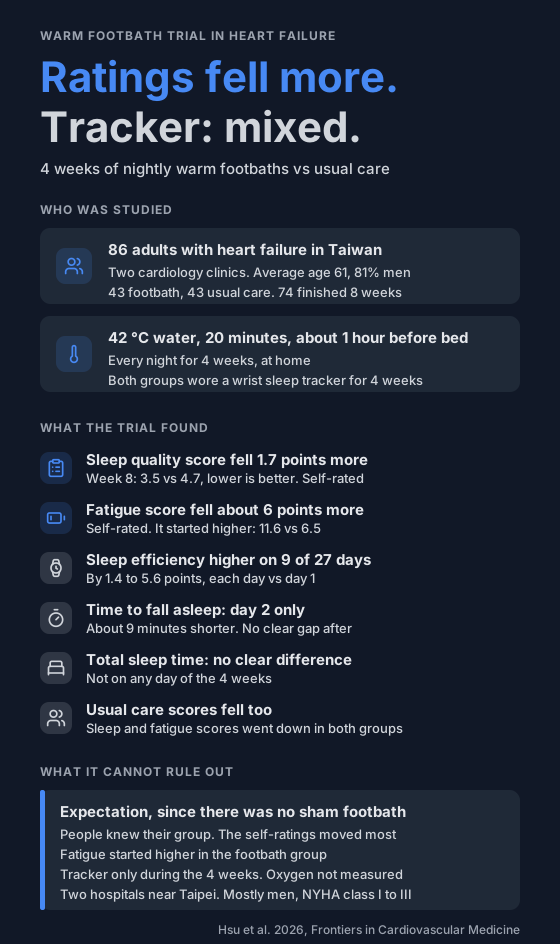
86 people with heart failure took a 42 °C footbath for 20 minutes every night for 4 weeks, or didn't. Self-rated sleep and fatigue scores fell more with the footbath, but a wrist tracker showed a mixed picture and no significant difference in total sleep time.
Poor sleep and tiredness are common with heart failure. Warm footbaths before bed are an old idea for sleep, but the authors found no earlier trial of their effect on both sleep and fatigue in people with heart failure.
A randomised trial published in September 2026 did that. It measured sleep two ways, by questionnaire and with a wrist tracker, and the two didn't tell the same story.
Who was in the trial?
- 86 adults with heart failure from cardiology clinics at two hospitals in northern Taiwan.
- Average age 61, 81% men (figures for the 74 who finished).
- Heart failure class I to III on the NYHA scale, where class III means symptoms with less than ordinary activity. Most (80%) were class II.
- People with foot wounds, leg injuries, poor circulation in the legs or a past stroke were left out.
- 74 finished all 8 weeks, 37 in each group. One person in the footbath group died after week 4; the authors judged it unrelated to the footbath.
What did they do?
- Footbath group (43 people): both feet in 42 °C water, about 10 cm above the ankle, for 20 minutes every night for 4 weeks. They did it at home, about an hour before bed, in a temperature-controlled foot spa, checking the water with a thermometer first. Plain water, nothing added.
- Usual care group (43 people): their usual heart failure care and no footbath.
- Both groups wore a wrist activity tracker (actigraph) for the 4 weeks.
- Sleep quality (the PSQI questionnaire) and fatigue were scored at the start, at week 4 and at week 8, four weeks after the footbaths stopped.
What did people report?
Scores went down in both groups, and further in the footbath group. On both scales, lower is better.
- Sleep quality score: at the start, the average was 5.2 to 5.7 across the two groups, close to the cut-off of 5 above which sleep counts as poor. By week 8 it was 3.5 with the footbath and 4.7 without. Compared with the usual care group, it fell 1.3 points more by week 4 and 1.7 points more by week 8. At week 4 the two groups' scores weren't significantly different on their own (4.1 vs 4.9); at week 8 they were.
- Fatigue score (0 to 45): it fell about 6 points more in the footbath group by week 4 and by week 8. But the footbath group started much higher, 11.6 against 6.5. At weeks 4 and 8 the two groups' scores weren't significantly different (4.3 vs 5.3, then 3.9 vs 4.8).
What did the wrist tracker show?
Less. Each of the 28 days was compared with day 1, to see whether the footbath group changed more than the usual care group.
- Total sleep time: the paper reports no significant difference between the groups on any day.
- Sleep efficiency (share of time in bed spent asleep): the footbath group's rise was bigger on 9 of the 27 days compared (days 2, 9, 11, 12, 13, 18, 23, 24 and 25), by 1.4 to 5.6 percentage points. On the other 18 days the difference wasn't significant.
- Time to fall asleep: about 9 minutes shorter in the footbath group on day 2. No significant difference on any other day.
The authors call the objective results mixed. Wrist trackers estimate sleep from movement, and can be well off on total sleep time; see EEG headband vs actigraphy.
The trial didn't measure overnight oxygen.
What can't it show?
- No blinding or sham. People knew whether they had the footbath, and the usual care group got no comparison routine. The authors say expectation or the attention of being studied may have played a part. The self-rated scores are what moved most.
- Uneven fatigue at the start. The footbath group began with almost twice the fatigue score, so it had more room to fall. The authors say their analysis accounts for the starting difference.
- Many single-day tests. The tracker results come from testing each day separately, and most days showed no difference.
- Short tracking. The tracker was only worn during the 4 weeks of footbaths, not at week 8.
- Who it applies to. A convenience sample from two hospitals near Taipei, mostly men, with no one in the most limited heart failure class. It ran from spring into summer, and the authors say season may have affected how keen people were.
- Size. 86 people, and the authors call for larger trials with longer follow-up.
- Funding. A research fund from MacKay Memorial Hospital, where the trial ran. The authors declare no commercial ties.
What can you do with this?
How you rate your sleep and what a tracker records can differ. The almond trial found the same split.
If you change an evening routine for your own reasons, compare your notes and recordings over several nights before and after, rather than one night each. The sleep experiment planner helps you set that up. An overnight pulse oximeter adds oxygen and pulse to that picture, which this trial didn't record. With heart failure, nights vary a lot; see six nights of overnight oxygen in heart failure.
One small trial isn't a reason to add footbaths to heart failure care. If you have heart failure, discuss any new evening routine with your heart team. The trial left out people with foot wounds or poor leg circulation, and told people to stop if they felt dizzy, sick, short of breath or tight in the chest.
Not a medical device. Does not diagnose, treat or prevent any condition. Discuss results and changes with a clinician.
References
- Hsu SM, Yang HY, Liang SY, Liu CY, Hung CL, Wang TJ. Effects of warm water footbath on sleep quality and fatigue in patients with heart failure: a randomized controlled study. Frontiers in Cardiovascular Medicine. 2026;13:1834981. doi:10.3389/fcvm.2026.1834981