Coherent Breathing, Blue Light and Stress
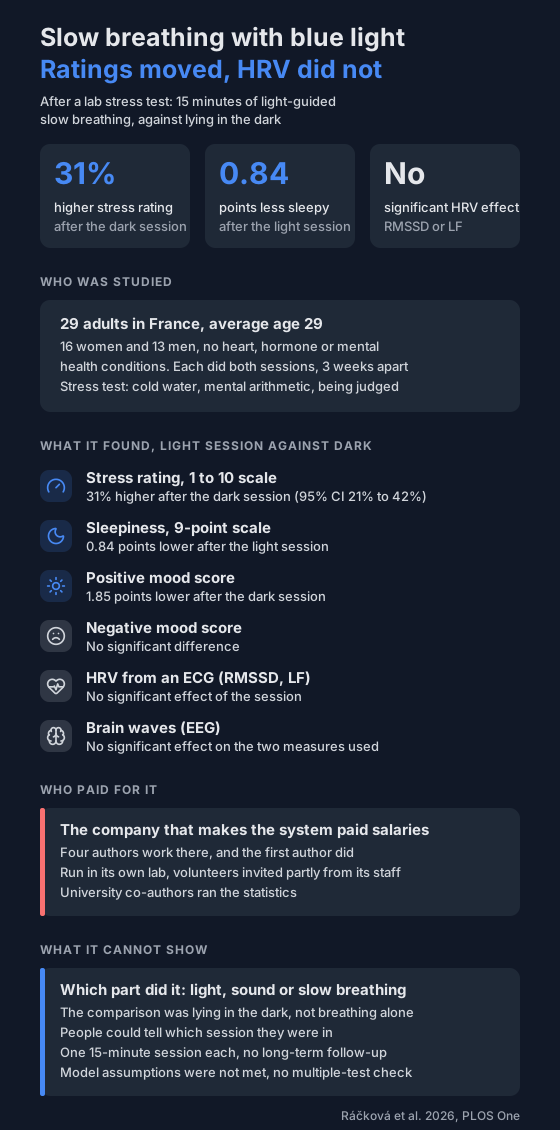
A 2026 crossover trial in 29 adults compared 15 minutes of light-guided slow breathing with lying in the dark after a stress test. Stress and sleepiness ratings were lower after the light session, HRV showed no significant effect, and four authors work for the device maker.
Coherent breathing means slow breathing at about six breaths a minute, or 0.1 Hz. It's often said to raise heart rate variability (HRV) and calm you down.
A randomised crossover trial published in September 2026 paired it with blue light after a stress test. People rated themselves less stressed and less sleepy than after lying in the dark. Their HRV showed no significant effect.
Four of the authors work for the company that makes the light-and-sound system it tested.
Who was in the study?
- 29 adults in France, 16 women and 13 men. 30 were recruited.
- Average age 29, skewed towards people under 34.
- People with heart disease, high blood pressure, hormone conditions, mental health conditions or medication affecting stress hormones were left out.
- Volunteers were invited by email from the company's staff and interns and from SpaceshipFR at the French space agency (CNES) and from the aerospace university ISAE-SUPAERO.
What did they do?
Each person came in twice, 3 weeks apart, and did both sessions in a random order.
- A stress test: cold water immersion, mental arithmetic and being judged on it.
- Then lying on a reclined bed, either:
- Light session: 15 minutes of pulsing light and sound cues pacing breathing at 5.5 breaths a minute.
- Dark session: lying in complete darkness with no cues.
Before and after, they rated stress on a 1 to 10 scale, sleepiness on the 9-point Karolinska scale, and positive and negative mood on a 20-item questionnaire. An ECG recorded HRV (RMSSD and LF power) and EEG electrodes recorded brain waves.
What did it find?
Against the dark session, after the light session:
- Stress ratings were lower. After the dark session they were 31% higher (95% CI 21% to 42%).
- Sleepiness was 0.84 points lower on the 9-point scale.
- Positive mood was higher. After the dark session it was 1.85 points lower.
- Negative mood showed no significant difference.
- HRV showed no significant effect of the session.
- Brain waves showed no significant effect on the two EEG measures used.
So the ratings moved and the heart signal didn't. HRV also wasn't linked to the stress or mood ratings, which the authors say contrasts with a lot of earlier work. They cite another recent study where light-guided slow breathing had a significant effect on RMSSD recovery after a stress test.
Did HRV go with anything?
Yes, with sleepiness. Higher RMSSD went with lower sleepiness ratings, and higher LF power with higher ones. That's an association in the authors' model, not an effect of the light.
People who rated themselves more stressed straight after the stress test also rated themselves more stressed after the session.
Who paid for it?
- The company that makes the system, and SpaceshipFR at CNES, paid salaries for six authors, per the funding statement in the published peer review history.
- An earlier competing-interest statement in that history says the company funded the research.
- Four authors work for it, and the first author did during the study.
- The sessions ran in the company's own research lab in its office.
- To limit bias, the authors say, co-authors at Masaryk University with no link to the company ran the statistics.
- The light and sound settings are proprietary and not described in the paper.
What can't it show?
- Which part did it. Light, sound cues and slow breathing were tested together. The authors say future studies should test each on its own.
- Breathing against breathing. The comparison was lying in the dark, so it can't say whether this beats slow breathing alone.
- Blinding. The paper calls it double-blind, but people could see whether they got light or darkness. The blinding it describes is of the researcher, who couldn't predict the allocation, and of the analysts.
- Precision. The authors say the statistical models broke an assumption in every case, and they didn't correct for testing several outcomes.
- Long term. One 15-minute session each, in healthy young adults. No follow-up, and no tests of thinking or work.
- Sleep. Night-time sleep wasn't measured. The authors note these light exposures are recommended in the daytime, or with enough daylight when used at night, because of effects on body clock and sleep.
What can you do with this?
If you want to try slow breathing, you can log it as a self-experiment.
- Rate your stress and sleepiness before and after, on the same scales each time.
- If you track HRV, compare it on days with and without a session, at the same time of day.
- Compare sets of days, not single sessions.
For how pulse-based HRV compares with an ECG, see wearable HRV vs ECG. For light and sleep, see daylight, evening light and sleep.
Not a medical device. Does not diagnose, treat or prevent any condition. Discuss results and changes with a clinician.
References
- Ráčková L, Diamond M, Makarová M, Morcinek P, Butin I, Nemmi F, Boyer S, Boyer L, Vašků JB, Chabani E. The effects of coherent breathing and blue light after an acute stress on sleepiness and the stress response in a workplace setting: A randomized double-blind cross-over trial. PLOS One. 2026;21(9):e0357293. doi:10.1371/journal.pone.0357293