Breathing Technique and SpO2 in Thin Air
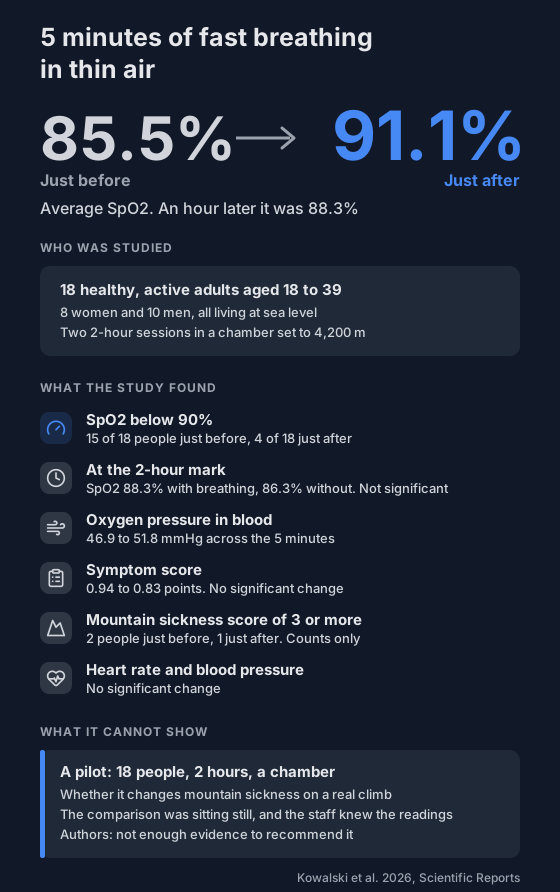
A 2026 pilot trial put 18 adults in a chamber set to 4,200 m. Five minutes of fast, guided breathing lifted average SpO2 from 85.5% to 91.1%, but an hour later the gap to the no-breathing session was no longer significant.
Breathe faster and your SpO2 goes up. The catch is that you also blow off carbon dioxide, which can leave you dizzy.
A pilot trial published in January 2026 tested a way around that. It lifted SpO2 straight afterwards, and showed little beyond that.
What was the technique?
It's called voluntary isocapnic hyperpnoea. You breathe deep at a guided 20 breaths a minute through a device with a bag that feeds some of your breathed-out air back to you. That's meant to hold your carbon dioxide steady.
Who was studied?
- 18 healthy, active adults aged 18 to 39, 8 of them women.
- All lived at sea level.
- Each sat for 2 hours in a chamber with the oxygen cut to match 4,200 m.
- They did this twice, on back-to-back days, in random order.
- In one session they did 5 minutes of the breathing after the first hour.
What happened to SpO2?
- Average SpO2 went from 85.5% just before the breathing to 91.1% just after.
- 15 of the 18 were below 90% before, and 4 after.
- At the same point in the session with no breathing, the average was 85.3%.
- At the 2-hour mark it was 88.3% with breathing and 86.3% without, a gap that wasn't statistically significant.
- By then 10 of 18 were below 90% with breathing and 13 without.
The authors call the lift short-lived.
Did they feel better?
The trial couldn't tell.
- The symptom score went from 0.94 to 0.83 points, which wasn't a significant change.
- 2 people met the cut-off for mountain sickness before the breathing and 1 after.
- Heart rate and blood pressure didn't change significantly.
The authors say 2 hours may not have been long enough to bring on symptoms. They call that an oversight.
What can't it show?
- It was a pilot: 21 people volunteered and 18 finished both sessions.
- The comparison was sitting still, with no dummy breathing task.
- The staff knew the readings, and the symptom score was self-reported.
- Carbon dioxide still drifted down, from 38.3 to 35.8 mmHg, which fell just short of significance (p = 0.068).
The authors say the evidence isn't enough to recommend the technique for mountain sickness.
What does it mean for your own readings?
- In this trial, 5 minutes of guided breathing moved the average reading by 5.6 points, so a spot check right after deep breathing may not match your resting level.
- For what to expect up high, see blood oxygen at altitude.
- On whether a reading says anything about how you'll feel, see predicting altitude sickness with oximetry.
Not a medical device. Does not diagnose, treat or prevent any condition. Discuss results and changes with a clinician.
References
- Kowalski T, Rębiś K, Wilk A, Szwed P, Grochowska J, Debevec T. Effectiveness of voluntary isocapnic hyperpnoea for mitigating hypoxemia and acute mountain sickness in normobaric hypoxia: a randomized crossover pilot trial. Scientific Reports. 2026;16(1):4784. doi:10.1038/s41598-026-35131-2