Nightmares and Sleep Study Results
A 2026 meta-analysis pooled 7 sleep lab studies, 112 people with frequent nightmares against 112 without. It found no statistically significant difference in sleep time, time awake or sleep stage shares.
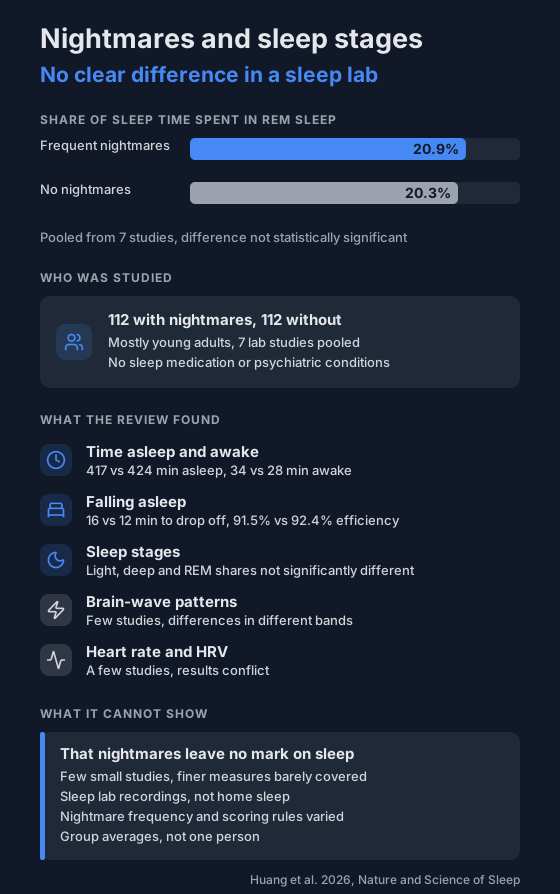
If you have frequent nightmares, you might expect your sleep to look different on a recording: more time awake, more or less REM, a different stage mix. Earlier sleep lab studies disagreed on this.
A 2026 meta-analysis pooled the studies that could be combined. On the standard measures, it found no statistically significant difference between people with frequent nightmares and people without.
Who was studied?
- A systematic review of 14 case-control studies of nightmares, with 7 of them pooled in the meta-analysis.
- The nightmare groups met the criteria for nightmare disorder, with no other known cause.
- The pooled studies had 112 people with nightmares and 112 controls, though some measures came from only 5 or 6 of the 7 studies.
- Average ages across the 14 studies ran from 20.7 to 34 years, so mostly young adults.
- Everyone was free of sleep-affecting medication.
- People with other neurological or psychiatric conditions, such as PTSD, depression or anxiety, were left out.
- Each person had an overnight sleep lab recording (polysomnography), usually after an adaptation night.
What did it find?
None of these pooled differences were statistically significant:
- Time asleep: 417 minutes with nightmares against 424 without (5 studies).
- Time awake after falling asleep: 34 against 28 minutes (5 studies).
- Sleep efficiency: 91.5% against 92.4%.
- Time to fall asleep: 16 against 12 minutes.
- Sleep stage shares: light sleep (N1 and N2) 6.7% and 45.6% against 7.1% and 47.5%, deep sleep (N3) 24.5% against 23.6%, REM 20.9% against 20.3%.
- Time to first REM sleep: 81 against 86 minutes (6 studies).
The authors found no sign of publication bias where they could test for it. Results held when they left out studies without an adaptation night or without clear checks for sleep apnea and limb movements, and when they split studies by scoring rules. The share of men in the nightmare group explained some of the differences between studies.
What about finer measures?
Some measures could not be pooled, because only a few studies reported them and in different ways.
- Brain-wave patterns: 3 studies found differences in power in frequency bands during or around REM sleep, but in different bands. A fourth found no difference in REM sleep.
- Cyclic alternating pattern (CAP): one study of 17 people with nightmares found a different mix of CAP types in non-REM sleep.
- Arousals: a study found more arousals just before REM sleep in the nightmare group, but another found no difference in arousal index.
- Heart rate: one study found higher heart rate across several sleep stages in the nightmare group, and another found no difference across the night.
- Heart rate variability (HRV): one study found lower high-frequency HRV around REM sleep, and two others found no difference.
- Just before a nightmare: one study found higher heart rate and a shorter breathing cycle in the last 5 minutes of REM sleep before a nightmare awakening, compared with the same people's awakenings without a nightmare.
The authors say this is too little data for confident conclusions. They call for larger studies that use the same methods and cover these finer measures.
What can't it show?
- That nightmares leave no mark on sleep. It found no statistically significant difference in the standard averages, with few studies to draw on.
- Anything about specific people. These are group averages.
- Home sleep. Every recording was made in a sleep lab. The authors couldn't account for differing lab bedtime routines or discomfort from wearing the equipment.
- A clean comparison. The studies differed in how they defined frequent nightmares, how they scored sleep and whether they used an adaptation night.
- Other groups. People with PTSD, depression or anxiety, who often have nightmares, were excluded, and the groups were mostly young.
- Nightmare frequency. The authors couldn't test whether it changed the results.
The authors say they used only one dataset when the same people appeared in several studies. Still, several of the 14 studies came from the same research groups, and Table 1 of the paper lists some with identical group sizes and ages, so it's not clear how independent they are.
The review was funded by Chinese government science grants, and the authors declared no conflicts of interest.
What can you do with this?
In this review, even lab-measured sleep time and stage shares didn't separate the two groups. So a consumer tracker's stage chart is unlikely to show whether you have nightmares.
If you want to look at a night's pulse and oxygen, you can open a recording in the session viewer. For how well consumer devices report sleep stages, see how smart rings score sleep stages. For HRV, see how accurate wearable HRV is.
If nightmares are frequent or distressing, discuss them with your doctor.
Not a medical device. Does not diagnose, treat or prevent any condition. Discuss results and changes with a clinician.
References
- Huang J, Wang M, Bao W, Lyu W, Wang Y, Wu S, Tang X, Ren R, Zhang Y. Polysomnographic Sleep in Idiopathic Nightmares: A Systematic Review and Meta-Analysis. Nature and Science of Sleep. 2026;18:602539. doi:10.2147/NSS.S602539