Parkinson's Sleep Changes Over Five Years
A 2026 Finnish study followed 183 people with Parkinson's, 5 years apart. Daytime sleepiness, naps, restless legs, sleep talking and nightmares became more common, while insomnia symptoms and sleep length held steady.
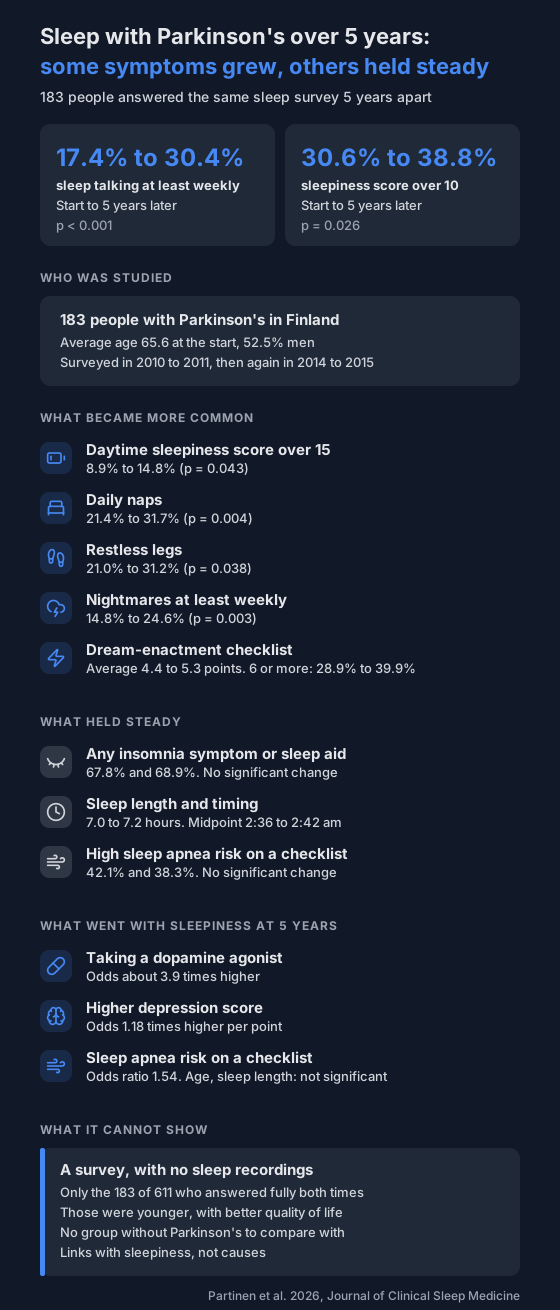
Poor sleep is one of the most common non-motor symptoms of Parkinson's disease. Most studies look at one sleep problem at a single point in time. This Finnish study asked the same people the same sleep questions twice, about 5 years apart, to see which problems grew and which didn't.
Who was studied?
- Members of the Finnish Parkinson's Association, picked at random from its register of people with Parkinson's.
- The survey went to 1,447 people in 2010 to 2011, and the first-round group numbered 611.
- 183 answered every question used in the study at both rounds, the second in 2014 to 2015.
- At the start, those 183 averaged 65.6 years old, 52.5% were men, and they'd had Parkinson's for 5.5 years on average.
- By the second survey that was 9.7 years.
- People said a neurologist had confirmed their Parkinson's. This wasn't checked against medical records.
- The survey used items from the Basic Nordic Sleep Questionnaire, plus standard checklists for daytime sleepiness (Epworth), restless legs, dream enactment and sleep apnea risk (STOP).
What became more common?
- Daytime sleepiness: a sleepiness score over 10 went from 30.6% to 38.8% (p = 0.026). A score over 15 went from 8.9% to 14.8% (p = 0.043).
- Daily naps: 21.4% to 31.7% (p = 0.004).
- Restless legs: 21.0% to 31.2% (p = 0.038).
- Sleep talking at least once a week: 17.4% to 30.4% (p < 0.001).
- Nightmares at least once a week: 14.8% to 24.6% (p = 0.003).
- Dream-enactment symptoms: the average checklist score went from 4.4 to 5.3 points (p < 0.001). The share scoring 6 or more went from 28.9% to 39.9% (p = 0.008).
Acting out dreams is a feature of REM sleep behaviour disorder. The authors see the rise in these symptoms and in sleep talking as a marker of the disease moving on. In earlier work on the same group, they linked sleep talking and longer sleep to higher mortality.
What held steady?
- Insomnia symptoms: trouble falling asleep, waking in the night, waking early and unrefreshing sleep showed no significant change. 67.8% and 68.9% had at least one of them or used a sleep aid regularly.
- Sleep length: 7.0 to 7.2 hours, not a significant change (p = 0.237).
- Sleep timing: the middle of the night's sleep moved from 2:36 to 2:42 am, not a significant change.
- Sleep apnea risk: 42.1% scored high risk at the start and 38.3% at 5 years, not a significant change.
- Daytime fatigue, hallucinations and night-time toilet trips: no significant change.
The stable insomnia result goes against some earlier reports. The authors suggest people may become less bothered by, or less aware of, broken sleep as the disease advances. They also say night waking may not have risen partly because the less well people dropped out.
What went with daytime sleepiness?
The authors looked at what went with a sleepiness score over 10 at the 5-year survey, with all factors in one model.
- Taking a dopamine agonist, a type of Parkinson's medicine: odds about 3.9 times higher (95% CI 1.54 to 10.04).
- A higher depression score: odds 1.18 times higher per point (95% CI 1.07 to 1.30).
- Sleep apnea risk on a checklist: odds ratio 1.54 (95% CI 1.08 to 2.20).
- Age, sex, sleep length, the total daily Parkinson's medicine dose and the dream-enactment score showed no significant link once the others were included.
- Levodopa and MAO inhibitors on their own showed no link.
These are links at one point in time, not causes. The authors say changes in medicine, other health conditions and daily life may also play a part.
What can't it show?
- It's a survey, with no sleep recordings. Sleep apnea and dream-enactment results come from checklists, and the authors say a full sleep study with video would be needed to confirm them.
- Sleep talking and nightmares can happen on their own, without dream enactment.
- Only the 183 who answered fully both times were included. They were younger, had Parkinson's for less time, and had better quality of life than those who weren't, so the authors think the real changes may be bigger.
- There was no group without Parkinson's, so the study can't separate Parkinson's from ordinary ageing.
- An insomnia scale was only used at the second survey, so insomnia couldn't be compared that way over time.
- There were no measures of movement symptoms, and all the people were in Finland.
- Funded by the Finnish Parkinson Foundation. The senior author reports fees and other ties with several drug companies, including Takeda and Orion-Pharma, outside this work.
What can you do with it?
If you or someone you care for has Parkinson's, the study suggests sleep is worth reviewing more than once, not just at the start. New daytime sleepiness, naps, restless legs, sleep talking or acting out dreams are all worth raising with the care team.
Sleep apnea risk was one of the things that went with sleepiness here. An overnight oximeter can't assess Parkinson's or dream enactment, but it can log your oxygen dips across several nights. See what the oxygen desaturation index means, try the sleep apnea risk check, and share your recordings with your doctor.
For more on what goes with daytime sleepiness, see what goes with sleepiness in sleep apnea. For nightmares and sleep recordings, see nightmares and sleep study results.
Not a medical device. Does not diagnose, treat or prevent any condition. Discuss results and changes with a clinician.
References
- Partinen E, Ylikoski A, Hublin C, Partinen M. Changes in sleep characteristics in Parkinson's disease: a prospective 5-year follow-up study. Journal of Clinical Sleep Medicine. 2026;22(1):166. doi:10.1007/s44470-026-00169-6