Multiple Sclerosis and Sleep Apnea Review
A 2026 meta-analysis of 40 studies that gave people with multiple sclerosis a full overnight sleep study found obstructive sleep apnea in about 44%, less sleep than healthy controls, and a link between breathing events and disability scores.
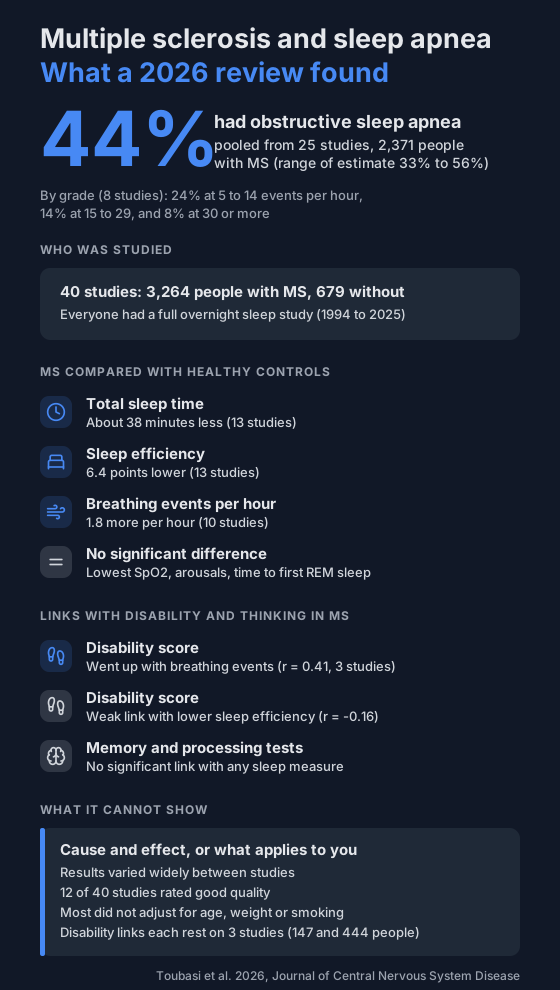
People with multiple sclerosis (MS) often say their sleep is broken and poor. Earlier reviews leaned partly on questionnaires, which only ask how sleep feels. A 2026 meta-analysis pooled only studies where people with MS had a full overnight sleep study.
It found obstructive sleep apnea in about 44% of them.
Who was in the review?
- 40 studies published between 1994 and 2025, from the US, Europe, Turkey, Australia, Canada, Egypt, India and China.
- 3,264 people with MS in total, and 679 healthy controls in the studies that had a comparison group.
- Everyone had polysomnography, the full overnight sleep study.
- Studies that only used sleep questionnaires were left out.
How common was sleep apnea?
- 25 studies with 2,371 people with MS reported it: 44% had obstructive sleep apnea, defined as 5 or more breathing events per hour.
- The plausible range around that figure was 33% to 56%.
- 8 studies split it by grade: 24% had 5 to 14 events per hour, 14% had 15 to 29, and 8% had 30 or more.
For comparison, the authors cite a review putting sleep apnea in the general adult population at 6% to 17%.
How did their sleep compare with people without MS?
Against healthy controls, people with MS had:
- About 38 minutes less total sleep (13 studies).
- Sleep efficiency, the share of time in bed spent asleep, 6.4 points lower (13 studies).
- 1.8 more breathing events per hour (10 studies).
There was no statistically significant difference in:
- The lowest oxygen level of the night (SpO2 nadir).
- How often they woke briefly (arousals).
- How long it took to reach REM sleep.
When the authors kept only the higher-quality studies, all three differences pointed the same way. The sleep time gap shrank to about 13 minutes in that subset.
Was sleep linked to disability?
The authors also looked at the EDSS, the standard MS disability score.
- More breathing events per hour went with a higher disability score (r = 0.41, 3 studies, 147 people).
- Lower sleep efficiency went with a higher score too, but the link was weak (r = -0.16, 3 studies, 444 people).
- None of the sleep measures had a significant link with scores on memory or processing speed tests.
The authors say these correlations come from few studies and few people, and should be read with caution.
What did it say about CPAP?
The review didn't test CPAP itself. It cites one earlier trial of 34 people with MS and sleep apnea, given CPAP or a sham device for 6 months. Fatigue and sleepiness scores came out better with CPAP. The authors say it's still unknown whether CPAP changes MS disability, and call for larger trials.
What can't it tell you?
- Cause. Every included study was observational, so it shows what goes together, not what causes what.
- A firm number. Results varied a lot between studies: for the 44% figure the heterogeneity was 97%, close to the maximum.
- Quality. 12 of the 40 studies (30%) were rated good quality, by one author, and most lost points for not adjusting for other factors and for unrepresentative groups.
- Shared risk factors. The authors note that age, weight and smoking are risk factors for both MS and sleep apnea, and most studies didn't account for factors like these.
- Who it applies to. The studies didn't split results by MS type, age, weight, how long people had MS or what medication they took.
The authors conclude that people with MS should be checked for sleep apnea and offered options like CPAP where appropriate. That's their view, and a conversation for you and your neurologist.
What can you do with this?
If you have MS and your sleep is broken, or you're tired beyond what you'd expect, mention it to your doctor. For the classic signs, see snoring vs sleep apnea. The sleep apnea risk check takes about a minute and helps you decide whether to bring it up.
An overnight oximeter can't tell you whether you have sleep apnea. It records your oxygen and pulse through the night, and you can share that with your doctor. For how a home oxygen recording compares with a lab study, see home oximetry vs a sleep study.
Not a medical device. Does not diagnose, treat or prevent any condition. Discuss results and changes with a clinician.
References
- Toubasi AA, Al-Sayegh TN. The Prevalence and Characteristics of Obstructive Sleep Apnea Among Patients With Multiple Sclerosis: A Systematic Review and Meta-Analysis. Journal of Central Nervous System Disease. 2026;18:11795735261485680. doi:10.1177/11795735261485680