GLP-1 vs SGLT2 vs Exercise for Sleep Apnea
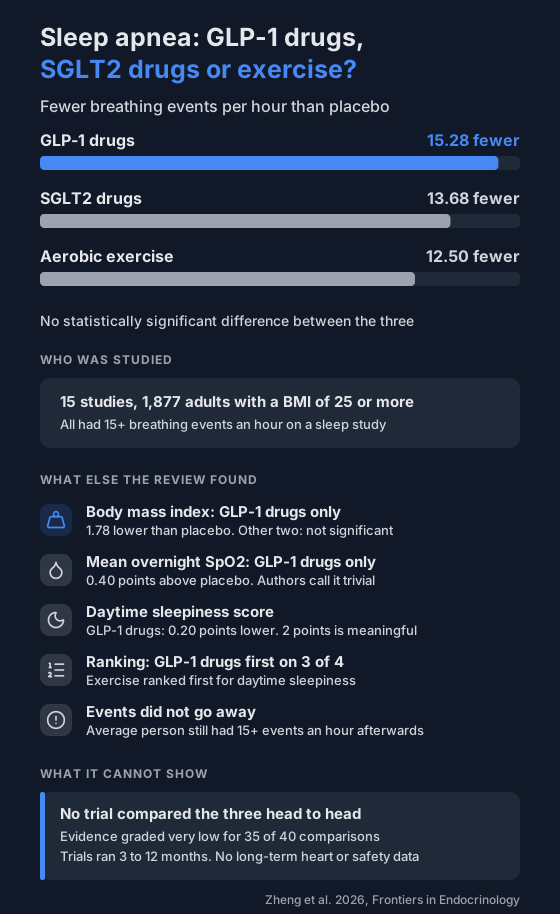
A 2026 network meta-analysis pooled 15 studies and 1,877 adults. GLP-1 drugs, SGLT2 drugs and aerobic exercise each cut breathing events by 12 to 15 an hour against placebo, with no clear winner between them.
Weight-loss injections get most of the attention in sleep apnea right now. But two other options have trials behind them too: SGLT2 drugs, which are diabetes tablets, and plain aerobic exercise.
Nobody has tested the three against each other in one trial. A review published in August 2026 did the next best thing and compared them indirectly.
All three cut breathing events per hour against placebo. None was shown to beat the others, and the authors grade most of their own evidence as very low.
What kind of study was it?
A network meta-analysis. It pools separate trials and uses their shared comparison groups (placebo or usual care) to estimate how the options stack up against each other.
That means every drug-versus-exercise and drug-versus-drug figure here is indirect.
Who was studied?
- 15 studies with 1,877 adults: 13 randomised trials and 2 case-control studies.
- Everyone had a BMI of 25 or more and at least 15 breathing events per hour on a sleep study.
- Average ages ran from the mid-40s to the mid-70s.
- The studies came from the United States, Brazil, China, Turkey, Italy and Spain.
- They lasted 3 to 12 months.
What was tested:
- GLP-1 drugs (5 studies): tirzepatide in two and liraglutide in three. No semaglutide study made it in.
- SGLT2 drugs (3 studies): all dapagliflozin 10 mg a day, compared with other glucose-lowering drugs.
- Aerobic exercise (7 studies): cycling, walking, treadmill work, interval training and one Tai Chi and Qigong programme, mostly three sessions a week for 12 weeks to 6 months.
What happened to breathing events?
Compared with placebo, the average drop in breathing events per hour was:
- GLP-1 drugs: 15.28 fewer (95% CI 8.35 to 22.22)
- SGLT2 drugs: 13.68 fewer (95% CI 2.60 to 24.77)
- Aerobic exercise: 12.50 fewer (95% CI 6.60 to 18.41)
The gaps between the three were small and not statistically significant. GLP-1 drugs against exercise, for example, came out at 2.78 fewer events an hour, with a range from 11.04 fewer to 5.47 more.
None of the three was significantly different from usual care.
Dropping the two case-control studies gave nearly the same results.
Did the breathing events go away?
No, and the authors say so directly.
Everyone started at 15 or more events per hour, and the study averages were considerably higher. A drop of 12 to 15 left the average person still at 15 or more events per hour.
The authors describe all three as add-ons, not replacements for established therapies.
What about weight, oxygen and sleepiness?
Body mass index (10 studies)
- GLP-1 drugs: 1.78 kg/m2 lower than placebo.
- SGLT2 drugs and exercise: no statistically significant difference from placebo.
- Against usual care, GLP-1 drugs came out 2.55 kg/m2 lower and SGLT2 drugs 1.34 kg/m2 lower.
- GLP-1 drugs also beat exercise by 1.35 kg/m2. That was the only significant result between any two of the three options, on any measure.
- The authors note that the size of the weight change didn't line up neatly with the size of the drop in breathing events, so weight is unlikely to be the whole story.
Mean overnight SpO2 (7 studies)
- GLP-1 drugs: 0.40 percentage points higher than placebo.
- The authors set 1 point as the smallest change that matters, and call 0.40 "clinically trivial".
- SGLT2 drugs and exercise were not significantly different from placebo.
- Against usual care, all three came out higher: GLP-1 drugs by 2.35 points, SGLT2 drugs by 2.60 and exercise by 1.95.
- New to the number? Start with what SpO2 is.
Daytime sleepiness score, 0 to 24 (6 studies)
- GLP-1 drugs: 0.20 points lower than placebo. The authors count 2 points as the smallest change that matters.
- Exercise and SGLT2 drugs were not significantly different from placebo.
- Against usual care, exercise came out 3.97 points lower and SGLT2 drugs 2.11 points lower.
So the option with the biggest drop in breathing events and weight made no meaningful difference to how sleepy people felt.
Which one ranked first?
- GLP-1 drugs ranked first for breathing events, BMI and mean SpO2.
- Exercise ranked first for daytime sleepiness.
The authors warn against reading much into this. A ranking only orders the average estimates. It says nothing about whether the gaps are real.
How strong is the evidence?
The review graded all 40 of its comparisons on a four-step scale:
- Highest grade: 0
- Second highest: 1 (GLP-1 drugs against placebo for BMI)
- Low: 4
- Very low: 35
The breathing-event result for GLP-1 drugs was graded low. For SGLT2 drugs and exercise it was very low.
What can't it tell you?
- Which is best. There are no head-to-head trials, so every comparison between the three is indirect.
- What "placebo" meant for exercise. The paper counts eight studies as placebo-controlled, but its study table lists a placebo drug in only three. By the table's counts the other five have to be exercise studies, where people know which group they're in. That matters most for a self-rated sleepiness score.
- Whether the studies are alike. Doses, exercise programmes, study length and what "usual care" covered all varied.
- SGLT2 drugs on firm ground. Only three studies, and the two non-randomised ones carried a large share of the weight.
- The long run. There's no data here on heart outcomes, side effects or cost.
- The full picture. The funnel plots hint that small studies with weaker results may be missing, which would make the effects look bigger than they are.
- A pre-set plan. The review protocol wasn't registered in advance.
What can you do with this?
Whether any of these suits you is a decision for you and your doctor. This review doesn't settle it.
If you're already on one of them, you can track what your nights look like along the way. An overnight oximeter logs your oxygen and pulse, and you can share the recordings with your doctor. It can't tell you whether you have sleep apnea or how many breathing events you had.
- Early weight loss in the tirzepatide sleep apnea trials
- What tirzepatide patients said in interviews
- Sleep apnea without sleepiness
Not sure whether sleep apnea is worth raising with a doctor? The sleep apnea risk check takes about a minute.
Not a medical device. Does not diagnose, treat or prevent any condition. Discuss results and changes with a clinician.
References
- Zheng J, Zhu Z, Bao Y, Hu Y, Dong Z, Zhao A, Li Q, Wang Y, Zhu M, Chen P. Efficacy of SGLT2 inhibitors, GLP-1 receptor agonists, and aerobic exercise for moderate-to-severe obstructive sleep apnea in overweight or obese patients: a network meta-analysis. Frontiers in Endocrinology. 2026;17:1869479. doi:10.3389/fendo.2026.1869479