Weight Loss Videos for Sleep Apnea, Rated
A 2026 study scored 235 YouTube, TikTok and Bilibili videos about weight loss for sleep apnea. Likes, comments and shares were only weakly linked to quality, and videos from verified organisations tended to score highest.
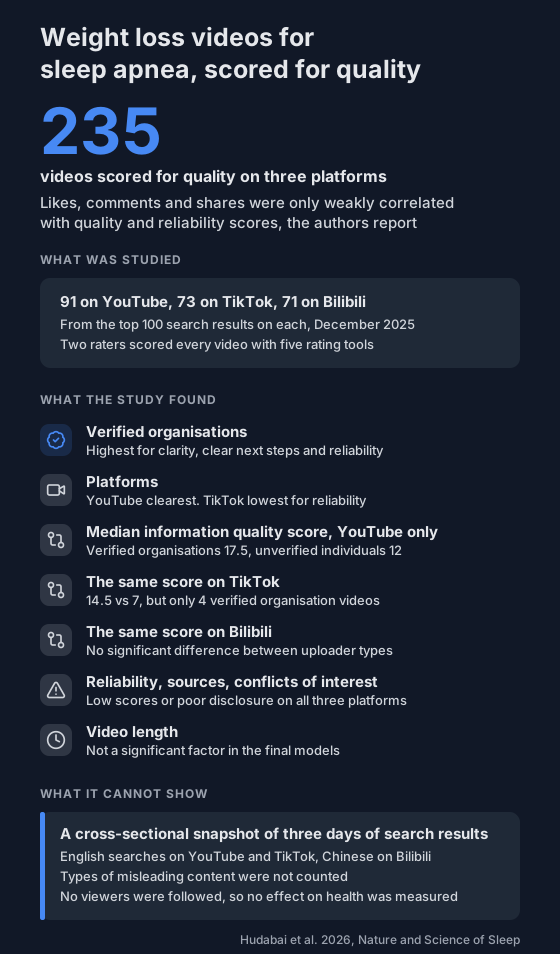
If you search for sleep apnea and weight loss, you get a lot of video. It's easy to assume the ones with the most likes are the good ones. A cross-sectional study published in 2026 scored 235 of these videos and found that likes were only weakly linked to quality.
What did the researchers do?
- They searched YouTube, TikTok and Bilibili for sleep apnea and weight loss over three days in December 2025.
- They used new anonymous accounts, took the top 100 results on each platform, and removed duplicates, adverts, off-topic videos, videos under 20 seconds and videos posted in the previous 7 days.
- That left 235 videos: 91 on YouTube, 73 on TikTok and 71 on Bilibili.
- Two raters with clinical backgrounds scored every video with five rating tools.
The tools covered how easy a video is to follow, whether it gives clear next steps, information quality (VIQI), overall quality (GQS), reliability (mDISCERN) and whether it names its author and sources (the JAMA benchmarks). Overall quality was the main outcome.
Do likes tell you which videos are good?
No, not in this sample.
- Likes, comments, favourites and shares rose and fell together (correlations of 0.86 to 1.00).
- The authors describe their correlations with the quality, reliability and transparency scores as weak. The text gives no figures for these.
- Follower counts tracked engagement (0.58 to 0.66).
- The quality scores tracked each other: easy-to-follow videos also scored higher for overall quality (0.71) and reliability (0.72).
The authors say popularity may be driven more by things like an attractive title than by quality.
Who made the better videos?
Each uploader was sorted into one of four types: verified or unverified, organisation or individual. The authors describe the verified accounts as institutions and health professionals.
- Verified organisations had the highest scores for being easy to follow, for clear next steps and for reliability.
- Overall quality scores were generally higher for verified organisations and verified individuals.
- On YouTube, the median information quality score was 17.5 for verified organisations, 14 for verified individuals and 12 for unverified individuals.
- On TikTok it was 14.5, 10 and 7. Only 4 TikTok videos came from verified organisations.
- On Bilibili there was no significant difference between uploader types.
Did the platform matter?
Who posts differs a lot by platform.
- YouTube. 35.2% of videos came from verified organisations. It had the highest median score for being easy to follow, and the paper's text says it also led for clear next steps.
- TikTok. 57.5% came from unverified individuals. It had the shortest videos (a median of 59 seconds) and the most likes (a median of 117). It scored lower for reliability than YouTube and Bilibili.
- Bilibili. 45.1% came from verified individuals. It had the longest videos (a median of 134 seconds) and the widest spread of scores for ease of following and overall quality.
Two findings held on every platform:
- Reliability scores were generally low.
- Videos scored poorly on saying where their information came from and on disclosing conflicts of interest.
Topics differed too. Medication was the most common topic on TikTok (23.3% of videos), and YouTube had the largest share of videos mentioning weight loss surgery (14.3%).
Are longer videos better?
Not in this study. The researchers built models to see what went with a higher overall quality score.
- The information quality score had the strongest link, followed by the transparency score.
- Video length was not statistically significant in the final models.
The authors call these models exploratory. The scores overlap in what they measure, so the models describe the sample and don't show cause.
What can't this study show?
- It's a cross-sectional snapshot. The authors say search rankings change, so the same search may not return the same videos later.
- Platform and language are mixed together. YouTube and TikTok were searched in English and Bilibili in Chinese, so a platform difference could be a language or regional difference.
- The Chinese version of TikTok, Douyin, was not included.
- The raters did not count how many videos pushed rapid weight loss, diet misinformation or commercial products. The authors noticed some, but did not measure it.
- Nobody who watched the videos was followed. The study says nothing about whether watching them changes what people do or how they fare.
The study was funded by the Natural Science Foundation of Guangdong Province, and the authors report no conflicts of interest.
What can you take from it?
The authors suggest clinicians encourage patients to check three things about a health video:
- Is the uploader a verified health professional or institution?
- Does the video say where its information comes from?
- Does it match established guidelines?
The authors add that a high count of likes, comments, shares or views does not necessarily mean a video is accurate or suits your situation. They also say weight loss plans for sleep apnea should be individual, and that clinicians should ask patients what they have watched online. If a video raises a question for you, discuss it with your doctor.
For what studies have found on weight and sleep apnea, see the obesity and sleep apnea study and the tirzepatide trial analysis.
Not a medical device. Does not diagnose, treat or prevent any condition. Discuss results and changes with a clinician.
References
- Hudabai R, Jian J, Yang P, Yi Y, Xu Y, Peng A, Yao J, Chen X. Quality and Reliability of Social Media Videos on Weight-Loss Interventions for Obstructive Sleep Apnea: A Multi-Platform Cross-Sectional Study. Nature and Science of Sleep. 2026;18:599776. doi:10.2147/NSS.S599776