Tirzepatide and Sleep Apnea: Who Responded?
A 2026 re-analysis of the two tirzepatide sleep apnea trials split the results by age, sex, BMI, neck size and starting event count. Every subgroup did better than placebo. It was post hoc, descriptive and funded by Eli Lilly.
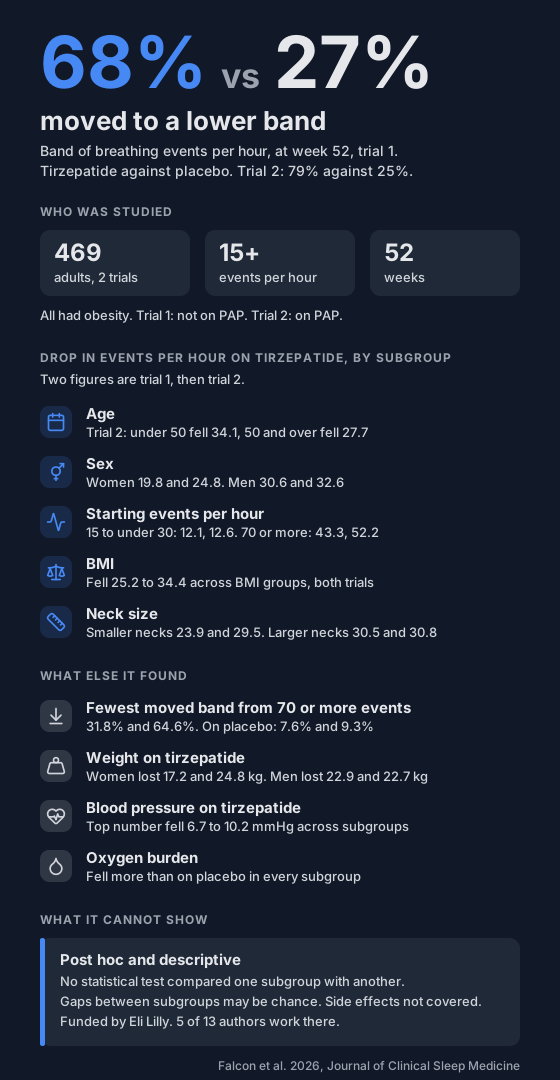
The two SURMOUNT-OSA trials tested tirzepatide, a weight-loss drug, in adults with obesity and obstructive sleep apnea. A 2026 paper split those results by age, sex, BMI, neck size and starting event count, to see whether any group stood out.
Every subgroup on tirzepatide did better than the same subgroup on placebo. The analysis was post hoc, descriptive and funded by Eli Lilly, which makes the drug.
Who was in the study?
- 469 adults with obesity (BMI 30 or more) and at least 15 breathing events per hour on a sleep lab study.
- Trial 1 had 234 people not using PAP (such as CPAP). Trial 2 had 235 people using it.
- About half got tirzepatide and half placebo, for 52 weeks.
An earlier post covers early weight loss in the same trials.
What did the researchers do?
They split each trial by five things measured at the start:
- Age: under 50, or 50 and over.
- Sex.
- Breathing events per hour: 15 to under 30, 30 to under 70, or 70 and over.
- BMI.
- Neck size: smaller or larger.
Then they compared the change at week 52 on tirzepatide and on placebo inside each subgroup.
What did they find overall?
The paper sorts breathing events per hour into four bands: under 5, 5 to under 15, 15 to under 30, and 30 or more. Among people with a sleep study at both the start and week 52, the share who moved to a lower band:
- Trial 1: 67.7% on tirzepatide, 26.8% on placebo.
- Trial 2: 79.0% on tirzepatide, 25.3% on placebo.
Moved to a higher band:
- Trial 1: 1.0% on tirzepatide, 3.7% on placebo.
- Trial 2: 2.9% on tirzepatide, 10.8% on placebo.
Did it differ by subgroup?
In every subgroup, breathing events per hour, weight and hypoxic burden fell further on tirzepatide than on placebo. Hypoxic burden is how deep and long the oxygen dips were. The top blood pressure number also fell on tirzepatide in every subgroup.
The size of the drop on tirzepatide varied. Where there are two figures, they are trial 1, then trial 2.
- Age. Results were mostly alike. In trial 2, people under 50 dropped 34.1 events per hour and people 50 and over dropped 27.7. The under-50s also lost more weight (24.4 kg against 22.2 kg), while blood pressure fell more in the older group (9.5 mmHg against 7.8 mmHg).
- Sex. Men dropped 30.6 and 32.6 events per hour. Women dropped 19.8 and 24.8. Men started with more events, which the authors say may explain it. Weight went the other way between trials: women lost 17.2 and 24.8 kg, men 22.9 and 22.7 kg.
- Starting events. People who started at 70 or more dropped 43.3 and 52.2 events per hour. People who started at 15 to under 30 dropped 12.1 and 12.6. As a share of where they started, the 70-and-over group tended to change the least.
- BMI. The drop was similar across BMI groups: between 25.2 and 34.4 events per hour, taking both trials together. People with a higher BMI lost more kilograms, mainly in trial 2.
- Neck size. Larger necks dropped 30.5 and 30.8 events per hour. Smaller necks dropped 23.9 and 29.5.
The top blood pressure number fell by 6.7 to 10.2 mmHg on tirzepatide across the subgroups.
Which group moved band least often?
People who started at 70 or more events per hour.
- Trial 1: 31.8% moved to a lower band on tirzepatide, 7.6% on placebo.
- Trial 2: 64.6% on tirzepatide, 9.3% on placebo.
The authors point out that this group starts furthest from the next band. Their average was 91 and 86 events per hour. On tirzepatide, 50.6% and 71.1% of them still had their events cut by half or more.
Of the three starting-event groups, people at 15 to under 30 moved band most often: 84.8% and 81.4% on tirzepatide, 38.0% and 30.1% on placebo.
What doesn't it tell you?
- Whether subgroups really differ. The analysis was post hoc and descriptive. No statistical test compared one subgroup with another, and the subgroups were small. The authors say the gaps may be chance.
- What drives the gaps. Each split looked at one thing at a time. Men, for example, were also younger and started with more events.
- Side effects. They weren't reported by subgroup.
- Dropouts. More people left the placebo arm than the tirzepatide arm in every subgroup, and data after stopping were excluded. The authors say whether this inflated the result needs a closer look.
- Independence. Eli Lilly funded the study. Five of the 13 authors work there and two more used to. Four others report fees, income or advisory roles with the company.
- Beyond a year. Follow-up stopped at 52 weeks.
What can you do with this?
Decisions about medication and PAP therapy belong with your doctor.
For what taking the drug was like, see interviews with tirzepatide patients.
You can log your weight next to your oxygen dips per hour and share both with your doctor. An oximeter doesn't count breathing events, so it can't tell you which band you're in.
Not a medical device. Does not diagnose, treat or prevent any condition. Discuss results and changes with a clinician.
References
- Falcon B, Xie CC, Redline S, Grunstein R, Turnbull CD, Rapoport DM, Wang H, Chakladar S, Dimitriadis GK, Lau E, Bednarik J, Liao B, Malhotra A. Association of tirzepatide with changes in OSA-related measures based on baseline characteristics - post hoc analyses of SURMOUNT-OSA. Journal of Clinical Sleep Medicine. 2026;22(1):155. doi:10.1007/s44470-026-00162-z