Tirzepatide and Sleep Apnea: Patient Views
Researchers interviewed 82 people as they left the tirzepatide sleep apnea trials. Most on the drug who snored said it got better, and over half disliked the side effects. Eli Lilly funded the study.
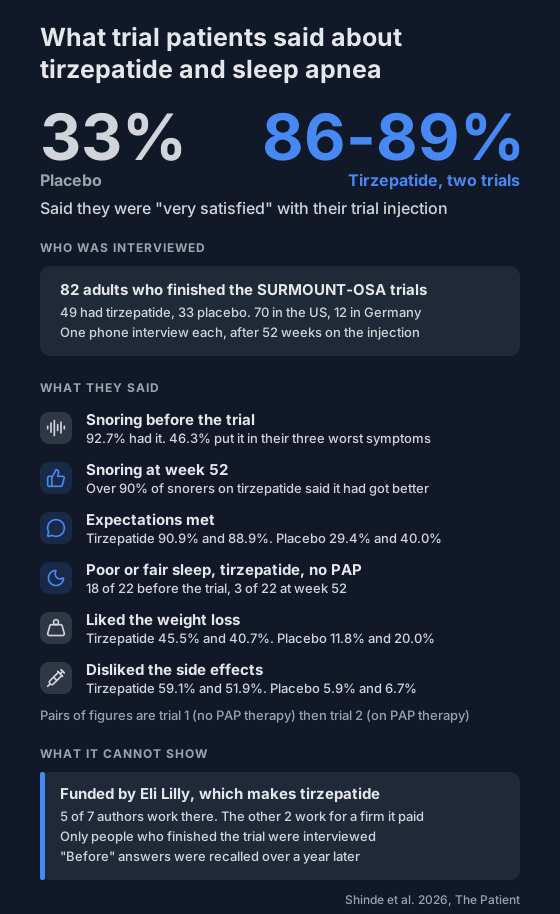
The tirzepatide sleep apnea trials reported sleep study numbers and body weight. A 2026 study asked what the people in them said.
Researchers phoned 82 of them as they left the trials. Eli Lilly, which makes tirzepatide, funded the study.
Who was interviewed?
- 82 adults with obesity and obstructive sleep apnea from the two SURMOUNT-OSA trials: 70 in the US, 12 in Germany.
- 49 had been on tirzepatide and 33 on placebo for 52 weeks.
- 40 came from trial 1 (people not using PAP therapy) and 42 from trial 2 (people on PAP therapy).
- Average age 52.7, 61.0% men, 91.5% White.
- Neither the interviewers nor the participants knew who had been on the drug.
What bothered them before the trial?
- Snoring: 92.7% had it, and 46.3% put it in their three worst symptoms.
- Getting up at night to urinate: 75.6%.
- Daytime effects of poor sleep: 91.5%.
Snoring is not the same as sleep apnea, but it was the complaint these people named most.
What did they say a year later?
- Of those on tirzepatide who had snored, over 90% said it had got better.
- Over 70% said the same for seven of the eight common symptoms they'd had.
- The exception was getting up at night to urinate: 47.1% and 64.7% in the two trials.
- On placebo, fewer than 50% said so for six of the eight.
- In trial 1, 18 of 22 people on tirzepatide rated their sleep poor or fair before, and 3 of 22 at week 52.
- "Very satisfied": 86.4% and 88.9% on tirzepatide in the two trials, 33.3% on placebo across both.
In this interview group, breathing events per hour fell 71.0% and 66.0% on tirzepatide, against a 4.7% fall and a 1.3% rise on placebo.
What didn't they like?
Side effects. 59.1% and 51.9% of the tirzepatide groups named them as a dislike, against 5.9% and 6.7% on placebo.
What can't it show?
- Independence. Five of the seven authors work for Eli Lilly, and the other two work for a firm it paid.
- Everyone who started. Only people who finished the trial were interviewed, and the authors say this may favour good experiences.
- Accurate "before" answers. People described their pre-trial symptoms more than a year afterwards, from memory.
- Other groups. Most were White.
An earlier post covers early weight loss in the same trials.
What can you do with this?
Whether a medicine suits you is a question for your doctor. If you're tracking your own nights, an overnight oximeter logs your oxygen and pulse, and you can share that with your doctor.
Not a medical device. Does not diagnose, treat or prevent any condition. Discuss results and changes with a clinician.
References
- Shinde S, Kanu C, Varnado OJ, Bednarik J, Dennehy EB, Dias-Barbosa C, Taylor N. Patients' Experiences of Obstructive Sleep Apnea and Tirzepatide Treatment: An Exit Interview Study. The Patient - Patient-Centered Outcomes Research. 2026;19(4):601-614. doi:10.1007/s40271-026-00808-3