Tirzepatide and Sleep Apnea: Early Weight Loss
A 2026 re-analysis of the tirzepatide sleep apnea trials found that people who lost 15% or more of their weight by week 20 were in remission far more often at one year. It was unplanned and funded by Eli Lilly.
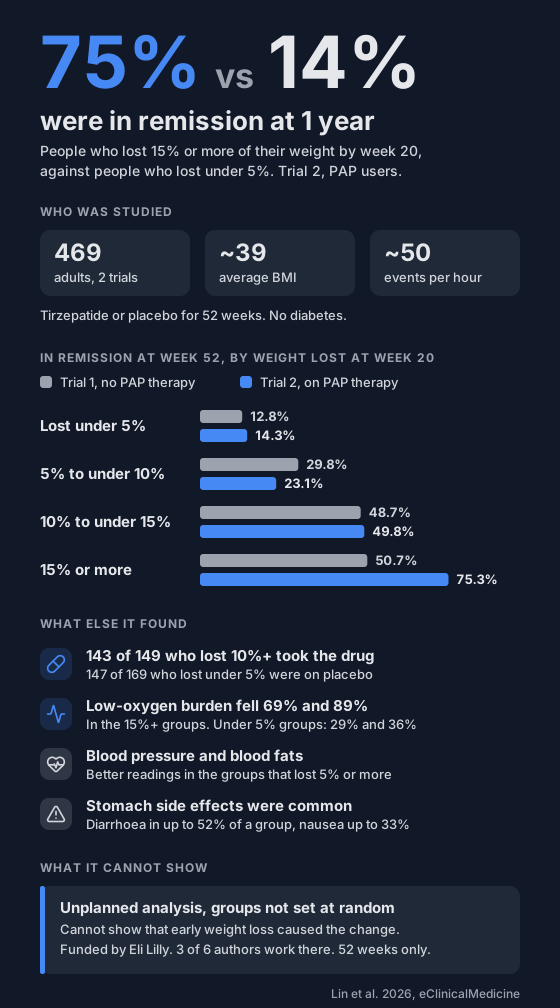
Tirzepatide is a weight-loss drug that was tested in people with obesity and obstructive sleep apnea. A 2026 paper asked whether the weight lost by week 20 lined up with their sleep study results at one year.
It did, but the analysis was unplanned and Eli Lilly funded it.
Who was in the study?
- 469 adults from the two SURMOUNT-OSA trials.
- All had obesity, at least 15 breathing events per hour, and no diabetes.
- Average BMI was about 39, with about 50 breathing events per hour.
- Trial 1 was people not using PAP (such as CPAP). Trial 2 was people using it.
- Half got tirzepatide and half placebo, for 52 weeks.
What did the researchers do?
They sorted people into four groups by weight lost at week 20, then compared them at week 52.
"Remission" meant fewer than 5 breathing events per hour, or 5 to 14 with a low daytime sleepiness score.
What did they find?
Remission at week 52, trial 1 then trial 2:
- Lost under 5%: 12.8% and 14.3%
- Lost 5 to 10%: 29.8% and 23.1%
- Lost 10 to 15%: 48.7% and 49.8%
- Lost 15% or more: 50.7% and 75.3%
Other results:
- Breathing events per hour fell in all four groups, and further in the two that lost 10% or more.
- More people in those two groups had them cut by half or more.
- Hypoxic burden (how deep and long the oxygen dips were) fell 69% and 89% in the top groups, against 29% and 36% in the bottom ones.
- Blood pressure, HDL cholesterol, triglycerides and sleep questionnaire scores were better in the groups that lost more.
- In trial 2, the link did not reach significance in people under 50.
- Stomach side effects were the most common: diarrhoea reached 52.2% in one group and nausea 32.6%.
- Serious adverse events did not differ between groups.
What doesn't it tell you?
- Cause. The groups were formed by what happened, not at random.
- Weight loss apart from the drug. 143 of the 149 who lost 10% or more were on tirzepatide. 147 of the 169 who lost under 5% were on placebo.
- Independence. Eli Lilly funded the study and took part in its design and analysis. Three of the six authors work there.
- Beyond a year. Follow-up stopped at 52 weeks.
What can you do with this?
Decisions about medication and PAP therapy belong with your doctor.
You can log your weight next to your oxygen dips per hour and share both with your doctor. An oximeter doesn't count breathing events, so it can't show remission.
Not a medical device. Does not diagnose, treat or prevent any condition. Discuss results and changes with a clinician.
References
- Lin YN, Sun XW, Dai SJ, Zhuang HX, Liu JJ, Li QY. Association between early body weight reduction and treatment outcomes in participants with obstructive sleep apnoea and obesity: a post hoc analysis of SURMOUNT-OSA trials. eClinicalMedicine. 2026;100:104203. doi:10.1016/j.eclinm.2026.104203