How Common Is Sleep Apnea? A São Paulo Study
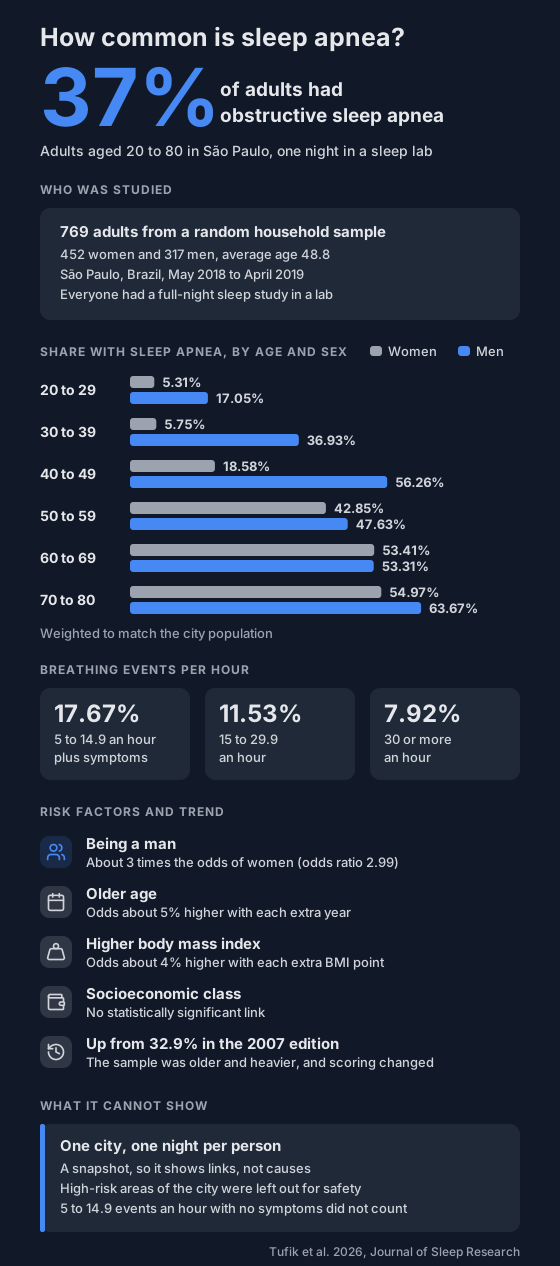
A 2026 study gave 769 randomly chosen São Paulo adults a full night in a sleep lab. 37% had obstructive sleep apnea: 45% of men and 31% of women.
Figures for how common sleep apnea is that come from clinic patients or health records only count people who've already been tested.
A study published in 2026 went door to door in São Paulo, Brazil, and brought a random sample of adults into a sleep lab. 37% of them had obstructive sleep apnea.
Who was studied?
- 769 adults aged 20 to 80 living in São Paulo: 452 women and 317 men, average age 48.8.
- They were picked at random by district, block, household and person, between May 2018 and April 2019.
- Every one of them spent a full night in a sleep lab.
- The results were weighted so the sample matched the city's mix of age, sex and social vulnerability.
It's the 4th edition of a long-running survey called EPISONO. The 3rd edition ran in 2007.
What counted as sleep apnea?
The study counted breathing events per hour of sleep.
- 15 or more an hour: counted, with or without symptoms.
- 5 to 14.9 an hour: counted only with loud snoring, daytime sleepiness, fatigue or reported pauses in breathing.
- Under 5 an hour: not counted.
How common was it?
- All adults: 37.12% (95% confidence interval 33.71% to 40.53%).
- Men: 44.88%.
- Women: 30.79%.
Split by events per hour:
- 5 to 14.9 an hour, with symptoms: 17.67%
- 15 to 29.9 an hour: 11.53%
- 30 or more an hour: 7.92%
How did it change with age?
The share rose with each older age group.
- 20 to 29: 10.80%
- 30 to 39: 22.01%
- 40 to 49: 39.44%
- 50 to 59: 44.70%
- 60 to 69: 53.38%
- 70 to 80: 58.41%
The gap between men and women was wide up to the 40s and much narrower after that. At 40 to 49 it was 56.26% of men against 18.58% of women. At 60 to 69 it was 53.31% of men and 53.41% of women. The authors didn't test that gap by age, so it's a pattern in their table, not a tested finding.
Some age groups were small, so those figures are rough. Only 63 people were aged 70 to 80.
For a different view of the same question, see sleep apnea by age and sex, which counted US patient records.
What went with higher odds?
The authors put age, body mass index (BMI), sex and socioeconomic class into one model.
- Sex. Men had about 3 times the odds of women (odds ratio 2.99).
- Age. Each extra year went with about 5% higher odds (odds ratio 1.05).
- BMI. Each extra BMI point went with about 4% higher odds (odds ratio 1.04).
- Socioeconomic class. No statistically significant link.
A second model looked at how many events per hour people had, and gave almost the same figures.
Is it getting more common?
The 2007 edition found 32.9%. This one found 37.1%.
Two things changed between them:
- The sample. 49.03% were aged 50 or over, up from 29.1%. 65.92% were overweight or obese, up from 59.9%.
- The scoring rule. A partial breathing event now needs a 30% drop in airflow, not 50%.
The authors think the scoring change had little effect. They say the rise likely reflects real changes in the population between 2007 and 2018.
What can't it show?
- Cause. It's a cross-sectional study, a single snapshot. It shows what went together, not what caused what.
- Everywhere. It's one city. The authors left out high-risk areas for interviewer safety, and say that's unlikely to have changed the result much.
- Night-to-night change. Each person had one night in the lab. See multi-night tracking vs one sleep study.
- A single true figure. The 37% depends on the definition. People with 5 to 14.9 events an hour and no symptoms weren't counted.
The study was funded by AFIP, a Brazilian research foundation that two of the authors are affiliated with. One author was a shareholder in a Brazilian digital insomnia therapy company and says that had no bearing on the study.
What can you do with this?
If you snore loudly, someone has heard you stop breathing in your sleep, or you're worn out during the day, see a doctor. For the other signs, read snoring vs sleep apnea.
Not sure? The sleep apnea risk check takes about a minute and helps you decide whether to talk to a doctor.
An overnight oximeter can't tell you whether you have sleep apnea. It records what your oxygen and pulse did, and you can share that with your doctor.
Not a medical device. Does not diagnose, treat or prevent any condition. Discuss results and changes with a clinician.
References
- Tufik S, Porcacchia AS, Pires GN, Andersen ML. Prevalence and Risk Factors for Obstructive Sleep Apnea in São Paulo: Findings From the 4th Edition of the EPISONO Study. Journal of Sleep Research. 2026;35(3):e70255. doi:10.1111/jsr.70255