Tongue Nerve Implant and Oxygen Burden
A 2026 look back at the STAR trial found median oxygen burden fell from 63.4 to 14.3 %min per hour after 12 months on a tongue nerve implant, and half the higher-burden people who missed the events target still ended below the cut-off. One author works for the implant maker.
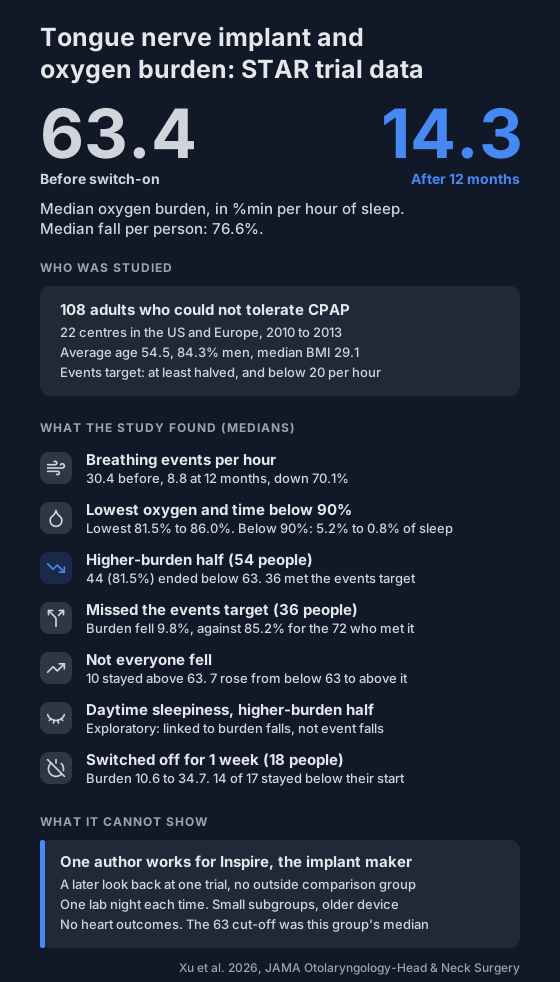
Tongue nerve implant studies usually judge success by one number: breathing events per hour. That count says nothing about how far oxygen falls during each event, or for how long.
A 2026 paper went back to the STAR trial, which tested a first-generation implant, and measured oxygen burden instead. We've covered a newer implant trial with a switched-off group and a records study comparing implants with CPAP. Neither covered oxygen burden.
What is oxygen burden?
- For each breathing event, it measures the area of the oxygen dip below the level just before it.
- Those areas are added up and divided by hours of sleep.
- The unit is %min per hour.
- It counts depth and length, so two nights with the same event count can score very differently.
For more on this, see two kinds of oxygen burden and sleep apnea beyond event counts.
Who was in the study?
- 108 adults from the STAR trial, run at 22 centres in the US and Europe from 2010 to 2013.
- All had obstructive sleep apnea, with 20 to 50 breathing events per hour, and couldn't tolerate CPAP.
- BMI over 32 ruled people out.
- Average age 54.5, 84.3% men, median BMI 29.1.
- Each had a lab sleep study before the implant was switched on and at 12 months. Only people with both studies were included.
The authors split the group at its median oxygen burden, 63%min per hour. Earlier studies have linked levels around there to heart problems.
What did it find?
Medians, before and after 12 months:
- Oxygen burden: 63.4 to 14.3 %min per hour. The median fall per person was 76.6%.
- Breathing events per hour: 30.4 to 8.8. The median fall per person was 70.1%.
- Lowest oxygen: 81.5% to 86.0%.
- Time below 90% (T90): 5.2% to 0.8% of sleep.
77 people (71.3%) had their burden more than halved and ended below 63.
What about people who missed the events target?
The trial's target was breathing events per hour at least halved, and below 20. 72 people met it and 36 didn't.
- Oxygen burden fell a median 85.2% in those who met it, and 9.8% in those who didn't.
- In the higher-burden half, 44 of 54 (81.5%) ended below 63. Only 36 of those 54 met the events target.
- 9 of the 18 in the higher-burden half who missed the target still ended below 63.
- 10 people stayed above 63, and 9 of them missed the target. Their event count barely changed.
- 7 people started below 63 and ended above it. None met the target, and their event count went up.
- One person met the target but stayed above 63.
The authors suggest the implant may turn some full pauses into partial ones. That could make each dip shallower and shorter without cutting the count. They didn't test this.
Did it go with less sleepiness?
Only in the higher-burden half, and only just.
- Each 1 standard deviation fall in oxygen burden went with a 1.25-point fall on a 24-point sleepiness score.
- The confidence interval ran from 0.02 to 2.48, so the low end was close to zero.
- Changes in breathing events per hour, arousals per hour, T90 and lowest oxygen weren't significantly linked to sleepiness.
- In the lower-burden half, no links were seen.
The authors call this exploratory and say it needs confirming in a larger group.
What happened when the implant was switched off?
At 12 months, 37 people who met the target were randomly split. 18 had the implant switched off for a week and 19 kept it on.
- Switched off: median burden went from 10.6 to 34.7.
- Kept on: 12.1 to 15.4.
- 14 of the 17 switched-off people who had the follow-up check were still below their starting burden.
- At 18 months, both groups had a median of 15.1.
What can't it tell you?
Limits the authors state:
- A look back. It's a later analysis of an old trial, run in a selected subset of patients.
- No outside comparison. Everyone got the implant. Only the one-week switch-off had a comparison group.
- One night. Each result is from a single lab night, and results vary from night to night.
- Small subgroups. Some groups had 7 to 18 people.
- An older device. The implant has been changed since, so results may not match current versions.
- Data quality. Signal quality varied between centres and some data were missing.
Things we noticed:
- Industry ties. One author is from Inspire Medical Systems, which makes the implant. Several others report grants, fees or support from Inspire. The paper text we read has no separate funding statement.
- No heart outcomes. The study shows burden went down. It doesn't show heart risk did.
- The cut-off. 63 was the median of this group, so "higher" and "lower" are relative to this group.
- Counts that don't add up. The paper says 91 people had a baseline sleep study and 11 a pre-activation one, which is 102, not 108. A check limited to baseline data uses 97 people.
- One table typo. The range given for lowest oxygen change in people who missed the target (2.0 to 3.8) doesn't contain its own median (0.5).
What can you do with this?
These are our suggestions, not the study's findings.
- Don't read this as a reason to choose or skip any therapy. That's a decision for you and your doctor.
- An overnight oximeter records your ODI, T90 and lowest SpO2, but not breathing events. Home oximetry is not a sleep study.
- You can share your recordings and ask what your sleep study showed beyond the event count.
Not a medical device. Does not diagnose, treat or prevent any condition. Discuss results and changes with a clinician.
References
- Xu J, Hajipour Z, Aloia MS, Op de Beeck S, Vanderveken OM, Huyett P, Soose RJ, Dedhia R, Strollo PJ Jr, Azarbarzin A. Hypoglossal Nerve Stimulation and Hypoxic Burden in Patients With Obstructive Sleep Apnea: A Secondary Analysis of the STAR Trial. JAMA Otolaryngology-Head & Neck Surgery. 2026;152(7):696-704. doi:10.1001/jamaoto.2026.1049