Sleep Apnea Over 85: What a 2026 Study Found
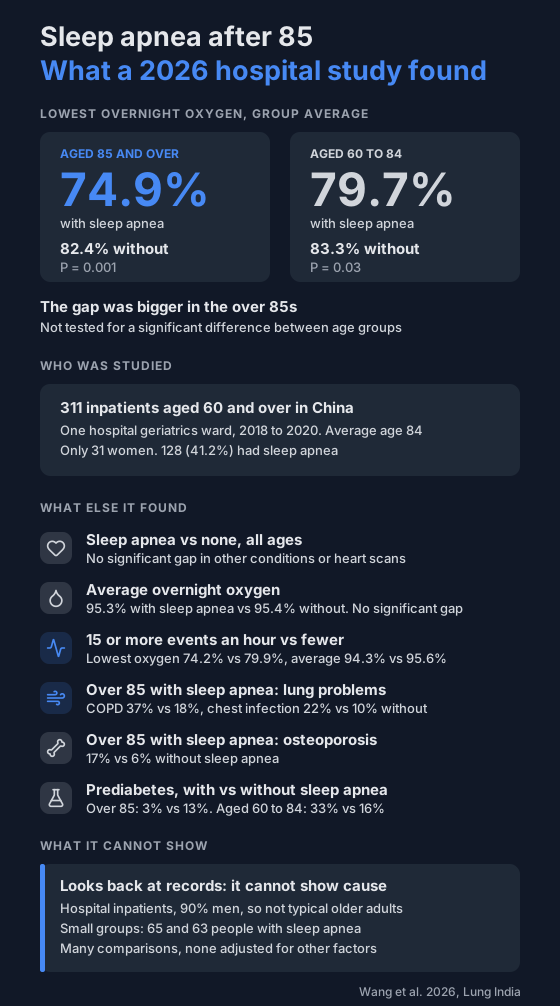
A 2026 study of 311 hospital inpatients aged 60 and over in China found that sleep apnea went with a lower overnight oxygen low in both age groups, with a bigger gap in those aged 85 and over: 74.9% against 82.4%.
Sleep apnea gets more common with age. Most of the research on it, though, is in people decades younger than 85.
A 2026 study from China looked at hospital patients aged 60 and over, and split them at 85. In both age groups, the people with sleep apnea had a lower overnight oxygen low than those without. The gap was bigger in the over 85s, though the study did not test whether that difference between the age groups was significant.
For how sleep apnea tends to show up in older adults, see sleep apnea in older adults.
Who was studied?
- 311 inpatients aged 60 and over on the geriatrics ward of one hospital in Shanghai.
- They had an overnight sleep study between 2018 and 2020, because of symptoms or hard-to-control blood pressure or weight.
- Average age was 84.
- Only 31 were women, 10% of the group.
- The researchers went back through their records afterwards.
- People with serious neurological conditions, or who couldn't complete the sleep study, were left out.
- It was funded by Shanghai public health and hospital research grants, and the authors report no conflicts of interest.
Sleep apnea meant 5 or more breathing events an hour of sleep. 128 people (41.2%) had it.
What did it find?
Across all ages, people with and without sleep apnea looked much the same:
- No statistically significant gap in other health conditions, including heart disease, high blood pressure, diabetes and COPD.
- No significant gap in heart structure or pumping on heart scans.
- Average overnight oxygen was 95.3% with sleep apnea and 95.4% without, with no significant gap.
The differences showed up when the researchers split people by how many events they had, and by age.
Did more events go with lower oxygen?
Yes. 47 people had 15 or more events an hour, and 81 had fewer.
- Lowest overnight oxygen averaged 74.2% in the 15 or more group, against 79.9% (P = 0.001).
- Average overnight oxygen was 94.3% against 95.6% (P = 0.04).
- Body mass index was a little higher: 24.7 against 23.5.
What was different after 85?
The study compared people with and without sleep apnea inside each age group. 174 people were 85 or over, 65 of them with sleep apnea. 137 were 60 to 84, 63 of them with sleep apnea.
The lowest overnight oxygen, as a group average:
- 85 and over: 74.9% with sleep apnea, 82.4% without (P = 0.001).
- 60 to 84: 79.7% with sleep apnea, 83.3% without (P = 0.03).
The gap was 7.5 points after 85 and 3.6 points before it. The study did not test whether those two gaps differ significantly.
In the 85 and over group, people with sleep apnea also had:
- More COPD: 37% against 18%.
- More chest infections: 22% against 10%.
- More osteoporosis: 17% against 6%.
- Slightly lower albumin, a blood protein: 36.1 against 37.2 g/L.
- Less impaired glucose tolerance, a form of prediabetes: 3% against 13%.
In the 60 to 84 group, none of those differed significantly, except impaired glucose tolerance, which went the other way: 33% with sleep apnea against 16% without.
The authors suggest the extra lung disease may explain some of the lower oxygen readings after 85.
To see how lung disease and sleep apnea overlap on overnight oxygen, see COPD, sleep apnea and overnight oxygen. For bone, see overnight oxygen and bone density.
What can't it show?
- It looked back at records, so it shows links, not causes.
- Everyone was a hospital inpatient, so these are not typical older adults living at home.
- 90% were men.
- The authors list the small number of women as a limitation.
- The groups were small: 65 and 63 people with sleep apnea.
- There was no information on when the sleep apnea started.
- The paper's abstract and Table 3 title describe the age result as over 85s with sleep apnea against 60 to 84s with sleep apnea, but the table itself compares people with and without sleep apnea inside each age group.
- The study ran many separate comparisons, none corrected for chance findings or adjusted for age, weight or other conditions.
- The authors' explanation, that people under 85 adapt to sleep apnea and those over 85 can't, is their idea and was not tested.
For a different look at older adults, a larger study of sleep apnea patients found women aged 70 and over spent more of the night below 90% oxygen than men: see women over 70 and overnight oxygen.
What can you do with it?
If you or a parent is over 85, the lowest reading of the night is one number worth logging. A home oximeter is not a sleep study, but it shows how far oxygen drops and how often. Read more on what SpO2 means, and bring your recordings when you talk to your doctor.
Not a medical device. Does not diagnose, treat or prevent any condition. Discuss results and changes with a clinician.
References
- Wang C, Xu Q, Zhao S, Yang K, Shao X, Fang G, Yang L. Clinical characteristics and comorbidities of sleep apnea in the older and oldest-old inpatients. Lung India. 2026;43(4):384-389. doi:10.4103/lungindia.lungindia_677_25