Blood Sugar and Overnight Oxygen
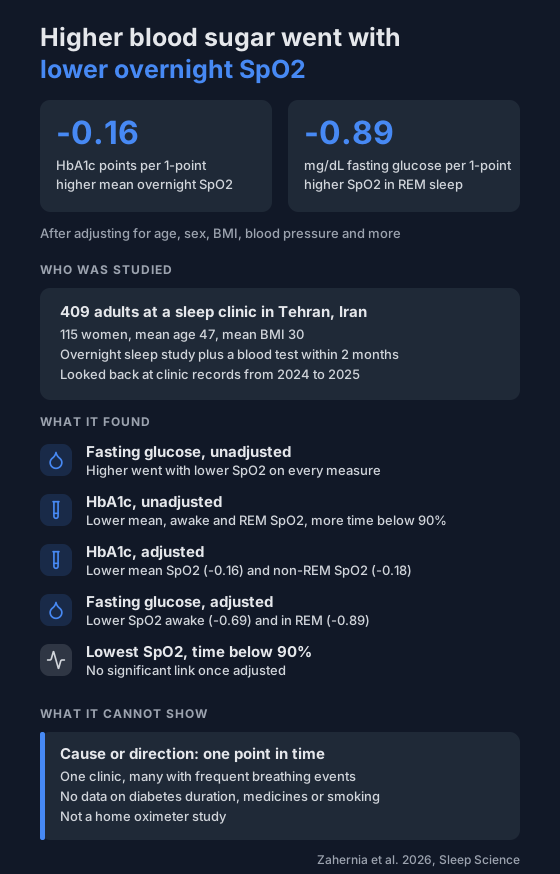
A 2026 study of 409 sleep-clinic patients in Iran found that higher HbA1c and fasting glucose went with lower SpO2 overnight. It was a look back at clinic records, so it can't show which came first.
Sleep apnea and diabetes often turn up in the same people. A study the authors cite followed 650 people for 8 to 10 years and linked more time below 90% SpO2 to a higher chance of developing diabetes.
A 2026 study from Tehran asked a narrower question. In people sent to a sleep clinic, do blood sugar results go with overnight oxygen? Higher HbA1c and higher fasting glucose did go with lower SpO2, but the study can't say why.
Who was studied?
- 409 adults at the Baharloo Hospital sleep clinic in Tehran, Iran. 115 were women.
- Mean age was 47 and mean BMI was 30.
- Each had an overnight sleep study between March 2024 and March 2025, and a blood test in the two months before it.
- 45 people (11%) already had diabetes on record, and 44 (11%) had high blood pressure.
- People with lung disease, inflammatory conditions, cancer or shift work were left out, as were sleep studies under 3 hours.
It was a look back at clinic records, not a study that recruited people to test a question.
What did they measure?
- Blood sugar: fasting glucose and HbA1c, which reflects the last two to three months.
- Overnight oxygen from the sleep study: mean SpO2, lowest SpO2, time below 90%, and mean SpO2 awake, in REM sleep and in non-REM sleep.
- Other things: age, sex, BMI, blood pressure, blood fats, sleepiness and insomnia scores, and breathing events per hour.
The group wasn't typical of the general public. Breathing events averaged about 40 an hour, and mean SpO2 was 90%. The authors say the group probably leaned toward people with frequent events.
What did they find?
Before adjusting for anything, higher fasting glucose went with lower SpO2 on every measure. It also went with more time below 90% (correlation 0.32) and more breathing events per hour. HbA1c showed a similar but patchier pattern, with no significant link to lowest SpO2 or non-REM SpO2.
After adjusting for age, sex, high blood pressure, blood fats, BMI, sleepiness, insomnia and breathing events per hour, the picture was narrower:
- HbA1c was lower by 0.16 points for each 1-point higher mean overnight SpO2, and by 0.18 for non-REM SpO2.
- Fasting glucose was lower by 0.69 mg/dL for each 1-point higher SpO2 while awake, and by 0.89 for REM sleep.
- Lowest SpO2 and time below 90% showed no significant link to either measure.
- HbA1c and fasting glucose didn't line up on the same oxygen measures. The paper points to past research on REM sleep and glucose but didn't test why.
The paper's models set blood sugar as the outcome and oxygen as the predictor. That is a statistical setup, not a finding about which drives which.
What can't it show?
- Which came first. The authors say a study like this can only find links. Blood sugar may affect oxygen, oxygen may affect blood sugar, or something else may affect both.
- Cause. The authors list ways low oxygen could affect glucose, such as stress hormones and insulin resistance, but they didn't test any of them.
- Missing background. There was no data on how long people had had diabetes, medicines, smoking, activity or belly fat. Leftover effects of these are possible.
- Mixed timing. Blood tests were taken up to two months before the sleep study. Fasting glucose moves day to day, so the match is looser.
- A selected group. These were clinic patients with many breathing events, so the results may not apply to people without them or to the general public.
- Small subgroups. Too few people had diabetes to compare them on their own.
- Many comparisons. Our own note: the paper tested six oxygen measures against two blood sugar measures and doesn't mention correcting for multiple tests.
- Unclear numbers. The methods say everyone had an HbA1c result, but some of the HbA1c p-values only fit a group far smaller than 409. The paper doesn't explain the gap.
The authors call for larger studies that follow people over time and record diabetes history, medicines and how people use therapy.
What can you do with this?
A home oximeter shows mean SpO2 and time below 90% over a night, the same kinds of numbers used here. This study used a full sleep study in a clinic, so home numbers aren't a direct match.
You could log your overnight oxygen alongside the blood sugar results you already get. The study can't tell you that moving one would move the other. For background on the measures, see what T90 is and time below 90% in kidney disease and diabetes. For another look at blood sugar markers, see the TyG index and lowest overnight SpO2.
If your blood sugar results or your sleep worry you, discuss them with your doctor.
Not a medical device. Does not diagnose, treat or prevent any condition. Discuss results and changes with a clinician.
References
- Zahernia M, Alemohammad ZB, Najafi A. Glycemic Indices and Polysomnographic Parameters in an Iranian Population Referred to a Sleep Clinic. Sleep Sci. 2026;19(2):1-8. doi:10.1055/s-0046-1829079 (PubMed)