Fascial Therapy for Sleep Apnea: 2026 Trial
A 2026 randomised trial gave 50 men with sleep apnea a 16-minute hands-on fascial session and 45 a quiet rest. Heart rate, blood pressure and SpO2 changed over time, but not differently between the groups.
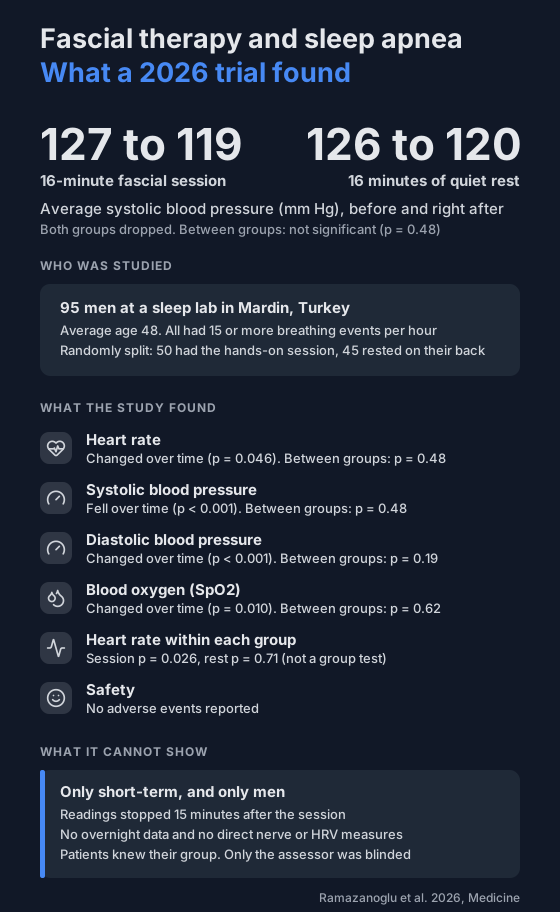
Sleep apnea is linked to an overactive "fight or flight" nervous system and higher blood pressure. The idea behind this trial was that hands-on work on the neck, chest and belly, along the path of the vagus nerve, might calm that down.
A 2026 trial from Turkey compared it with lying quietly for the same time. Heart rate, blood pressure and SpO2 changed over time, but the change was not significantly different between the two groups.
Who was in the trial?
- 95 men sent to a sleep lab in Mardin, Turkey, with 15 or more breathing events per hour on a lab sleep study.
- Average age 48, ages 28 to 65.
- Average BMI about 30 to 31, and average breathing events per hour about 33 in both groups.
- Nobody had started CPAP, a mouthpiece or surgery, or anyone who had used them had stopped at least 3 months earlier.
- None was taking blood pressure medicines or other drugs expected to affect heart rate or blood pressure.
- People with uncontrolled high blood pressure, heart disease, lung disease, stroke, epilepsy or a BMI over 40 were left out.
No women took part. Five women were assessed, and none qualified.
What was done?
It was a randomised controlled trial, registered in advance, with men split into two groups using sealed envelopes:
- Fascial mobilization (50 men): physiotherapists spent 16 minutes working on 8 spots across the neck, chest and belly, 2 minutes each, with light to firm pressure.
- Quiet rest (45 men): lying on their back for the same 16 minutes, with no touch.
Heart rate, blood pressure and SpO2 were checked sitting up before, right after, and 5 and 15 minutes after. The person taking the readings didn't know which group each man was in.
What did it find?
Blood pressure fell in both groups, and so did heart rate:
- Systolic blood pressure: 127.0 to 119.3 mm Hg with the session, 125.8 to 119.8 with rest. The change over time was significant (p < 0.001). The difference between groups was not (p = 0.48).
- Diastolic blood pressure: the change over time was significant (p < 0.001). The difference between groups was not (p = 0.19).
- Heart rate: 81.7 to 74.1 beats a minute with the session, 77.1 to 73.8 with rest. The group starting points differed (p = 0.047), so the authors used the starting value as an adjustment and compared only the three readings after. Across those three, the change over time was just significant (p = 0.046). The difference between groups was not significant (p = 0.48).
- SpO2: 95.0% to 94.2% with the session, 95.4% to 94.8% with rest. The change over time was significant (p = 0.010). The difference between groups was not (p = 0.62).
The abstract and conclusion report no adverse events. The methods section says no serious adverse events.
Why isn't "it changed" the same as "it worked"?
The change over time only tells you that the numbers moved across the readings. It doesn't tell you why. Both groups lay down for 16 minutes and had repeated readings.
Only the comparison between groups shows what the session added. Here there was no statistically significant difference.
One result could mislead if read alone. Heart rate changed over time in the session group (p = 0.026) but not in the rest group (p = 0.71). That looks like a win, but none of the pairwise checks between readings in the session group was significant, the group started about 5 beats a minute higher, and the direct comparison between groups wasn't significant. The authors call these within-group results descriptive. A change that is significant in one group and not in the other doesn't show the groups differ.
The authors conclude the results don't show a specific effect of the session. They put the shared changes down to rest, relaxation, getting used to the setting or other time-related factors.
What doesn't it tell you?
- It was short. Readings stopped 15 minutes after one session. Nothing was measured overnight, and no sleep outcomes were tracked.
- It can't speak to the nervous system. Heart rate, blood pressure and SpO2 are not direct measures of nerve activity, and no HRV was recorded. The authors suggest future studies add HRV.
- Men only. No women were enrolled.
- Patients knew their group. Only the person taking readings was blinded, so expectations can't be ruled out.
- The size estimate was borrowed. It came from a massage study in healthy people, so the authors are unsure the trial was big enough to pick up a difference between groups. The final sample was larger than the 50 required, which also makes small time effects more likely to reach significance.
- No correction for multiple tests. The authors call the borderline time effects, such as heart rate at p = 0.046, exploratory.
- No funding. The authors declare no funding and no conflicts of interest.
- A null result is not proof of no effect. It means this study found no significant difference in these measures, over this short window.
What can you take from it?
A reading that moves after an intervention isn't evidence the intervention did it. When you log your own SpO2, pulse or blood pressure, compare against a night or an evening where you changed nothing.
Single readings also shift with rest, posture and the oximeter itself, so look at several.
Not a medical device. Does not diagnose, treat or prevent any condition. Discuss results and changes with a clinician.
References
- Ramazanoglu E, Mete Cavus F, Endamli DB, Kabak M, Cil B. The effects of multiregional fascial mobilization on heart rate and physiological parameters in patients with obstructive sleep apnea: A randomized controlled trial. Medicine (Baltimore). 2026;105(42):e51172. doi:10.1097/MD.0000000000051172