Oxygen Burden and Inflammation in HIV
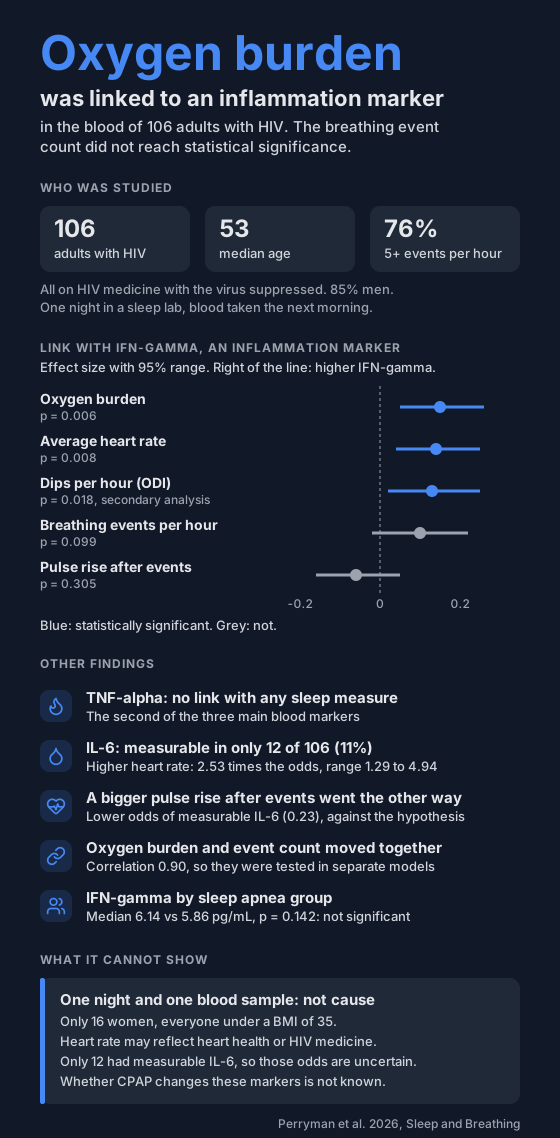
A 2026 study of 106 adults with HIV found that oxygen burden and average overnight heart rate were linked to the inflammation marker IFN-gamma, while the breathing event count did not reach statistical significance.
People living with HIV who take effective HIV medicine still tend to have more inflammation and more heart disease than people without HIV. Studies have also found sleep apnea is common in this group.
A 2026 study from San Diego asked whether the two are connected. It found that how much oxygen people lost during the night was linked to one blood marker of inflammation. The usual count of breathing events per hour did not reach statistical significance.
Who was in the study?
- 106 adults living with HIV, aged 18 to 65, in San Diego.
- All were on HIV medicine, with the virus kept at very low levels in the blood.
- Median age was 53, and 85% were men.
- Nobody had a BMI of 35 or more, and nobody was already using sleep apnea therapy such as CPAP regularly.
- Each spent one night in a sleep lab, and blood was taken the next morning.
- Oxygen burden, pulse rise and average heart rate were available for 105 of them.
At 5 or more breathing events per hour, 76% (81 people) met the study's cut-off for sleep apnea. That is the cut-off in the paper's results; its abstract says more than 5. Those with sleep apnea were older, at a median 55 years against 39.
What did it measure?
Four things from the sleep study:
- Breathing events per hour. The standard count.
- Oxygen burden (the paper calls it hypoxic burden). How deep and how long oxygen dipped below its level before each breathing event, added up per hour of sleep.
- Pulse rise after events. How much the heart rate jumped after each breathing event.
- Average heart rate across the whole night.
And three blood markers of inflammation: IFN-gamma, TNF-alpha and IL-6. The team also looked at 27 other markers; those results are in the paper's supplement.
For more on oxygen burden, see two kinds of oxygen burden and what event counts miss.
What did it find?
After adjusting for age and sex:
- Oxygen burden was linked to higher IFN-gamma (p = 0.006).
- Average heart rate was also linked to higher IFN-gamma (p = 0.008), in the same model as oxygen burden.
- Breathing events per hour leaned the same way but didn't reach statistical significance (p = 0.099).
- Pulse rise after events wasn't significantly linked to IFN-gamma (p = 0.305).
- In a secondary analysis, dips per hour (ODI) was linked to higher IFN-gamma too (p = 0.018).
The event count and oxygen burden moved closely together, with a correlation of 0.90. So the authors tested them in separate models rather than side by side.
Split simply into "with" and "without" sleep apnea, IFN-gamma showed no statistically significant difference: a median 6.14 against 5.86 pg/mL.
What about the other two markers?
- TNF-alpha wasn't significantly linked to any sleep measure.
- IL-6 was too low to measure in 94 of the 106 people, so only 12 had a measurable level.
- Breathing events per hour and oxygen burden weren't significantly linked to measurable IL-6.
- Higher average heart rate went with higher odds of measurable IL-6: 2.53 times per standard-deviation step, with a wide 95% range of 1.29 to 4.94.
- A bigger pulse rise after events went with lower odds of measurable IL-6 (0.23 per step, range 0.07 to 0.79). That's the opposite of what the authors expected.
- With only 12 people in the measurable group, these IL-6 results are uncertain.
What doesn't it tell you?
- Cause. It's a cross-sectional analysis: one night and one blood sample per person. So it shows what went together, not what caused what. The authors say this themselves.
- Heart rate's role. The authors say average heart rate may reflect general heart health or the HIV medicine, not sleep apnea.
- Who it applies to. Only 16 women took part, and people with a BMI of 35 or more were left out.
- Where the inflammation comes from. There were no blood cell counts to show which cells made the markers.
- Whether therapy changes it. The authors say it's not known whether CPAP or other sleep apnea therapy lowers IFN-gamma. They plan to study that next.
The study was funded by the US National Institutes of Health, Veterans Affairs and a California state research programme. Some authors reported fees or past research funding from sleep and drug companies, outside this study.
What can you do with this?
Breathing events and hypoxic burden are scored from a full sleep study, and home oximetry is not a sleep study. But it records two of the things this study looked at: your oxygen dips and your pulse through the night.
- ODI counts the dips.
- T90 is the share of the night below 90%.
- The pulse trace shows your overnight heart rate.
If you snore, wake up unrefreshed or someone has seen you stop breathing, try the sleep apnea risk check. Then share your oximeter data with your doctor.
Not a medical device. Does not diagnose, treat or prevent any condition. Discuss results and changes with a clinician.
References
- Perryman AN, Masso-Silva JA, Orr JE, Sun X, Jain S, DeYoung PN, Norby B, Ancoli-Israel S, Malhotra A, Grant I, Karris MY, Crotty Alexander LE, Owens RL. Obstructive sleep apnea-related hypoxemia and heart rate dynamics are associated with systemic inflammation in people living with HIV. Sleep and Breathing. 2026;30(5):242. doi:10.1007/s11325-026-03786-w