Sleep Apnea Traits From the Pulse Wave
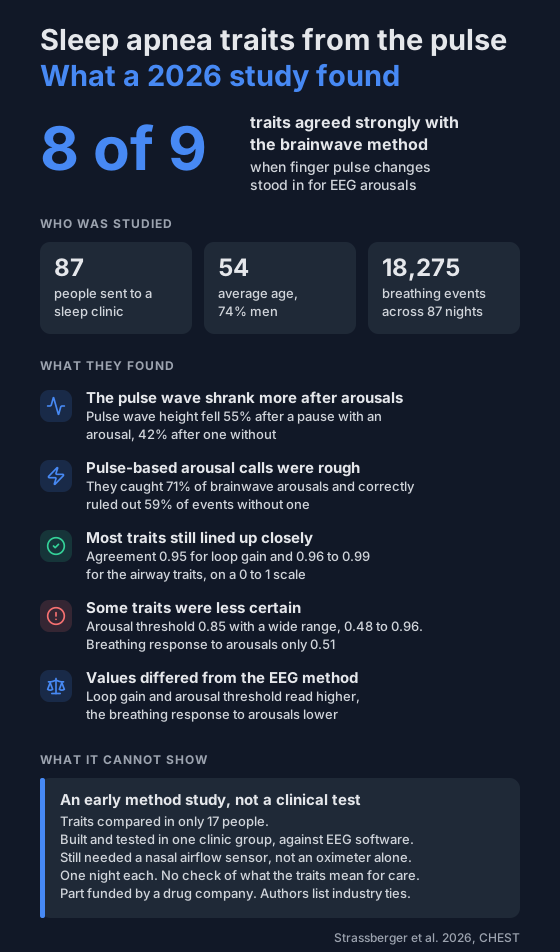
A 2026 study of 87 sleep clinic patients swapped brainwave arousals for finger pulse wave changes when working out sleep apnea traits. 8 of 9 traits had agreement of 0.80 or higher.
Researchers describe sleep apnea by traits, like how easily the airway narrows and how easily you wake. The usual software for reading those traits from a sleep study needs arousals scored by hand from brainwaves (EEG). Most home sleep tests don't record EEG.
A 2026 study from Gothenburg, Sweden, tried using changes in the finger pulse wave instead. The pulse wave is the signal an oximeter already records with its light sensor.
What are these traits?
- Loop gain. How strongly your breathing control overreacts to a change in breathing. High loop gain tends to give cycles of over- and under-breathing.
- Arousal threshold. How much breathing effort it takes before you briefly wake.
- Airway traits. How much airflow you keep when your throat muscles are relaxed, and how much the muscles make up for that.
A related 2026 preprint read two traits from the oxygen trace alone; see sleep apnea traits from oximeter data. This study takes a different route: it keeps the standard trait method and only replaces the EEG arousals.
Who was studied?
- A cross-sectional study: 97 people sent to a sleep clinic for possible sleep apnea; 10 were left out for poor signals, leaving 87.
- Average age 54, 74% men, average BMI 27.7.
- Average of 33 breathing events per hour.
- Each had one night of a full sleep study at home, EEG included, scored by one trained technician.
- 18,275 breathing events across all 87 nights.
How did it work?
- From the finger pulse wave they took three signals: pulse rate, pulse wave height, and how long the pulse took to travel to the finger.
- 79% of breathing events ended with an EEG arousal.
- A model built on 70 people learned to guess whether an event ended with an arousal. It used the three pulse signals, the size of the oxygen drop and the event type.
- Those guessed arousals replaced the EEG arousals in the standard trait software.
- The traits from both versions were compared in the other 17 people.
What did they find?
- The pulse wave reacted more after arousals. Pulse wave height fell 55% after a pause in breathing with an arousal, against 42% without one. For shallower events it was 50% against 41%.
- Pulse rate rose more too. 14.5% after a pause with an arousal, 7.4% without.
- Single arousal calls were rough. In the 17 test people, the model caught 71% of EEG arousals and correctly ruled out 59% of events without one.
- The traits still lined up. On a 0 to 1 agreement scale, 8 of 9 traits scored 0.80 or higher. Loop gain was 0.95 and the airway traits were 0.96 to 0.99.
- Some traits were less certain. The arousal threshold scored 0.85 but with a wide range, 0.48 to 0.96. Muscle compensation scored 0.80, range 0.60 to 0.91. The breathing response to arousals scored only 0.51.
One reason the authors give for the traits holding up despite rough single calls: the software looks at 7-minute stretches, so one wrong call matters less.
Did the numbers match exactly?
No. 7 of 9 traits came out with consistent differences; only the time delay and passive airflow did not.
- Loop gain read higher with the pulse method, 0.53 against 0.49.
- The arousal threshold read higher, 156 against 137.
- The breathing response to arousals read much lower, 18.5 against 39.5.
The high agreement scores suggest people kept roughly the same order from low to high. The authors say clinical studies need to check whether the differences matter.
What can't it show?
- A large test. The traits were compared in just 17 people, which is why some ranges are wide.
- Other groups. The model was built and tested in one clinic group. The authors call for larger validation studies.
- A direct yardstick. The comparison was against the EEG version of the same software, not a direct measure of breathing drive.
- Oximeter alone. The method still needed a nasal airflow sensor. The authors' point is that airflow and an oximeter are on many home sleep tests.
- Other health factors. It didn't account for other conditions or medication, which may change the pulse response.
- What the traits mean for care. It didn't test whether traits read this way predict how anyone does on any therapy.
Who funded it?
Desitin, a German drug company, along with Swedish public grants, the EU and the US National Institutes of Health. The paper says the funder had no role in the study. Three of the five authors list industry ties:
- Hedner lectures for SomnoMed, Desitin and Bayer, advises SomnoMed, and co-owns a licensed sleep apnea patent.
- Sands consults for Nox Medical, Inspire, Merck, Apnimed, Eli Lilly and Respicardia, has grants from Apnimed, Prosomnus and Dynaflex, and is a named co-inventor on intellectual property on combination drug therapy (with royalties) and on reading sleep apnea traits from wearables. The trait software is free for academic use.
- Grote lectures for Resmed, Philips, AstraZeneca and Lundbeck, has grants from Bayer, advises Onera, and co-owns a licensed sleep apnea patent.
What can you do with this?
Your oximeter app won't work out these traits. It does show your pulse rate, and in this study pulse rate rose after breathing events, more so when they ended in an arousal. You can look for that pattern in your own nights with the session viewer.
For more on what sits behind each dip, read brief awakenings and oxygen dips and overnight heart rate and CVHR. If your recordings show lots of dips, share them with your doctor.
Not a medical device. Does not diagnose, treat or prevent any condition. Discuss results and changes with a clinician.
References
- Strassberger C, Hedner J, Sands SA, Zou D, Grote L. From Pulse to Phenotype: Sleep Apnea Endotyping for Polygraphy via Oximeter-Derived Autonomic Arousal. Chest. 2026;169(5):1345-1356. doi:10.1016/j.chest.2025.12.005