Slow Wake-Up After Apnea and Mortality
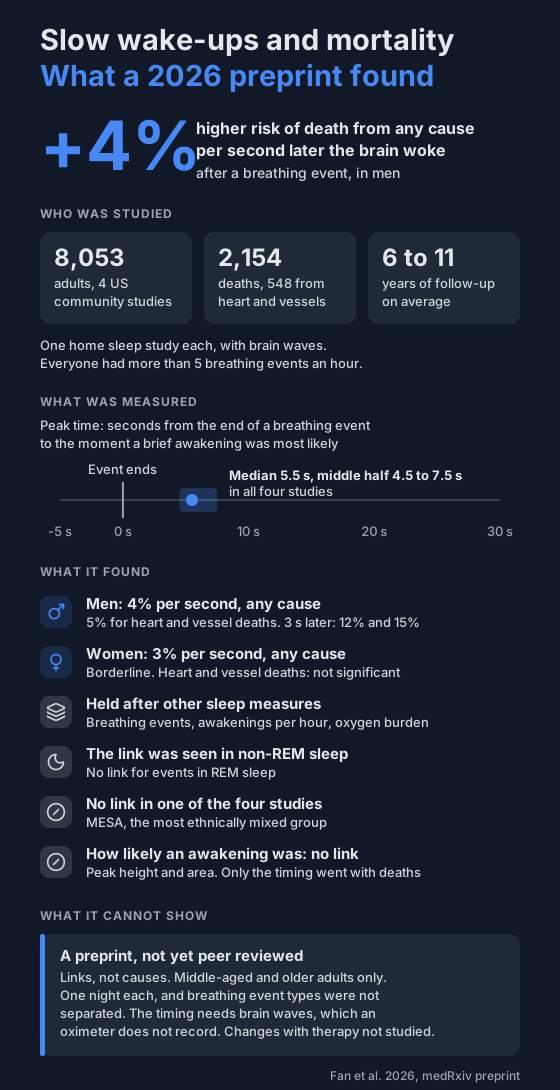
A 2026 preprint, not yet peer reviewed, of 8,053 adults found that a later brain wake-up after each breathing event went with a higher risk of death, 4% per second in men.
When your breathing stops or gets shallow in your sleep, your brain often wakes for a few seconds as the event ends. Sleep studies count these brief awakenings, called arousals, but don't usually look at their timing.
A 2026 preprint from US universities did. It measured how many seconds after each breathing event the brain was most likely to wake. People whose brains woke later had a higher risk of dying over an average of 6 to 11 years.
A preprint hasn't been peer reviewed yet, so read it as early work.
Who was in the study?
- 8,053 adults from four long-running US studies: the Sleep Heart Health Study, MESA, MrOS (men only) and SOF (women only).
- Average age ranged from 64 in the largest group to 83 in SOF.
- Each had one sleep study at home with brain-wave recording, run between 1995 and 2013.
- Everyone had more than 5 breathing events an hour; the median ranged from 16 to 21 across the studies.
- 2,154 of them died during follow-up, 548 from heart and blood vessel disease.
What did they measure?
For each person, the authors lined up every breathing event at the moment it ended. They then charted how likely a brief awakening was in each second, from 5 seconds before to 30 seconds after.
- Peak time: the second when an awakening was most likely.
- Peak height: how likely it was at that peak.
- Area: how likely it was over the whole window.
The median peak time was 5.5 seconds in all four studies, and the middle half of people fell between 4.5 and 7.5 seconds.
What did they find?
Only peak time went with deaths. Peak height and area didn't.
Pooled across the studies, after adjusting for age, race, BMI, smoking, blood pressure, benzodiazepine use, diabetes, depression, coronary heart disease and COPD:
- Men: each second later went with a 4% higher risk of death from any cause, and 5% from heart and blood vessel disease.
- Women: each second later went with a 3% higher risk of death from any cause. That one was borderline: the 95% range ran from 0% to 6% (p=0.04), and the women's studies disagreed more with each other than the men's did. The link with heart and blood vessel deaths wasn't statistically significant.
- The authors scaled this up: a 3-second delay, the width of the middle half, went with a 12% higher risk of death from any cause and 15% from heart and blood vessel disease in men, and 9% from any cause in women.
In the Sleep Heart Health Study women and in MrOS, the slowest quarter had about 30% higher risk of death from any cause than the fastest quarter, and about 70% higher for heart and blood vessel deaths. The quarter comparisons weren't statistically significant in MESA or SOF.
In each study's results, the links barely moved when the authors also accounted for breathing events per hour, awakenings per hour or oxygen burden. Peak time was only weakly related to any of them.
Were there any surprises?
- One group showed nothing. MESA, the most ethnically mixed of the four, had no statistically significant link.
- The link was seen in non-REM sleep. Non-REM peak time went with deaths in Sleep Heart Health Study women and MrOS men, though not in that study's men or in SOF. Peak time in REM sleep, the dreaming stage, had no link with deaths in any group. The authors think non-REM peak time reflects how hard a person is to wake.
- Who woke later. In the Sleep Heart Health Study, older age and higher BMI went with later peaks, and so did a history of heart disease in men. More breathing events per hour went with slightly earlier peaks.
What doesn't it tell you?
- Peer review. It's a preprint.
- Cause. It's observational, so it shows what went together, not what caused what. A late peak could reflect a harder-to-wake brain, a slow-to-open airway or something else.
- Everyone. The groups were middle-aged and older, and two studies were one sex only.
- Event type. Blocked-airway and central breathing pauses weren't analysed apart.
- Repeatability. Each person had one night, scored by hand.
- Therapy. It doesn't say whether peak time changes on CPAP or other care.
- Ties. Some authors report consulting fees, patents or shares with sleep-tech and drug companies.
What can you do with this?
Peak time needs a brain-wave recording. An oximeter doesn't record brain waves, so it can't measure this.
For more on what awakenings do to oxygen dips, see brief awakenings and oxygen dips. For other measures beyond the event count, see sleep apnea beyond event counts.
If you snore, feel tired in the day, or someone has seen you stop breathing, the sleep apnea risk check helps you decide whether to talk to a doctor. You can also share your oximeter data with your doctor.
Not a medical device. Does not diagnose, treat or prevent any condition. Discuss results and changes with a clinician.
References
- Fan J, Westover MB, Leng Y, Zhang GQ, Stone KL, Redline S, Thomas RJ, Cui L, Sun H. Delayed Arousal Response to Sleep Apnea Encodes Mortality. medRxiv [Preprint]. 2026 May 21:2026.05.18.26353387. doi:10.64898/2026.05.18.26353387 (PubMed)