Blood Vessel Stiffening at Sleep Arousals
A 2026 study of 18,275 breathing events found the oximeter pulse wave pointed to stiffer blood vessels when an event ended in a brief arousal: after full breathing pauses, pulse timing shortened by 21.1% with an arousal against 17.9% without.
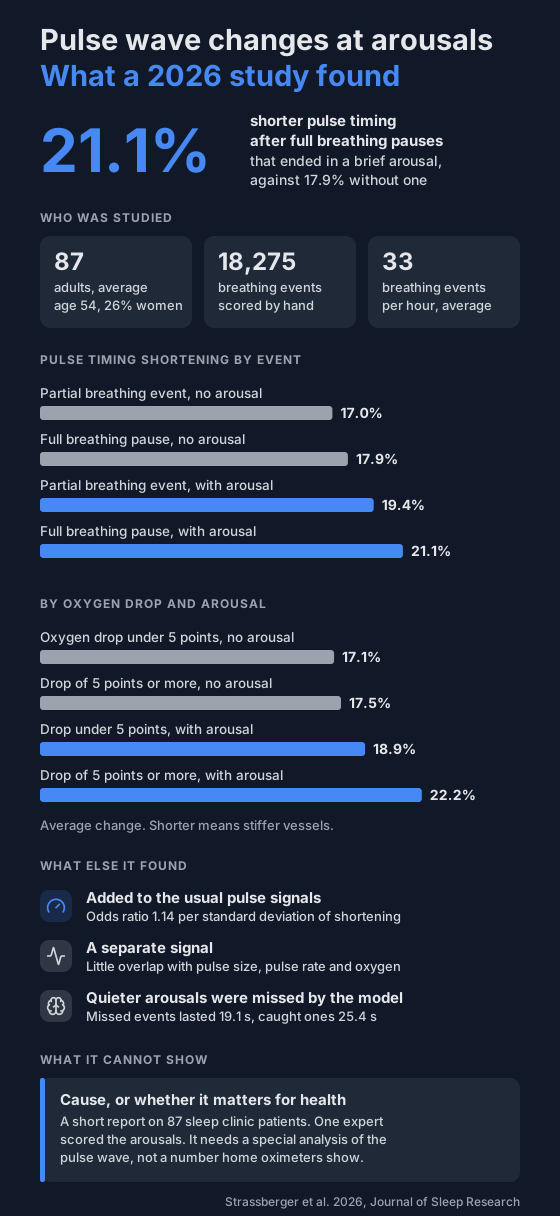
A breathing pause at night often ends with a brief arousal: your brain wakes for a few seconds without you knowing. It's already known that your pulse speeds up and the pulse wave at your finger shrinks when that happens, because blood vessels narrow.
A study published in April 2026 looked at a third thing in the same oximeter signal: how stiff the blood vessels got. When a breathing event ended in an arousal, the pulse wave pointed to stiffer vessels than when it didn't.
What did they measure?
Each heartbeat sends a pressure wave down your arteries. Part of it bounces back from the rest of the body, so the pulse wave at your finger is a main wave plus a reflected one.
- The researchers split every single pulse wave into those two parts.
- The gap between their peaks is called pulse propagation time (PPT).
- Stiffer arteries carry the wave faster, so the gap gets shorter.
They measured how much PPT shortened, in percent, just after each breathing event ended.
Who was in the study?
- 87 patients from a Swedish sleep clinic.
- Average age 54, and 26% were women.
- On average they had 33 breathing events an hour.
- Each had a full portable sleep study, with brain waves recorded.
- 18,275 breathing events were scored by hand, and one expert scored the arousals.
What did it find?
PPT shortened after every kind of breathing event, by 17-22% on average. It shortened more when the event ended in an arousal:
- Partial breathing events: 17.0% without an arousal, 19.4% with one.
- Full breathing pauses: 17.9% without, 21.1% with.
The size of the oxygen drop added to it:
- Oxygen drop under 5 points, no arousal: 17.1%.
- Drop of 5 points or more, with an arousal: 22.2%.
Does it add anything to pulse rate?
The authors built a model to pick out which events ended in an arousal. It already used the change in pulse rate, pulse size and oxygen, plus the type of event, age, sex and BMI.
- Adding PPT made the model fit better.
- Each standard deviation of extra shortening went with 1.14 times the odds of an arousal.
- PPT barely overlapped with the other signals, so it carried separate information.
The authors call the effect modest. The model missed arousals that came with a smaller body response. Those events were shorter, 19.1 seconds against 25.4 seconds for the ones it caught, and had smaller oxygen drops.
What doesn't it tell you?
- Cause or health effects. It's an observational analysis of sleep study recordings. It shows what went together during the night, not that these moments harm the heart.
- Everyone. 87 sleep clinic patients, mostly men.
- Scoring. One expert scored all the arousals, so differences between scorers weren't tested.
- Other arousals. Only arousals after breathing events were studied.
- Detail. It's a short report, so many methods aren't described. The event counts in its tables add up to fewer than the 18,275 in the text.
- Funding. The work was funded by a drug company (Desitin), a Swedish heart and lung charity and the Swedish state. Two authors co-own a patent for a sleep apnea therapy.
What can you do with this?
PPT is a research measure that needs the raw pulse wave and special software. Home oximeter reports don't show it.
What your oximeter does record is pulse rate. Pulse rises that line up with oxygen dips are one of the signs covered in overnight heart rate and CVHR. For how arousals line up with dips, see brief awakenings and oxygen dips.
If your nights show frequent dips or you feel worn out in the day, share your data with your doctor.
Not a medical device. Does not diagnose, treat or prevent any condition. Discuss results and changes with a clinician.
References
- Strassberger C, Zou D, Hedner J, Grote L. Vascular Dynamics During Respiratory Arousal From Sleep Assessed by Oximeter-Based Vascular Stiffness Measures. Journal of Sleep Research. 2026;35(5):e70343. doi:10.1111/jsr.70343