Circulation Time, Oximetry and Heart Failure
A 2026 study of 89 adults with sleep apnea timed how long oxygen took to bottom out after breathing restarted. The delay ran longer with weaker heart pumping, but the whole-night difference was not statistically significant and the sample was small.
When you stop breathing in your sleep, your oxygen drops. What's less well known is that the low point on a finger oximeter arrives some seconds after breathing restarts. That delay is the time blood takes to get from your lungs to your finger, called circulation time.
Earlier studies linked a longer delay to a heart that pumps out less blood. A 2026 study from Los Angeles measured it in sleep studies and compared it with heart scans.
Who was in the study?
- 89 adults with sleep apnea, with more than 5 breathing events per hour on an in-lab sleep study.
- All had a heart ultrasound within a year of the sleep study.
- The scan gave their ejection fraction: the share of blood the heart's main chamber pumps out with each beat.
- 14 had an ejection fraction of 45% or less, a sign of weaker pumping.
- 75 had 50% or more.
- 13 people with a borderline ejection fraction and 38 with a different heart problem, stiffness of the main chamber, were left out.
- Median ages were 67.5 with weaker pumping and 64 with typical pumping, and 64 of the 89 were men.
How was circulation time measured?
- From the moment breathing picked up again after an event, seen on the sleep study's breathing sensors, to the lowest SpO2 reading on the finger oximeter.
- Events were timed in the first, middle and last third of the night in three sleep stages, light (N2), deep (N3) and REM, and averaged.
- One researcher did all the timing by hand.
The authors say a delay under 20 seconds is typical. For how a dip is counted in the first place, see what counts as an oxygen dip.
What did it find?
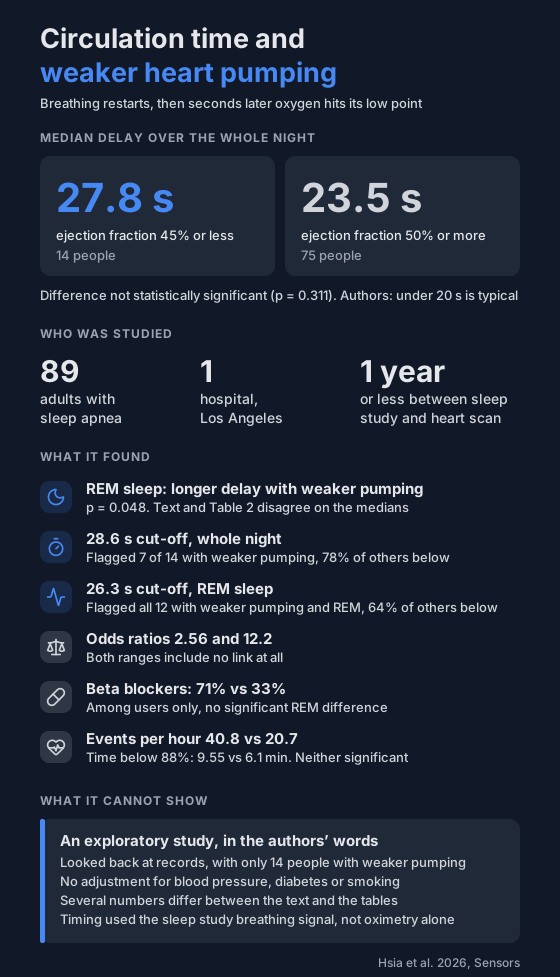
- Whole night. The median delay was 27.8 seconds with weaker pumping and 23.5 seconds with typical pumping. The difference was not statistically significant.
- REM sleep. The delay was longer with weaker pumping, and this difference was statistically significant (p = 0.048). The text gives two different medians for that group, 29 and 35 seconds, against 25.5 seconds. Table 2 prints 35 and 25.5 under the opposite groups.
- Ejection fraction itself. There was only a weak, non-significant link between a longer delay and a lower ejection fraction.
Could a cut-off pick out weaker pumping?
The authors looked for the delay that best separated the two groups.
- 28.6 seconds, whole night. It flagged 7 of the 14 people with weaker pumping. 78% of the others were below it.
- 26.3 seconds, REM sleep. It flagged all 12 people with weaker pumping who had REM sleep. 64% of the others were below it.
- People over the cut-offs had higher odds of weaker pumping, 2.56 times for the whole night and 12.2 times for REM.
But both odds ratios had ranges wide enough to include no link at all (0.55 to 11.16, and 0.54 to 272.5). The authors put this down to the small sample.
What else differed?
- Beta blockers. 71% of the weaker pumping group took these heart drugs, against 33% of the others. Beta blockers have been linked to a longer circulation time. Among the beta blocker users alone, the REM difference was no longer significant.
- Breathing events. A median of 40.8 per hour with weaker pumping, against 20.7. Not significant.
- Time below 88% oxygen. A median of 9.55 minutes against 6.1. Not significant.
- Type of sleep apnea. Central and complex sleep apnea were more common in the weaker pumping group (p = 0.009).
For a larger study of time below 90% in heart failure, see time below 90% and heart failure.
What can't it show?
- Cause. It looked back at hospital records, so it shows what went together, not what caused what.
- A reliable cut-off. The authors call it exploratory and underpowered, and say larger studies are needed.
- Other conditions. It didn't adjust for high blood pressure, diabetes, kidney disease, heart artery disease or smoking.
- Oximeter accuracy factors. Smokers weren't excluded, and skin tone wasn't recorded.
- Clean numbers. Some figures differ between the text and the tables, including the REM medians and the ranges.
- Home use. The timing needed the sleep study's breathing sensors. A finger oximeter on its own shows the dip, not when breathing restarted. The authors plan to try the method on home sleep tests.
What can you do with this?
The authors suggest sleep study reports could include circulation time. They also say a long delay on a sleep study is a reason to have the heart checked.
If you have heart failure or sleep apnea and wonder about this, ask your doctor. One night may not show the full picture, as six nights of oxygen in heart failure found. You can share your overnight recordings with your doctor.
Not a medical device. Does not diagnose, treat or prevent any condition. Discuss results and changes with a clinician.
References
- Hsia WJ, Rodman J, Cantrill B, Castriotta RJ. Sleep Circulation Time from Pulse Oximetry and Polysomnography: Predictive Value in Patients with Heart Failure with Reduced Ejection Fraction. Sensors. 2026;26(15):4849. doi:10.3390/s26154849