ODI and Coronary Artery Disease: 2026 Study
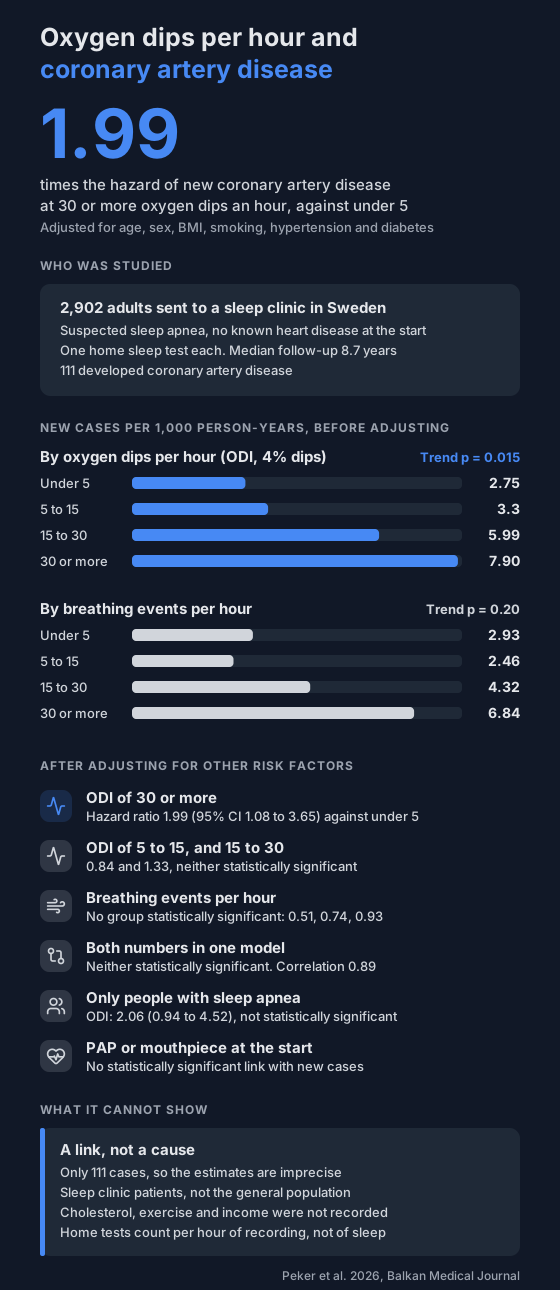
A Swedish study followed 2,902 sleep clinic patients for a median of 8.7 years. An ODI of 30 or more was linked to new coronary artery disease. The breathing event count was not, and neither stood out when both were modelled together.
Sleep apnea is usually graded by how many breathing events you have per hour. Some researchers think the oxygen dips matter more for the heart than the event count does.
A Swedish study published in 2026 compared the two in the same patients. It followed them for years to see who developed coronary artery disease.
New to ODI? Start with what the oxygen desaturation index is.
Who was studied?
- 2,902 adults sent to a sleep clinic in Skaraborg, Sweden, with suspected sleep apnea.
- None had known heart disease at the start.
- Average age was 52, and 65% were men.
- Each had one home sleep test between 2005 and 2011.
- They were followed until April 2018, a median of 8.7 years.
- 111 developed coronary artery disease: a heart attack, a procedure to reopen a coronary artery, or a recorded coronary artery disease code.
What was compared?
Two numbers from the same home test:
- ODI: oxygen dips of 4% or more per hour.
- Breathing events per hour: pauses and partial reductions in airflow, whether or not oxygen dipped.
Both were split into the same four groups: under 5, 5 to 15, 15 to 30, and 30 or more per hour.
The two numbers were not the same size. The median ODI was 10.0 and the median breathing event count was 20.0. 864 people had an ODI under 5, but only 307 had a breathing event count under 5.
For how a dip gets counted, see what counts as an oxygen dip.
What did it find?
New cases of coronary artery disease per 1,000 person-years, before any adjustment:
| Per hour | By ODI | By breathing events |
|---|---|---|
| Under 5 | 2.75 | 2.93 |
| 5 to 15 | 3.3 | 2.46 |
| 15 to 30 | 5.99 | 4.32 |
| 30 or more | 7.90 | 6.84 |
The same table in the paper gives a trend test for each column. The trend across the ODI groups was statistically significant (p = 0.015). The trend across the breathing event groups was not (p = 0.20).
The authors then adjusted for age, sex, BMI, smoking, high blood pressure and diabetes, using the 2,849 people with complete data (110 cases):
- ODI of 30 or more: hazard ratio 1.99 against ODI under 5 (95% confidence interval 1.08 to 3.65). That means about twice the rate of new cases over the follow-up.
- ODI of 5 to 15 and 15 to 30: hazard ratios of 0.84 and 1.33, neither statistically significant.
- Breathing events per hour: no group was statistically significant. The hazard ratios were 0.51, 0.74 and 0.93.
Leaving out the 9 cases that happened in the first year gave a hazard ratio of 2.24 for the top ODI group (1.17 to 4.28).
So is ODI the better number?
Not clearly.
- Together, neither stood out. With both numbers in one model, neither had a statistically significant link with new cases (p = 0.58 and p = 0.61).
- They overlap heavily. The correlation between the two was 0.89.
- As a sliding scale, both fell just short. Per 10 more per hour, the hazard ratio was 1.11 for ODI (p = 0.055) and 1.10 for breathing events (p = 0.057).
- 30 is not a cliff edge. The authors say the result at 30 or more likely reflects a weak, steady rise, not a threshold.
Their conclusion is that oxygen dip numbers may add information, and that no single number captures the coronary risk.
What about people who had sleep apnea?
- Restricted to the participants with sleep apnea, the ODI hazard ratio was 2.06 (0.94 to 4.52), which was not statistically significant. The authors call this exploratory.
- 69.1% were started on positive airway pressure (the family CPAP belongs to) or a mouthpiece when they joined.
- Starting one had no statistically significant link with new coronary artery disease.
- The study only knew who started, not who kept using it, so the authors say it can't tell you whether either therapy works for the heart.
For trial evidence on that question, see CPAP and heart health.
What can't it show?
The authors list these limits:
- Cause. It's an observational study, so it shows a link, not a cause.
- Missing factors. Cholesterol, physical activity, income and detailed medication use were not recorded.
- Few cases. 111 cases is a small number, so the estimates are imprecise.
- Clinic patients. Everyone had been referred for suspected sleep apnea, so it may not apply to the general population.
- Home tests. They count per hour of recording, not per hour of sleep, which can undercount breathing events. That may affect the comparison with ODI.
- One combined outcome. Heart attacks, procedures and recorded codes were not available separately.
- Deaths. 216 participants died during follow-up, and the analysis did not formally account for that.
Three things we noticed:
- The paper doesn't say how sleep apnea was defined for the subgroup, or which ODI groups the 2.06 compares.
- The trend p-values are printed beside the unadjusted rates, and the paper says they come from a regression model without saying whether that model was adjusted.
- One sentence in the abstract says ODI stayed linked when both numbers were modelled together. The results table, the discussion and the abstract's own conclusion all say it did not.
The study was funded by Swedish regional research grants, the Research Fund at Skaraborg Hospital and the Skaraborg Research and Development Council. The authors declare no conflict of interest.
What can you do with this?
These are our suggestions, not the study's findings.
- If you track ODI at home, check which dip size it uses. This study counted 4% dips, and 3% and 4% counts aren't interchangeable.
- Look at the trend over many nights, not one reading.
- This study compared groups of clinic patients on a home sleep test. It doesn't tell you what your own ODI means for your heart.
- If your ODI is often high, share the recordings with your doctor. A home oximeter is not a sleep study and can't tell you your heart risk.
Related: oxygen dips and blood pressure.
Not a medical device. Does not diagnose, treat or prevent any condition. Discuss results and changes with a clinician.
References
- Peker Y, Hjälm HH, Glantz H, Pıhtılı A, Thunström E. Nocturnal Hypoxemia and Incident Coronary Artery Disease in Obstructive Sleep Apnea: Results from the Sleep Apnea Patients in Skaraborg Study. Balkan Medical Journal. 2026;43(9):503-512. doi:10.4274/balkanmedj.galenos.2026.2026-3-213