Time Below 90% and Kidney Risk in Diabetes
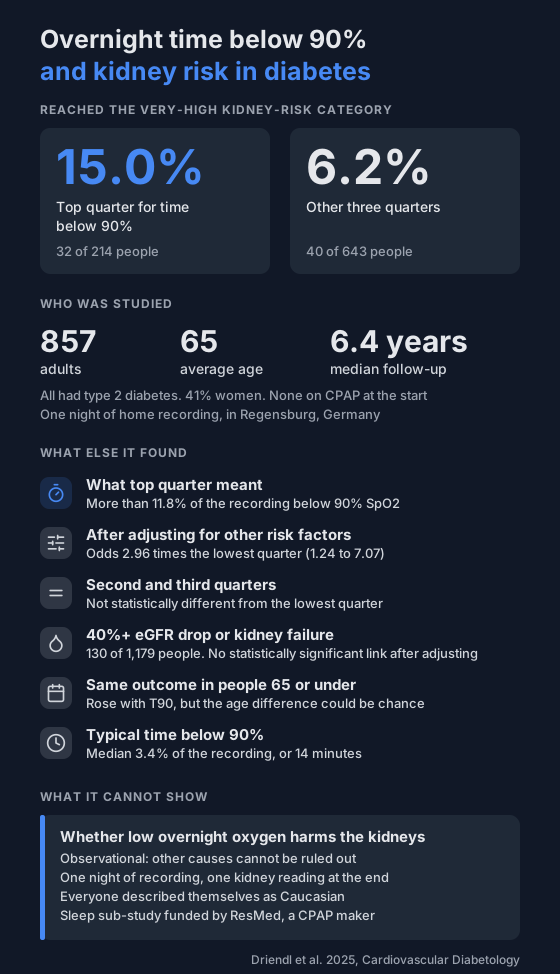
A study followed 857 adults with type 2 diabetes for about 6 years. Of those in the top quarter for overnight time below 90% SpO2, 15.0% reached the highest kidney-risk category, against 6.2% of the rest.
Type 2 diabetes is a major risk factor for chronic kidney disease. A German study published in 2025 asked whether overnight oxygen has anything to do with who gets worse.
It looked at T90, the share of the night spent below 90% SpO2. New to the term? Read what T90 is.
Who was in the study?
- 857 adults with type 2 diabetes from the DIACORE cohort in Regensburg, Germany.
- Their average age was 65, and 41% were women.
- They'd had diabetes for a median of 9 years.
- Most had preserved kidney function at the start.
- Nobody was using CPAP at the start.
Each person wore a two-channel home monitor for one night, between 2011 and 2015. It recorded nasal airflow and pulse oximetry.
The researchers then checked blood and urine every two years, for a median of 6.4 years.
What did they measure?
The kidney guideline group KDIGO sorts people into four risk categories, using a blood test (eGFR) and a urine test (albumin). The study counted how many people moved into the highest one, "very high risk". Nobody in the analysis was in it at the start.
T90 was split into quarters:
- Lowest quarter: under 0.5% of the recording below 90%.
- Top quarter: more than 11.8%.
- The median for the whole group was 3.4%, or 14 minutes.
What did they find?
72 of the 857 people (8.4%) reached the very-high-risk category.
- Top quarter for T90: 32 of 214 people, or 15.0%.
- The other three quarters together: 40 of 643 people, or 6.2%.
- Lowest quarter on its own: 4.7%.
The researchers then adjusted for age, sex, waist-hip ratio, blood pressure, blood pressure and cholesterol medication, blood sugar control, years with diabetes, starting kidney function and hemoglobin.
- The top quarter still had 2.96 times the odds of the lowest quarter.
- The 95% confidence interval was wide: 1.24 to 7.07.
- The second and third quarters weren't statistically different from the lowest.
The top quarter also started out with lower kidney function and a higher BMI than the other three quarters. That's why the adjusted figure is the one to look at.
What about kidney failure?
That was the second outcome, and the result was weaker.
The paper's "kidney failure" is a combined outcome: a drop in eGFR of at least 40%, end-stage kidney disease, or death from a kidney cause. It used a larger group of 1,179 people for this, and 130 of them (11%) met the definition. Of those 130, 13 had end-stage kidney disease and 2 died of a kidney cause.
- It was more common in the higher T90 quarters.
- After adjusting for other risk factors, the link was no longer statistically significant (top quarter against lowest: odds 1.28 times, 95% confidence interval 0.71 to 2.28).
- In people aged 65 or under, the odds of this outcome rose across the T90 quarters. In people over 65 they didn't.
- The test for whether the two age groups really differed wasn't statistically significant, so that split could be chance.
What doesn't it tell you?
- Cause. It's an observational study. People with more time below 90% may differ in ways the researchers couldn't measure.
- Change over time. T90 came from one night. In a subset of 285 people recorded twice, the group average barely moved (10.0% and 10.4%), but one person's two recordings agreed only partly (intraclass correlation 0.64).
- Lasting kidney change. Each person's final category came from a single blood and urine sample. Guidelines ask for a reduced reading to last at least 3 months.
- Sleep time. T90 was a share of the whole recording, not of time asleep. The authors say this may understate the link.
- Everyone. All participants described themselves as Caucasian.
- Whether changing T90 helps. The authors say more research is needed to find out.
The sleep sub-study was funded by ResMed, which makes CPAP machines.
For a similar study on a different organ, see time below 90% and heart failure.
What can you do with this?
If you have type 2 diabetes, your kidney checks are the blood and urine tests your doctor already orders. An oximeter doesn't replace them.
An overnight oximeter does record T90. One night can be off, so record several.
If your T90 is often well above zero, share the recordings with your doctor.
Not a medical device. Does not diagnose, treat or prevent any condition. Discuss results and changes with a clinician.
References
- Driendl S, Stadler S, Baumert M, Stark KJ, Heid IM, Pec J, Zeman F, Preiss A, Böger CA, Bergler T, Arzt M. Nocturnal hypoxemic burden is associated with worsening prognosis of chronic kidney disease in patients with type 2 diabetes. Cardiovascular Diabetology. 2025;24(1):354. doi:10.1186/s12933-025-02918-y