COPD, Sleep Apnea and Overnight Oxygen
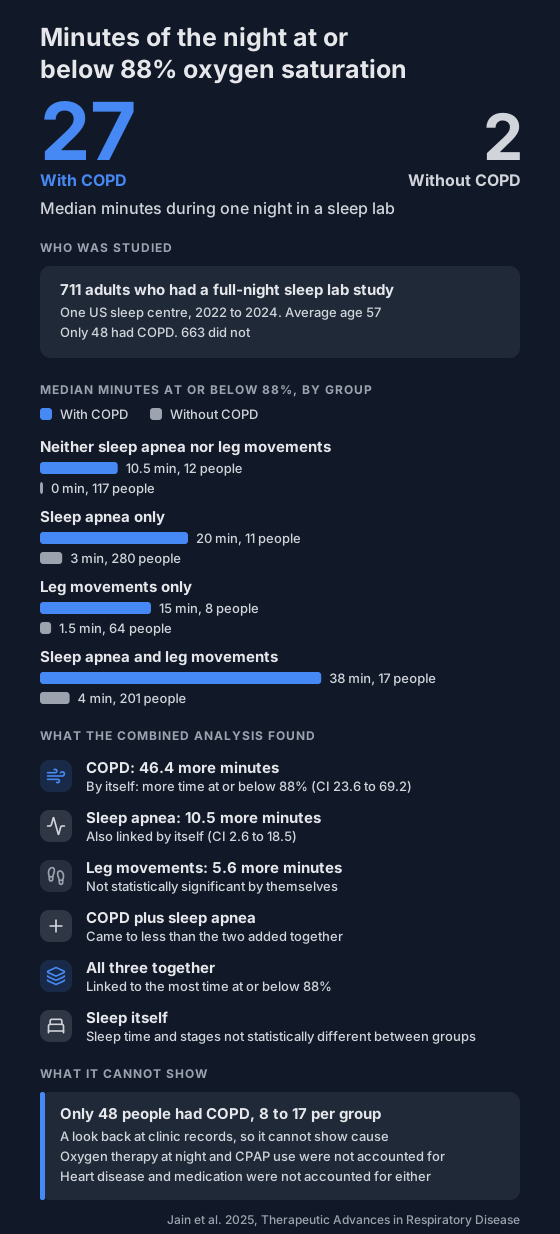
A 2025 sleep lab study of 711 adults found people with COPD spent a median 27 minutes of the night at or below 88% oxygen saturation, against 2 minutes without COPD. Only 48 of them had COPD.
COPD and sleep apnea can both lower your oxygen at night. Some people have both, and some also have periodic leg movements, where the legs twitch or jerk over and over during sleep.
A 2025 study looked at how the three add up. It counted the minutes each person spent at or below 88% oxygen saturation during one night in a sleep lab.
Who was studied?
- 711 adults who had a full-night sleep study at one referral sleep centre in Fresno, California, between June 2022 and July 2024.
- Average age 57. 55.6% were women.
- 48 had COPD on their medical record. 663 didn't.
- The COPD group was older: 68.6 on average, against 56.4.
Everyone was sorted into four groups:
- Neither sleep apnea nor leg movements.
- Sleep apnea only, meaning 5 or more breathing events per hour.
- Leg movements only, meaning 15 or more leg movements per hour.
- Both.
How much time did people spend at or below 88%?
The figures are medians, in minutes of the night.
- With COPD: 27 minutes (middle half of people: 7.5 to 68).
- Without COPD: 2 minutes (middle half: 0 to 8).
Average SpO2 over the night was 91.1% with COPD and 93.3% without.
Sleep itself looked much the same. After adjusting for age, total sleep time, sleep stages and number of awakenings weren't statistically different between the two groups.
This measure works like T90, with the line drawn at 88% instead of 90%.
How did sleep apnea and leg movements add to it?
| Group | With COPD | Without COPD |
|---|---|---|
| Neither | 10.5 min (12 people) | 0 min (117 people) |
| Sleep apnea only | 20 min (11 people) | 3 min (280 people) |
| Leg movements only | 15 min (8 people) | 1.5 min (64 people) |
| Both | 38 min (17 people) | 4 min (201 people) |
- With COPD, only the "both" group was statistically different from the "neither" group.
- Without COPD, the "sleep apnea only" and "both" groups were statistically different from "neither". "Leg movements only" wasn't.
What did the combined analysis find?
The authors ran one model across all 711 people, adjusted for age and sex. The model also had terms for the conditions in combination, so the first three figures are for each condition by itself.
- COPD was linked to 46.4 more minutes at or below 88% (95% confidence interval 23.6 to 69.2).
- Sleep apnea was linked to 10.5 more minutes (2.6 to 18.5).
- Leg movements were linked to 5.6 more minutes, which wasn't statistically significant (-5.9 to 17.0).
- COPD plus sleep apnea came to less than the two added together.
- All three together were linked to the most time at or below 88%.
The authors' reading: in people with COPD, the lungs account for most of the low-oxygen time. Sleep apnea shows up most clearly in people without COPD.
They also suggest that people with COPD, sleep apnea and leg movements together may need closer attention to their oxygen levels while on CPAP, and may need extra oxygen. That's the authors' suggestion, not something the study tested, and it's a decision for a clinician.
What can't it show?
- Only 48 people had COPD. The four COPD groups had 8 to 17 people each, so those medians are rough.
- The tests don't fully agree. A separate test inside the COPD group found no statistically significant effect of sleep apnea, leg movements or the two combined.
- The counts don't fully agree either. The four groups without COPD add up to 662, not 663. The paper's main table counts 472 people with sleep apnea without COPD and 34 with COPD, while the groups give 481 and 28.
- It can't show cause. It's a look back at clinic records from one night each. The authors say low oxygen in COPD might itself trigger leg movements.
- Things that weren't accounted for: heart disease, heart failure, medication, oxygen therapy at night and CPAP use.
- Everyone was referred for a sleep study, so they aren't typical of the general population.
The authors declared no funding and no conflicts of interest.
What can you do with it?
- If you have COPD and log your nights, the minutes at lower saturation are worth watching alongside the dip count.
- A fingertip oximeter doesn't record leg movements or breathing events. Those need a sleep study.
- If your recordings show long stretches at low saturation, share them with your doctor.
Not a medical device. Does not diagnose, treat or prevent any condition. Discuss results and changes with a clinician.
References
- Jain V, Modi H, Park M, Ghimire A, DelRosso LM. Nocturnal hypoxemia in COPD: the amplifying effect of comorbid OSA and PLMS on oxygen desaturation. Therapeutic Advances in Respiratory Disease. 2025;19:17534666251380431. doi:10.1177/17534666251380431