Overnight Oxygen and Bone Density
A 2026 study of 4,690 adults aged 40 to 70 found that a higher ODI and more breathing events per hour went with lower bone density at most body sites, higher mean overnight SpO2 went with higher density, and sleep efficiency showed no significant link.
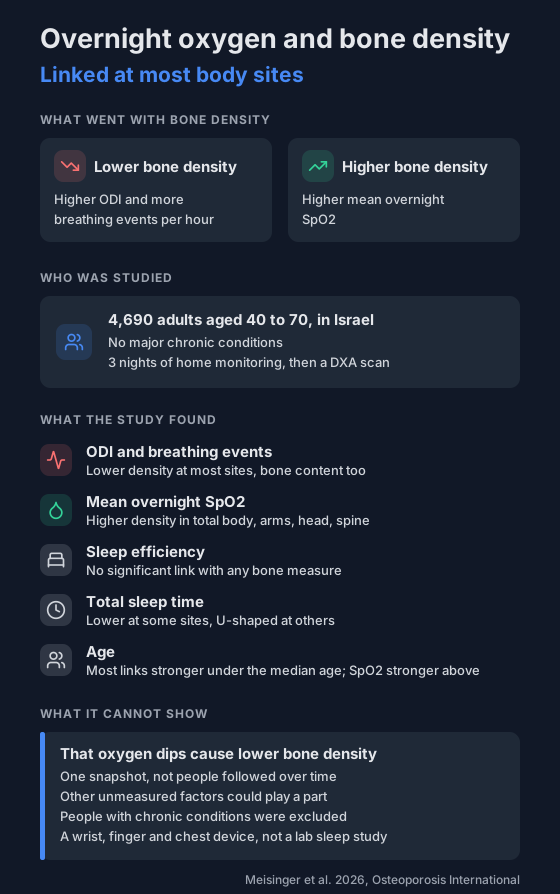
A 2026 study asked whether overnight oxygen and breathing measures line up with bone density.
In 4,690 adults, a higher ODI and more breathing events per hour went with lower bone density at most body sites. Higher average overnight SpO2 went with higher density. It's a snapshot, so it can't say which comes first.
Who was studied?
- 4,690 adults aged 40 to 70 from the Human Phenotype Project, a cohort that started in Israel in 2018.
- People with heart, lung, kidney, gut, metabolic, brain or mental health conditions, or a history of cancer, were excluded.
- The limitations section says 78% were born in Israel, while the baseline table puts it at about 64%.
- Women made up 43% of the group sleeping under 6 hours and 53% of those sleeping 6 hours or more. The paper doesn't give an overall figure.
What was measured?
- Sleep: three nights at home with a WatchPAT 300, a wrist device with a finger sensor that includes a pulse oximeter, plus a chest sensor for movement and snoring. The paper reports it was checked against lab sleep studies in earlier work. It gave total sleep time, mean overnight SpO2, sleep efficiency, ODI and two breathing-event rates per hour. Each measure was the average of the three nights.
- Bone: a DXA scan of the whole body, giving bone mineral density (BMD) and bone mineral content (BMC) for the head, arms, legs, trunk, ribs, pelvis, hip and spine.
- Adjusted for: age, sex, BMI, physical activity, smoking, alcohol, vegetarian diet and household income.
- The median ODI was about 2 events per hour, the median breathing event rate was about 8 per hour, and the median average SpO2 was 95.3%.
Related: what ODI means and how ODI tracks breathing events per hour.
What did it find?
- ODI and breathing events: higher values went with lower BMD or BMC at most sites. The one exception was rib bone content, which went the other way. For the spine, the links for ODI and one of the breathing-event rates were stronger at higher values.
- Mean overnight SpO2: higher values went with higher BMD and BMC in the total body, arms, head and spine. Below 90% the paper says the picture wasn't clear, because the confidence bands were wide.
- Sleep efficiency: no significant link with any bone measure.
- Total sleep time: longer sleep went with lower bone content in the legs and at the femoral neck and shaft, with matching density results. Bone content of the arms and one spine segment (L2) showed what the paper calls a U-shaped link. The authors read their sleep time results as both short and long sleep going with lower bone measures.
- Age: the links were mostly stronger in people under the median age. SpO2 was the exception, with stronger links in the older half.
The main text of the paper doesn't give the size of the differences in density. They're in the supplement, which isn't part of this summary.
What can't it show?
- It's observational and cross-sectional, so it can't show that oxygen dips lower bone density, or the other way round.
- The authors say unmeasured factors could still explain some of the links, despite the adjustments.
- Excluding people with chronic conditions may have introduced selection bias, and the results may not apply to them.
- The device doesn't say whether the three nights were typical.
- The authors note that home tests like this one may miss lower-grade breathing events compared with a lab sleep study, which could blur the links.
- Most participants were born in Israel, so the results may not carry over to other groups.
- 192 models were run, and the authors used a stricter significance cutoff to allow for that.
- The authors report no conflicts of interest. Open access publishing was funded by Projekt DEAL.
What do the authors conclude?
- They call for more clinical awareness of the link, including bone density testing in people with sleep apnea.
- They suggest doctors ask about sleep duration and consider bone density testing for people who sleep very short or very long hours.
- They also suggest asking people with low bone density about snoring, witnessed breathing pauses and unrefreshing sleep.
- They suggest insomnia therapy or exercise may help maintain bone density, which this study did not test.
- They say more research is needed on whether care for sleep apnea protects bone.
What can you do with it?
- Look at your average SpO2 and ODI across many nights, not one.
- In this study, ODI and average SpO2 lined up with bone measures, and sleep efficiency didn't.
- If you already have a bone density result, or a family history, mention your overnight oxygen trends when you talk to your doctor.
For more on how oxygen measures relate to other health markers, see ODI and coronary artery disease and sleep hours and osteoporosis after menopause.
Not a medical device. Does not diagnose, treat or prevent any condition. Discuss results and changes with a clinician.
References
- Meisinger C, Freuer D. Objectively measured sleep parameters and bone health: results from the Human Phenotype Project (HPP) cohort. Osteoporosis International. 2026;37(8):2017-2026. doi:10.1007/s00198-026-08041-2