Sleep Hours and Osteoporosis After Menopause
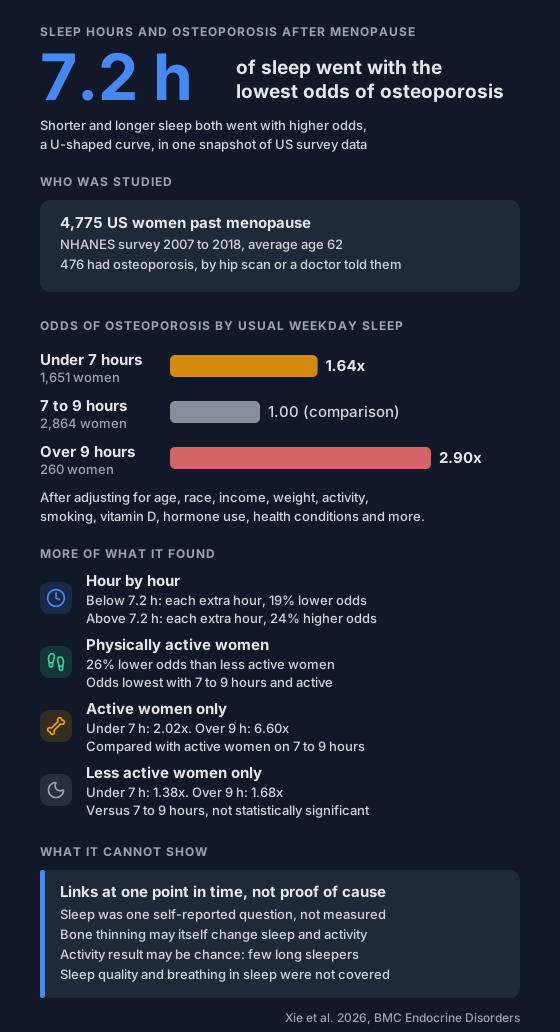
A 2026 study of 4,775 US women past menopause found both short and long sleep went with higher odds of osteoporosis, with the lowest odds at about 7 hours a night.
Bone thins faster after menopause as estrogen drops. Earlier studies linked both short and long sleep to lower bone density.
A 2026 study looked at whether the two line up in US women past menopause. Both short and long sleep went with higher odds of osteoporosis, and the lowest odds sat at about 7 hours a night.
Who was in the study?
- 4,775 women past menopause from NHANES, a US national health survey, between 2007 and 2018.
- Their average age was 62.
- They answered one question: how much sleep do you usually get on weekday or work nights?
- The researchers grouped them as under 7 hours, 7 to 9 hours, and over 9 hours.
- Osteoporosis meant a hip bone scan in the osteoporosis range, or a doctor having told them they had it.
- 476 of the women had osteoporosis by that definition.
What did it find?
Compared with women sleeping 7 to 9 hours, after adjusting for age, weight, income, activity, smoking, vitamin D, hormone use, long-term conditions and other factors:
- Under 7 hours: 1.64 times the odds of osteoporosis.
- Over 9 hours: 2.90 times the odds.
The curve was U-shaped, with the lowest odds at about 7.2 hours.
- Below 7.2 hours, each extra hour of sleep went with 19% lower odds.
- Above 7.2 hours, each extra hour went with 24% higher odds.
Treating sleep as a straight line, with no turning point, showed no statistically significant link. The pattern only appeared once short and long sleep were looked at separately.
Where does physical activity come in?
- Women who reported at least 500 MET-minutes of activity a week, a cut-off taken from US activity guidelines, had 26% lower odds of osteoporosis than less active women.
- The lowest odds were in women who were active and slept 7 to 9 hours.
- Less active women sleeping 7 to 9 hours had 1.87 times the odds of that group.
The sleep link looked different by activity level:
- Active women: under 7 hours went with 2.02 times the odds, over 9 hours with 6.60 times.
- Less active women: 1.38 and 1.68 times, neither statistically significant.
So the link with long sleep was strongest in active women. The authors suggest things the survey didn't measure well may explain it: frailty, pain, low mood, other health problems, poor sleep quality or breathing problems in sleep. They also say it may be a chance finding, since few women slept over 9 hours and the tests weren't corrected for running many comparisons.
What can't it show?
- Cause. It's a single snapshot, so it can't say whether sleep affects bone, bone affects sleep, or something else drives both.
- Reverse direction. Pain or a known osteoporosis finding could change how women sleep and move.
- Measured sleep. Sleep hours came from one self-reported question about weekdays.
- Sleep quality. Insomnia, broken sleep and breathing during sleep weren't measured. The authors suggest long sleep may partly reflect sleep apnea or other health problems.
- Activity type. Activity was total self-reported effort, with no split between weight-bearing exercise, housework or work.
- Who it covers. Only US women past menopause.
What can you do with this?
US sleep guidance, which the study cites, says adults should regularly get at least 7 hours. Most of the women in the study slept 7 to 9 hours. If you're regularly well outside that, or sleeping long and still tired, it's worth raising with your doctor. That's also the place to talk about bone health after menopause.
Sleep habits after menopause also line up with later weight gain. A separate study looked at daytime sleepiness and sleep apnea after menopause. An overnight oximeter can't tell you anything about your bones. It logs your oxygen and pulse through the night, and how long each recording ran.
Not a medical device. Does not diagnose, treat or prevent any condition. Discuss results and changes with a clinician.
References
- Xie R, Liu Y, Wu Z, Huang K, Sun Q. Sleep duration and prevalent osteoporosis among U.S. postmenopausal women: a cross-sectional analysis of NHANES 2007-2018 with assessment of potential effect modification by physical activity. BMC Endocrine Disorders. 2026;26(1):318. doi:10.1186/s12902-026-02481-x