Sleep Habits and Weight After Menopause
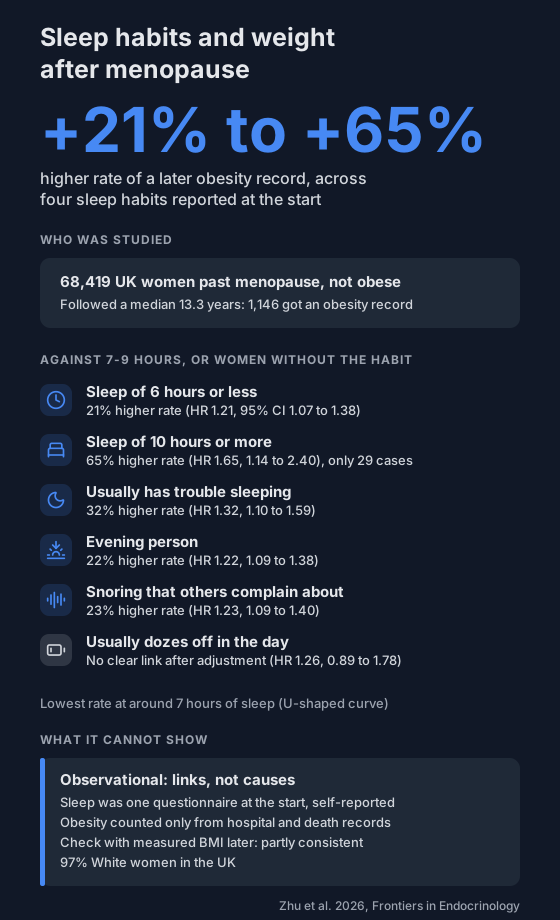
A UK study followed 68,419 women past menopause for about 13 years. Short or long sleep, frequent insomnia, being an evening person and snoring were each linked with more later obesity records.
Weight tends to creep up after menopause, and so do sleep problems. Plenty of studies link poor sleep with weight gain, but few have looked at women past menopause on their own.
A 2026 study did, using UK Biobank data on 68,419 women. Several everyday sleep habits went with a higher rate of obesity being recorded in the years that followed.
Who was in the study?
- 68,419 women in the UK who had been through menopause, aged about 60 on average.
- None had obesity at the start: their BMI was between 18.5 and just under 30.
- 97% were White.
- They answered a short sleep questionnaire once, at the start, between 2006 and 2010.
- They were followed for a median of 13.3 years.
The questions covered five things:
- How many hours they slept in 24 hours.
- Trouble falling asleep or waking in the night: never or rarely, sometimes, or usually.
- Whether they saw themselves as a morning or evening person.
- Whether a partner, relative or friend complained about their snoring.
- How often they dozed off in the day without meaning to.
"Obesity" here meant an obesity code in a hospital record or on a death record.
What did it find?
1,146 women got an obesity record during follow-up, about 1 in 60.
After adjusting for age, ethnicity, education, deprivation, smoking, alcohol, exercise, diet, diabetes, blood pressure, periods and pregnancy history, the pill and HRT, the rate was higher for:
- 6 hours of sleep or less: 21% higher than 7 to 9 hours (HR 1.21, 95% CI 1.07 to 1.38).
- 10 hours or more: 65% higher (HR 1.65, 1.14 to 2.40). Only 947 women slept this long, and 29 of them got an obesity record, so this figure is the least precise.
- Usually having trouble sleeping: 32% higher than never or rarely (HR 1.32, 1.10 to 1.59).
- Being an evening person: 22% higher than a morning person (HR 1.22, 1.09 to 1.38).
- Snoring that others complain about: 23% higher (HR 1.23, 1.09 to 1.40).
Two things showed no clear link once everything was adjusted for:
- Having trouble sleeping only sometimes (HR 1.07, 0.90 to 1.28).
- Dozing off in the day, even usually (HR 1.26, 0.89 to 1.78).
Plotted against hours of sleep, the rate followed a U shape, lowest at around 7 hours.
These are relative figures. Out of every 100 women in the study, fewer than 2 got an obesity record at all.
Did the results hold up?
Mostly:
- Leaving out obesity records from the first 2 years gave similar results.
- So did adding waist-to-hip ratio to the adjustments.
- Some women had their BMI measured again later. Using a BMI of 30 or more at that visit instead, short sleep and frequent insomnia still went with more obesity, but the other habits gave weaker or mixed results.
The authors also looked at blood tests taken at the start. They found small signals involving inflammation and blood fats, such as CRP, triglycerides and HDL cholesterol. Most didn't hold up after correcting for the number of tests, and the authors call them clues for future research, not an explanation.
What can't it tell you?
- Cause. It's observational. It shows which habits went with later obesity records, not that the habits caused the weight gain.
- Sleep over time. Sleep was asked about once, by questionnaire, at the start. Nobody measured it, and habits may have changed over 13 years.
- All obesity. Only obesity written into hospital or death records counted. Some women who reached a BMI of 30 may never have got that code, and women who saw doctors more often may have been more likely to.
- Who's missing. About 86,000 women were left out for missing answers. Age at menopause wasn't adjusted for.
- Everyone. Almost all the women were White and living in the UK.
The authors declared no conflicts of interest. The paper has no funding section, but its publisher record lists Chinese national and provincial science grants.
What can you do with this?
The authors suggest that sleep length, insomnia, being an evening person and snoring be part of weight and metabolic health checks for women after menopause. They also say snoring that hints at breathing problems during sleep is worth looking into.
If you snore loudly, someone has heard you stop breathing in your sleep, or you're often exhausted in the day, see a doctor. For how it can show up after menopause, read daytime sleepiness after menopause, and for the link with weight, read obesity and sleep apnea.
The sleep apnea risk check takes about a minute and helps you decide whether to talk to a doctor.
An overnight oximeter can log your oxygen and pulse night by night. It can't tell you why you're gaining weight or whether you have sleep apnea, but it gives you a record to share with your doctor.
Not a medical device. Does not diagnose, treat or prevent any condition. Discuss results and changes with a clinician.
References
- Zhu M, Liu S, Gang X, Wang Y. Multidimensional sleep behaviours and incident obesity in postmenopausal women: a prospective cohort study. Frontiers in Endocrinology. 2026;17:1890100. doi:10.3389/fendo.2026.1890100