Sleep Apnea in Women vs Men: Heart and Oxygen
A 2026 study of 230 adults with sleep apnea in Turkey found the women were older and heavier when found, had lower overnight oxygen and higher lung artery pressure on heart scans, while the authors report higher blood inflammation ratios in the men.
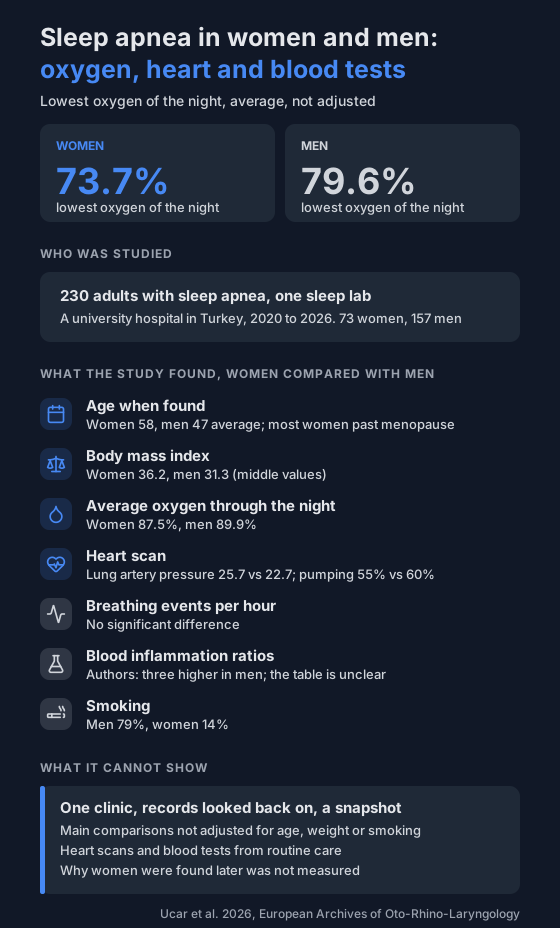
Sleep apnea is often pictured as a man's problem. Women get it too, and are often found later.
A 2026 study from Turkey compared 230 women and men with sleep apnea. The women were older and heavier at their sleep study, and their overnight oxygen was lower. Their heart scans also showed higher pressure in the lung artery.
How is this different from the Chinese study?
We covered a larger study of 1,632 adults in China that also found lower oxygen lows in women. This one differs in three ways:
- Smaller: 230 people against 1,632.
- No adjustment: the Chinese study compared women and men at the same grade and adjusted for age and BMI. This one compared the raw groups.
- More than sleep: it added heart scans and blood tests.
The women were also heavier than the men here, while in the Chinese study they were lighter.
Who was studied?
- 230 adults with sleep apnea, found on a sleep lab study at one university hospital in Turkey between 2020 and 2026.
- 73 women and 157 men.
- The researchers went back through hospital records, so nothing was collected for the study itself.
- Heart scans and blood tests came from routine care in the 6 months before the sleep study.
- 90% of the women were past menopause.
- Smoking (58%), high blood pressure (50%) and high cholesterol (50%) were common across the group.
What did it find?
Age and weight. The women were older: 58 on average against 47. Their BMI was higher: a middle value of 36.2 against 31.3.
Breathing events. Breathing events per hour didn't differ significantly (middle values 34.8 for women, 26 for men, p=0.081).
Overnight oxygen. Both oxygen numbers were lower in the women:
- Average through the night: 87.5% against 89.9% (p=0.007).
- Lowest of the night: 73.7% against 79.6% (p=0.001).
Heart scans.
- Lung artery pressure averaged 25.7 in women and 22.7 in men (p below 0.001). The middle value was 20 in both groups, so the gap came from a smaller number of higher readings.
- The share of blood the heart pumps out with each beat had a middle value of 55% in women and 60% in men (p below 0.001).
Blood tests. The authors looked at five inflammation ratios worked out from routine blood counts.
- The authors report three were higher in men: monocytes to HDL cholesterol, monocytes to LDL cholesterol, and an index called SII.
- The published table doesn't clearly back this: its middle SII value is higher in women (448 against 350), and its monocyte column also looks higher in women.
- Two, called SIRI and PIV, showed no significant difference.
- 79% of the men smoked, against 14% of the women. The authors say smoking and the usual blood count differences between the sexes may explain some of this.
Other conditions. High blood pressure (67% against 43%), high cholesterol (63% against 43%) and COPD or asthma (40% against 19%) were all more common in the women.
What can't it tell you?
- Cause. It's a snapshot from past records. It shows differences, not why they happen.
- Age and weight. The women were 11 years older and heavier, and the main comparisons weren't adjusted for that. The authors say this may explain part of the oxygen and heart differences.
- One extra model. The authors also ran a model that weighed many factors together, with age and BMI considered. Lower average oxygen still went with being a woman. Lowest oxygen and the heart scan figures weren't among the factors that held up.
- "Found later". The authors suggest women are found later in the course of sleep apnea. The study only shows they were older at their sleep study, not how long they'd had it.
- Everyone. One clinic and people referred for a sleep study. The authors say referral habits may differ between women and men.
- Heart and blood data. These came from routine care, up to 6 months before the sleep study, without a fixed method.
- Missing factors. Medication, hormones beyond menopause status and other health conditions weren't fully accounted for.
- The published table. Some rows in the results table appear shifted, and it lists a BMI of 275 and a pumping figure of 600%, which can't be real values. The figures here follow the authors' text where the two disagree, and the blood ratio results are the least certain.
The authors call for larger studies across more centres. The only funding stated was open access funding from TÜBİTAK, Turkey's science research council.
What can you do with this?
This part is ours, not the study's.
- Your oximeter shows your average and lowest overnight oxygen. See what SpO2 is.
- It can't measure lung artery pressure or how well your heart pumps. Those need a heart scan.
- A 6-point gap in lowest oxygen is a group average, not adjusted for age or weight. It says little about any one person.
Women's symptoms can look different, such as morning headaches or daytime sleepiness after menopause. If you're tired, sleep badly or wake with headaches, talk to a doctor, even if you don't snore. The sleep apnea risk check can help you decide whether to bring it up, and you can share your recordings.
Not a medical device. Does not diagnose, treat or prevent any condition. Discuss results and changes with a clinician.
References
- Ucar Y, Incekas C, Karabulut KU, Golen MK. The effect of gender on clinical characteristics and diagnostic process of obstructive sleep apnea syndrome. European Archives of Oto-Rhino-Laryngology. 2026;283(9):5661-5670. doi:10.1007/s00405-026-10345-2