Night Oxygen for Central Sleep Apnea: A Trial
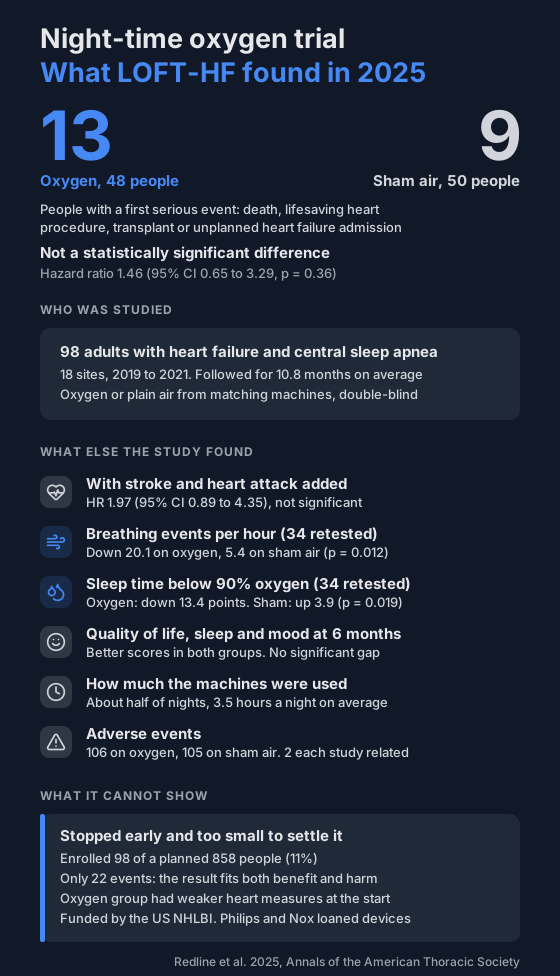
LOFT-HF gave 98 people with heart failure and central sleep apnea oxygen or sham air at night. Breathing events fell on oxygen, but serious events did not, and the trial stopped early.
In central sleep apnea, breathing pauses because the brain's signal to breathe drops out, not because the airway is blocked. People with heart failure who have it are admitted to hospital and die at higher rates than those who don't.
So the idea of giving low-flow oxygen at night has been around for more than 25 years. LOFT-HF, published in December 2025, is described by its authors as the only double-blind, sham-controlled trial built to test whether it changes what happens to people over the long term. It stopped early, and what it did find was not what the researchers expected.
Who was in the trial?
- 98 adults with heart failure and central sleep apnea, at 18 sites.
- Average age about 63, and 23% were women.
- Their hearts pumped weakly: the average ejection fraction was 27.8%.
- They averaged 30.6 central breathing events per hour of sleep.
- People who already used CPAP or oxygen, or whose daytime oxygen was below 90%, were not included.
What did they get?
- 48 people got an oxygen concentrator to use during sleep.
- 50 got a sham machine that looked the same and blew plain air at the same flow.
- Early in the trial, the flow was fixed at 3 litres a minute for both groups.
- Neither the participants nor the researchers knew who had which. Of 57 people asked at the end, about 46% couldn't guess their group and 16% guessed wrong.
- Everyone stayed on their usual heart failure medication.
- Follow-up averaged 10.8 months.
Did oxygen change the sleep recordings?
Yes. 34 people had a repeat sleep study on their machine, a median of 11.3 months in.
- Breathing events per hour: down 20.1 on oxygen, down 5.4 on sham air (p = 0.012).
- Central events per hour: down 18.2 on oxygen, down 6.4 on sham air (p = 0.040).
- Share of sleep spent below 90% oxygen: down 13.4 percentage points on oxygen, up 3.9 on sham air (p = 0.019). That measure is T90.
- Central events fell below 10 per hour in 12 of 18 people on oxygen and 7 of 16 on sham air (p = 0.179).
- Most people still had more than 5 events per hour: 16 of 18 on oxygen and 15 of 16 on sham air.
Did that turn into better health?
No, not in this trial.
The main outcome was the first of: death from any cause, a lifesaving heart procedure, a heart transplant, or an unplanned hospital stay for worsening heart failure.
- 13 people in the oxygen group had one, against 9 in the sham group.
- The hazard ratio was 1.46, with a 95% confidence interval of 0.65 to 3.29 (p = 0.36).
- That's not a statistically significant difference. The interval is wide enough to cover both a benefit and a harm.
- With stroke and heart attack added to the outcome, the hazard ratio was 1.97 (95% CI 0.89 to 4.35).
- Leaving out people who used their machine less than 2 hours a night gave 1.25 (95% CI 0.45 to 3.44).
The authors call it an unexpected trend toward more events on oxygen, and say the trial, though too small, gives no support for night-time oxygen working in this group.
Did people feel any different?
72 people filled in questionnaires again at 6 months.
- Heart failure quality of life, sleep disturbance, sleep-related impairment, mood and general health scores all moved in the better direction in both groups.
- None of the gaps between the groups was statistically significant.
- The sham group's scores went up too, which the authors say points to possible placebo effects.
How much was the oxygen used?
Less than the researchers expected.
- Machines were used on about half of nights.
- On the nights they were used, it was for 7.6 hours on average.
- Across all nights, that works out at 3.5 hours a night.
- Use was similar in both groups.
- About 30% of participants reported trouble sleeping because of machine noise and a dry nose.
There were 211 adverse events: 106 in the oxygen group and 105 in the sham group. Four were judged to be related to the study, two in each group.
What doesn't it tell you?
- Whether oxygen helps or harms. The trial planned for 858 people and stopped at 98, which is 11%. Enrolment was slow and COVID-19 made it worse. With 22 events, it can't settle the question.
- A fair comparison of equal groups. Despite randomisation, the oxygen group started with a lower ejection fraction (25.2% against 30.3%) and more people in the higher heart failure classes.
- Who might respond differently. People with less low oxygen at the start, and those with less stable breathing control, had higher hazard ratios on oxygen for the wider outcome that includes stroke and heart attack. Those subgroups were small and the intervals were very wide.
- Everyone with heart failure. 82% of participants had high-risk markers, so the group may not represent everyone with heart failure and central sleep apnea.
- The full picture on the sleep recordings. Only 34 of 98 people had a repeat sleep study.
The trial was funded by the US National Heart, Lung, and Blood Institute. Philips Respironics loaned the oxygen and sham machines, and Nox Medical loaned the sleep recorders.
What can you take from this?
- A lower count on a sleep recording is not the same thing as a better outcome. In this trial, the oxygen numbers and event counts moved and the serious events did not follow.
- Night-time oxygen is something a doctor prescribes. If you have heart failure and questions about oxygen at night, ask your cardiologist or sleep clinic.
- For how overnight oxygen measures relate to heart failure in other research, read time below 90% and heart failure.
An overnight oximeter can't tell you whether you have central sleep apnea. It records what your oxygen and pulse did, and you can share that with your doctor.
Not a medical device. Does not diagnose, treat or prevent any condition. Discuss results and changes with a clinician.
References
- Redline S, Li D, Javaheri S, Patel SR, Parthasarathy S, Fang JC, Brown LK, Dunlap M, Badr MS, Shah N, Chi L, Majid R, Teodorescu M, Stewart G, et al. Nocturnal Oxygen Therapy for Central Sleep Apnea in Patients with Heart Failure: A Multisite, Double-Blind, Sham-controlled Randomized Clinical Trial (LOFT-HF). Annals of the American Thoracic Society. 2025;22(12):1951-1960. doi:10.1513/AnnalsATS.202504-409OC