Ring Oximeter Plus Radar vs Sleep Study
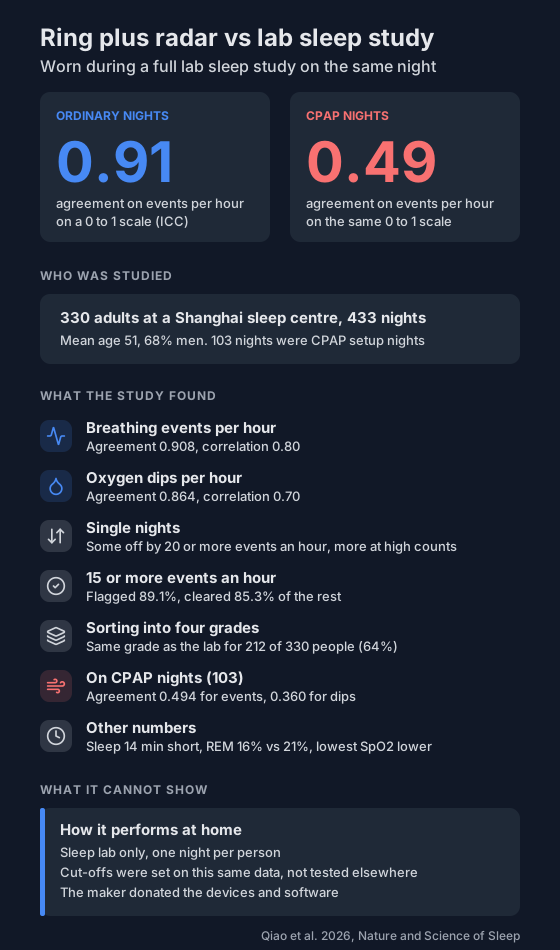
A 2026 study had 330 adults wear a ring oximeter, with a radar beside the bed, during 433 lab sleep study nights. Events per hour tracked the lab well on ordinary nights (ICC 0.91), but much less on CPAP nights (0.49).
A ring oximeter measures oxygen and pulse, but it can't see your breathing. So any breathing events per hour it reports are an estimate.
A 2026 study from Shanghai paired a ring oximeter with a radar unit beside the bed that tracks chest movement without touching you. People wore the ring, with the radar running, during a full lab sleep study, and the researchers compared the numbers night by night.
On ordinary nights the totals tracked the lab closely. Sorting people into the lab's four grades was rougher, and on CPAP nights agreement fell a long way.
What was the setup?
- The ring (Circul): a reflective oximeter worn on a finger. It records oxygen, pulse and movement.
- The radar (OrbSense): a small box on a bedside surface, 10 to 20 cm above chest level and within 2.2 m of the bed. It picks up breathing and body movement.
- The software: combines both into breathing events per hour, oxygen dips per hour, sleep time and sleep stages.
Both devices are made by Megahealth and are registered as medical devices in China.
Who was studied?
This was a prospective study at one sleep centre.
- 330 adults aged 18 to 80, booked for a lab sleep study at Huashan Hospital, Fudan University, between June 2023 and April 2024.
- Mean age 51, 67.6% men, mean BMI 24.6.
- 103 of them came back for a second lab night to set up CPAP, so there were 433 nights in total.
- On the lab study, 127 had under 5 breathing events per hour, 84 had 5 to 15, 43 had 15 to 30 and 76 had 30 or more.
- Not everyone was there for sleep apnea. The group also included insomnia, sleep movement disorders, parasomnias and daytime sleepiness of central origin.
- People on oxygen were excluded, and so was anyone the ring didn't fit.
- 23 recordings were dropped because the ring showed a lowest SpO2 of 0% or 200 minutes of sleep or less, which points to a loose ring or a failed recording.
How close were the numbers?
Agreement was scored with the intraclass correlation (ICC), which runs from 0 to 1.
On the 330 ordinary nights:
- Breathing events per hour: ICC 0.908, correlation 0.80.
- Oxygen dips per hour (ODI): ICC 0.864, correlation 0.70.
The totals rose and fell together, but single nights could be well off. For breathing events, 95% of the gaps fell between about 19 events per hour one way and 28 the other. The gaps grew as the counts went up.
How well did it sort people by grade?
The device's own count ran higher than the lab's at the bottom. Using the lab's cut-offs of 5, 15 and 30, it put 50 of the 127 people the lab had under 5 at 5 or more.
So the researchers worked out new cut-offs for the device from this same data: 13.6, 20.8 and 30.9 events per hour. With those:
- Lab 15 or more: the device flagged 89.1% of them and cleared 85.3% of the rest.
- Lab 30 or more: flagged 90.8%, cleared 88.8%.
- Lab 5 or more: flagged 76.8%, cleared 85.0%.
Sorting into four grades went less well. The device matched the lab's grade for 212 of 330 people, about 64%.
- Top grade (30 or more): 69 of 76 matched.
- Under 5: 108 of 127 matched.
- 5 to 15: 21 of 84 matched, and 44 were put in the lowest grade.
- 15 to 30: 14 of 43 matched, and 17 were put in the top grade.
The authors say the 5 to 30 range is where it misgraded most, and that a lab study is still needed for people near a cut-off.
When the cut-offs were tested by splitting the data five ways, the overall accuracy score (AUC, 0 to 1) dropped to 0.836, with 79.7% flagged and 83.1% cleared.
What happened on CPAP nights?
On the 103 CPAP setup nights, agreement fell:
- Breathing events per hour: ICC 0.494, correlation 0.58.
- Oxygen dips per hour: ICC 0.360, correlation 0.33.
The device tended to read higher than the lab. Of 77 CPAP nights the lab scored under 5, the device put 20 at 13.6 or more.
The authors suggest the CPAP airflow interferes with the radar, or changes how the chest and belly move. They didn't test that. They also say it's open whether the ring alone would do better on CPAP nights.
If you're on CPAP, see tracking your oxygen alongside CPAP.
Did other sleep problems change things?
Agreement stayed high in all three groups, and was lowest for movement disorders and parasomnias. Agreement on breathing events per hour (ICC) by group:
- Insomnia and/or sleep apnea: 0.931.
- Daytime sleepiness of central origin: 0.920.
- Sleep movement disorders and parasomnias: 0.840.
What about the other numbers?
- Sleep time: 362 minutes on the device against 376 in the lab.
- REM sleep: 16.4% of sleep on the device against 20.5% in the lab.
- Lowest SpO2: 81.5% on the device against 85.1% in the lab.
- Time below 90% (T90): 18.1 minutes against 16.9.
- Central breathing pauses: almost none on the device (0.04 an hour against 0.39). There were no clear cases of central sleep apnea in the group, so the authors say this can't be judged yet.
What can't it tell you?
- How it does at home. People set up the devices themselves, but in a sleep lab with technicians watching.
- Night-to-night repeatability. Each comparison was one night.
- Whether the cut-offs hold up. They were worked out from this same data and haven't been tested on a new group.
- How it does with oxygen therapy. Those people were excluded.
- How other rings do. These numbers are for this ring, radar and software together.
Megahealth supplied and donated the devices and software. The authors say the company had no other involvement and declare no competing interests.
For other rings against a lab study, see ring oximeter vs sleep study and Belun ring vs lab sleep study.
What can you do with this?
- If your ring or app shows a breathing event estimate, read single nights loosely, especially between 5 and 30.
- Watch your ODI as a trend across several nights.
- Home oximetry is not a sleep study. If your numbers worry you, share them with your doctor.
Not a medical device. Does not diagnose, treat or prevent any condition. Discuss results and changes with a clinician.
References
- Qiao M, Zhang H, Yuan L, Huang Y, Zhang Q, Pan S, Xu L, Fu C, Yu H. Diagnostic Performance of a Combined Reflective Photoplethysmography and Ultra-Wideband Radar Device for Obstructive Sleep Apnea: Comparison with Polysomnography. Nature and Science of Sleep. 2026;18:602209. doi:10.2147/NSS.S602209