CPAP Titration Night Oxygen and Use
In 304 adults who had a CPAP titration night, each 1% higher lowest SpO2 that night went with about 12% higher odds of meeting a 90-day use target, after allowing for their events per hour beforehand.
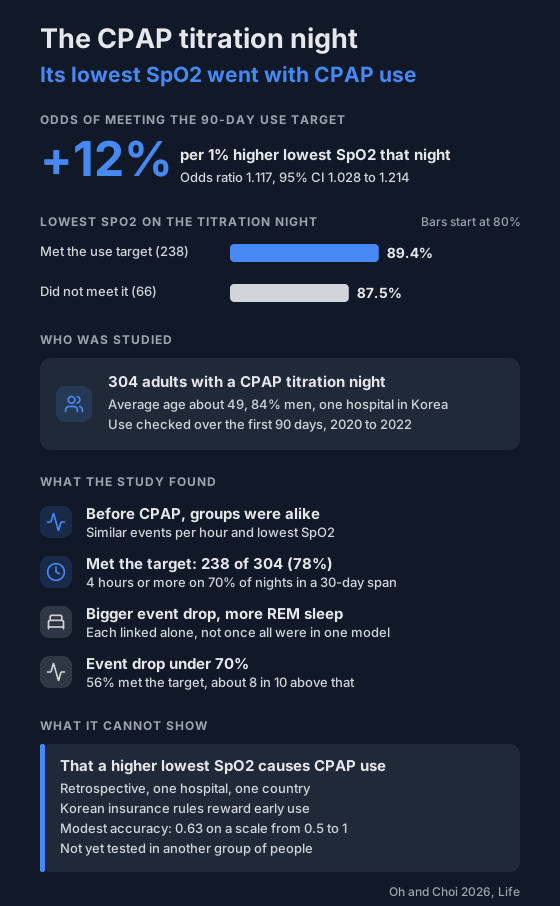
CPAP use usually gets blamed on masks, comfort and motivation. A 2026 study from Korea looked at whether readings from the first night on CPAP, the pressure-setting "titration" night in a sleep lab, were linked to later use. Of everything it measured that night, the lowest oxygen reading (SpO2 nadir) had the strongest link.
What is a titration night?
- A sleep lab night where a technologist adjusts the CPAP pressure until breathing events stop.
- It's usually a person's first night on CPAP.
- The lab records oxygen, sleep stages, arousals and events per hour, so a lot of numbers come out of one night.
Who was studied?
- 304 adults with obstructive sleep apnea at one university hospital in Korea, who had a titration night between 2020 and 2022.
- Average age about 49. 84% were men.
- Before CPAP, they averaged about 44 breathing events per hour in the group that met the target and 39 in the group that didn't. The difference wasn't statistically significant.
- Use was counted as meeting the target if it was 4 hours or more a night on at least 70% of nights, in any 30-day span in the first 90 days. This is the Korean insurance rule.
- It was a retrospective study of hospital records.
What did it find?
- 238 of 304 (78%) met the use target. 66 did not.
- Lowest SpO2 on the titration night: 89.4% in those who met the target and 87.5% in those who didn't (p = 0.010).
- Before CPAP: the lowest SpO2 was 77.5% against 77.9%. Events per hour, age, BMI and sleepiness were also similar.
- Odds: each 1% higher lowest SpO2 on the titration night went with 1.117 times the odds of meeting the target (95% CI 1.028 to 1.214), after allowing for age, sex, BMI, baseline events per hour and the other titration measures.
- Against other measures: the fall in events per hour, the share of REM sleep and the arousal rate were each linked to use when looked at one at a time, but once all were in one model only the lowest SpO2 kept a statistically significant link.
- A drop in events under 70%: 56% (23 of 41) met the target. Above that, 79% to 84% did, with no further gain past a 95% drop.
- Two groups: whether events fell below 5 an hour or not, the lowest SpO2 link was almost the same (about 1.9 and 2.0 times per 5% higher). The comparison of use between those two groups, 81% against 74%, was not statistically significant, and the authors say it was underpowered.
How well did it predict use?
- Adding the titration measures to age, sex, BMI and baseline events raised the area under the curve from 0.566 to 0.683. After correcting for over-fitting it was 0.632, where 0.5 is chance and 1 is perfect.
- The authors call that modest. It says something about groups, not about any one person.
Why might the lowest SpO2 matter?
The authors offer two explanations and couldn't test which is right.
- Oxygen that comes back up on the first night may make CPAP feel like it's working, which can encourage use.
- Oxygen that stays low even at an effective pressure may point to other things, such as lung disease or low ventilatory reserve, that make CPAP harder to live with.
What can't it show?
- A link, not a cause. It doesn't show that a higher lowest SpO2 leads to more CPAP use.
- Retrospective, one hospital, one country, and no outside check on the results.
- Korean reimbursement rules require proof of use within 90 days, which gives people a reason to use CPAP early. Rates and links may differ elsewhere.
- Mask leak, mask fit, comfort, mood, insomnia and lung or body-position data weren't available.
- Only 66 people didn't meet the target, so the individual estimates are imprecise. The authors call the findings preliminary.
- It looked at the first 90 days only, not use beyond a year.
- Funding came from a Korean government technology program and the university. The authors reported no conflicts of interest.
For who else stops early, see who stops CPAP in the first year.
What can you do with it?
If you're on CPAP, an oximeter can show your own overnight oxygen alongside your usage; see tracking oxygen with CPAP.
- Note your lowest SpO2 on your first nights and how it changes over the following weeks.
- Bring those readings to your next review, along with any mask or comfort problems.
- Don't read your numbers against this study's averages. It can't say what any one person's reading means.
The authors suggest earlier follow-up for people whose titration night looks like the non-adherent group's, but they note it hasn't been tested.
Not a medical device. Does not diagnose, treat or prevent any condition. Discuss results and changes with a clinician.
References
- Oh J, Choi JH. Comprehensive positive airway pressure titration parameters as predictors of therapeutic adherence in obstructive sleep apnea. Life (Basel). 2026;16(9):1462. doi:10.3390/life16091462