Mouthpiece vs CPAP: Oxygen Dips Compared
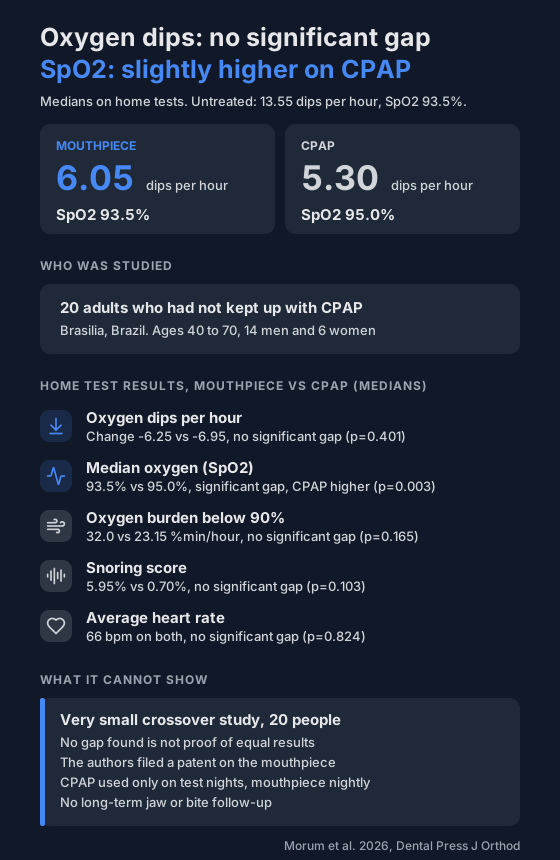
In 20 adults who had not kept up with CPAP, a 3D-printed jaw-advancing mouthpiece and CPAP both lowered oxygen dips per hour on home tests, with no statistically significant gap. Median SpO2 was slightly higher on CPAP.
CPAP is the usual first choice for obstructive sleep apnea, but many people don't keep using it. A jaw-advancing mouthpiece is the common alternative, and an overview of 14 reviews found CPAP lowered breathing events and oxygen dips per hour more than a mouthpiece did.
A 2026 study from Brazil tested a 3D-printed mouthpiece made from digital scans of the teeth. In 20 adults who had not kept up with CPAP, oxygen dips per hour fell about as much with the mouthpiece as with CPAP, with no statistically significant difference. Median SpO2 was slightly higher on CPAP. The authors filed a patent on the device.
Who was in the study?
- 20 adults aged 40 to 70 in Brasilia, Brazil: 14 men and 6 women.
- Average age 54.9, average BMI 27.6.
- All had sleep apnea confirmed in a sleep lab, at fewer than 50 breathing events per hour (28.9 on average).
- All had used CPAP before and had not kept it up.
- People with a BMI above 35 or too few teeth to hold the device were left out.
What was the mouthpiece?
- Two 3D-printed resin splints, one for the upper teeth and one for the lower, joined at the sides.
- Metal-free and without a plate over the roof of the mouth.
- Made from intraoral scans, then moved forward in two steps: 50% and then 75% of the person's maximum jaw advance, about 30 days per step.
How were the tests done?
- Each person had a home sleep test under three conditions: no device, CPAP and the mouthpiece.
- The order was randomised, with a one-week gap between conditions.
- Everyone stopped CPAP at the start and was asked to wear the mouthpiece at least 6 hours a night throughout the study.
- CPAP was only used on its test nights.
So the CPAP results show how it performed when worn, not how long people kept wearing it.
What did the home tests show?
Medians for each condition:
| No device | Mouthpiece | CPAP | |
|---|---|---|---|
| Oxygen dips per hour (ODI) | 13.55 | 6.05 | 5.30 |
| Oxygen (SpO2) | 93.5% | 93.5% | 95.0% |
| Oxygen burden below 90% (%min/hour) | 59.55 | 32.00 | 23.15 |
| Snoring score | 28.2% | 5.95% | 0.70% |
| Heart rate (bpm) | 67.5 | 66 | 66 |
The authors compared the change from the no-device night for each therapy.
- Oxygen dips per hour: median change of -6.25 on the mouthpiece and -6.95 on CPAP. No statistically significant difference (p = 0.401).
- Oxygen burden: -27.0 against -30.3. No statistically significant difference (p = 0.165).
- Snoring: -17.5 against -34.5. No statistically significant difference (p = 0.103).
- Heart rate: median change of 0 on both. No statistically significant difference (p = 0.824).
- SpO2: the one significant gap (p = 0.003). The median change was 0.0 on the mouthpiece and +1.0 on CPAP.
The authors call the SpO2 gap small and unlikely to matter clinically.
What doesn't it tell you?
- Equal results. No statistically significant difference isn't proof that the two are equal. The authors ran no equivalence test, and with 20 people a real gap could be missed.
- A broad group. It is 20 adults in one city in Brazil.
- Conflicts of interest. The authors filed a patent application for the mouthpiece.
- Who supplied the device. The appliances were provided by a Brazilian company, Silent Sleep.
- Long-term effects. The authors note that long-term jaw, bite and heart and metabolic outcomes still need larger, longer studies.
- Real-world use. CPAP was only used on its test nights, while the mouthpiece was meant to be worn every night. The study says nothing about how long anyone would keep using either device.
- The type of study. It was a crossover study, so each person acted as their own comparison, but the paper doesn't say how many nights each test covered.
The authors conclude the mouthpiece is a viable alternative for people who struggle with CPAP. That is their conclusion, drawn from a very small study.
What can you do with this?
Oxygen dips per hour (ODI) is a number an overnight oximeter reports, so it's a measure you can see in your own data. It can't tell you which therapy is right for you, and any change in therapy is a decision for you and your doctor.
For more on how the two compare, see CPAP vs mouthpiece: 14 reviews and mouthpiece vs CPAP and blood pressure.
Not a medical device. Does not diagnose, treat or prevent any condition. Discuss results and changes with a clinician.
References
- Morum T, Sampaio D, Hecksher JB, Faber J. Effectiveness of a fully digital mandibular advancement appliance compared with CPAP in the treatment of obstructive sleep apnea. Dental Press Journal of Orthodontics. 2026;31(4):e262663. doi:10.1590/2177-6709.31.4.e262663.oar