CPAP and Driving: 24 Taxi Drivers in Taipei
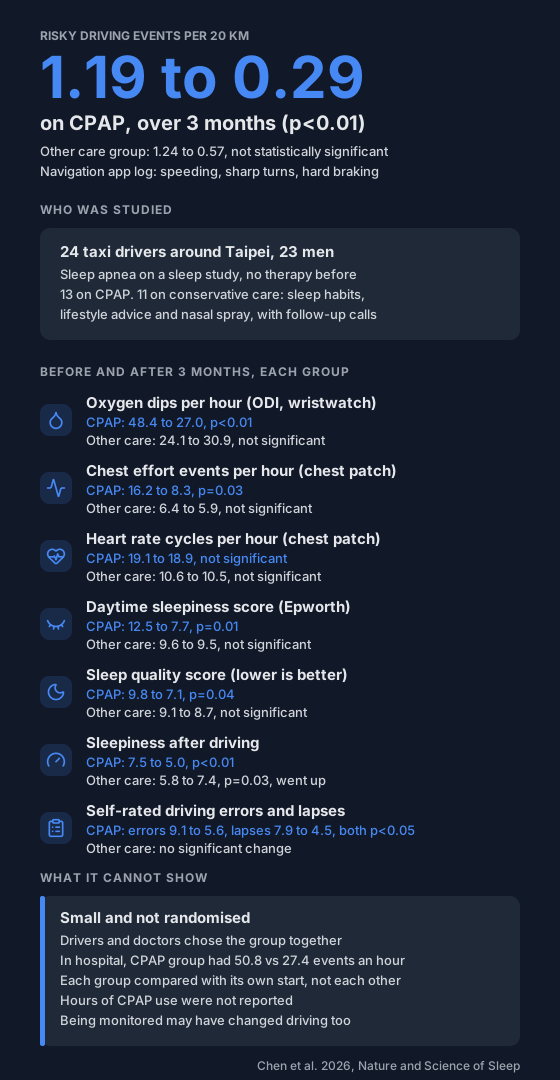
A small 2026 study followed 24 taxi drivers with sleep apnea for 3 months. In the 13 on CPAP, risky driving events per 20 km went from 1.19 to 0.29 and oxygen dips per hour from 48.4 to 27.0. In the other group, neither changed by a statistically significant amount.
Sleep apnea is common in professional drivers, and it's linked to daytime sleepiness and crashes. Earlier research on CPAP and driving has often used crash records or driving simulators.
This small study from Taiwan tracked taxi drivers on real roads instead. A navigation app logged how they drove, and wearables logged their nights, before and after 3 months of either CPAP or conservative care.
In the CPAP group, risky driving events and oxygen dips both went down. In the other group, driving events, oxygen dips and sleep scores showed no statistically significant change, and sleepiness while driving went up.
Who was studied?
- 24 taxi drivers from the Taipei area, recruited through taxi associations and public notices.
- 23 men and 1 woman, average age around 45 to 48. The text says the conservative group had 10 men and 1 woman; Table 1 prints 12/1, which doesn't add up to 11.
- Each had sleep apnea on an overnight sleep study in hospital and no therapy for it before.
- 13 went on CPAP for 3 months, with the target of at least 4 hours a night on 5 nights a week.
- 11 got conservative care: a brochure on sleep habits, the bedroom, smoking, alcohol, caffeine, exercise, food and stress, plus a nasal spray.
- Everyone got phone calls twice a week and a monthly clinic visit.
The groups weren't chosen at random. Each driver and their doctor picked the option together.
What was measured?
For 3 to 4 days before and again after the 3 months:
- Driving: a navigation app logged trips and flagged speeding, sharp steering, harsh acceleration and hard braking. The study counted these per 20 km.
- Nights: an oximeter wristwatch counted oxygen dips of 3% or more per hour (ODI), and a chest patch counted heart rate cycles and chest effort events per hour.
- Questionnaires: sleep quality, daytime sleepiness, sleepiness before, during and after driving, and a driving behaviour questionnaire.
The wearable numbers below are from the paper's before-and-after table (Table 5). The baseline table (Table 3) prints different starting values for the same measures, for example oxygen dips of 52.3 rather than 48.4 an hour in the CPAP group.
New to ODI? Read what ODI counts. The heart rate cycles are close to the CVHR number some oximeter apps show.
What changed on CPAP?
All of these are before and after, in the 13 drivers on CPAP:
- Risky driving events per 20 km: 1.19 to 0.29 (p < 0.01).
- Oxygen dips per hour: 48.4 to 27.0 (p < 0.01).
- Chest effort events per hour: 16.2 to 8.3 (p = 0.03).
- Heart rate cycles per hour: 19.1 to 18.9, not statistically significant.
- Daytime sleepiness score (Epworth): 12.5 to 7.7 (p = 0.01).
- Sleep quality score: 9.8 to 7.1, where lower is better (p = 0.04).
- Sleepiness after driving: 7.5 to 5.0 (p < 0.01). It also went down mid-drive, from 6.2 to 4.4.
- Self-rated driving errors: 9.1 to 5.6 (p < 0.01). Lapses went from 7.9 to 4.5 (p = 0.03).
Daily driving time and distance didn't change by a statistically significant amount. Distance went from 113 to 144 km a day (p = 0.06). Hard braking was the most common event in both groups, before and after.
And on conservative care?
In the 11 drivers on conservative care:
- Risky driving events per 20 km: 1.24 to 0.57 (p = 0.08), so this fell too, but not by a statistically significant amount.
- Oxygen dips per hour: 24.1 to 30.9, not statistically significant.
- Daytime sleepiness and sleep quality scores: almost unchanged.
- Sleepiness mid-drive and after driving: both went up, from 4.7 to 6.3 and from 5.8 to 7.4 (both p = 0.03).
The authors think 3 months may be too short for lifestyle changes to show. They also note this group started with fewer breathing events, and weight loss wasn't part of the plan. They conclude conservative care may suit as an addition to CPAP rather than on its own.
What can't it show?
- A fair head-to-head. It wasn't randomised. The CPAP group started with far more breathing events per hour on the hospital sleep study: 50.8 against 27.4 on average. Each group was compared with its own start. The abstract mentions comparisons between groups, but the only between-group tests reported are of the starting values.
- Much at all with certainty. 24 drivers is small, and the authors call the findings preliminary.
- How much CPAP was used. The paper doesn't report hours of use, and there was no objective check on whether the other group followed the advice.
- That CPAP alone did it. The authors say being watched by the study may have changed how people drove. They point to the falls in oxygen dips and chest effort events as a sign that wasn't the whole story.
- Crashes. The app counted risky events, not collisions.
A subgroup of drivers with 30 or more breathing events an hour on the hospital sleep study gave the same pattern, but it was even smaller: 12 on CPAP and 4 on conservative care. Its numbers are only in the supplement.
The study was funded by research councils in Taiwan and the UK and by Taipei Medical University. The authors declare no conflicts of interest.
How does it fit with other research?
A different study of older taxi drivers in Singapore found low CPAP use and no statistically significant change in reaction time. Read that study. For what goes with sticking to CPAP, see this review.
What can you do with this?
If you drive for a living and snore loudly, feel sleepy at the wheel, or someone has heard you stop breathing in your sleep, see a doctor.
Not sure? The sleep apnea risk check takes about a minute and helps you decide whether to talk to a doctor.
Already on CPAP? An overnight oximeter logs your oxygen dips each night, so you can track them alongside CPAP and share the trend with your clinic.
Not a medical device. Does not diagnose, treat or prevent any condition. Discuss results and changes with a clinician.
References
- Chen Z, Liu WT, Majumdar A, Hsu WH, Kuan YC, Kang JH, Chen YL, Chien R, Wang P, Lee KY, Feng PH, Chen KY, Lee HC, Lin YC, et al. Comparative Treatment Strategies for Obstructive Sleep Apnea and Their Relationships with Aberrant Driving Behaviors: Taxi Drivers in Taipei Metropolitan Area. Nature and Science of Sleep. 2026;18:596899. doi:10.2147/NSS.S596899