Caffeine Naps for Drivers With Sleep Apnea
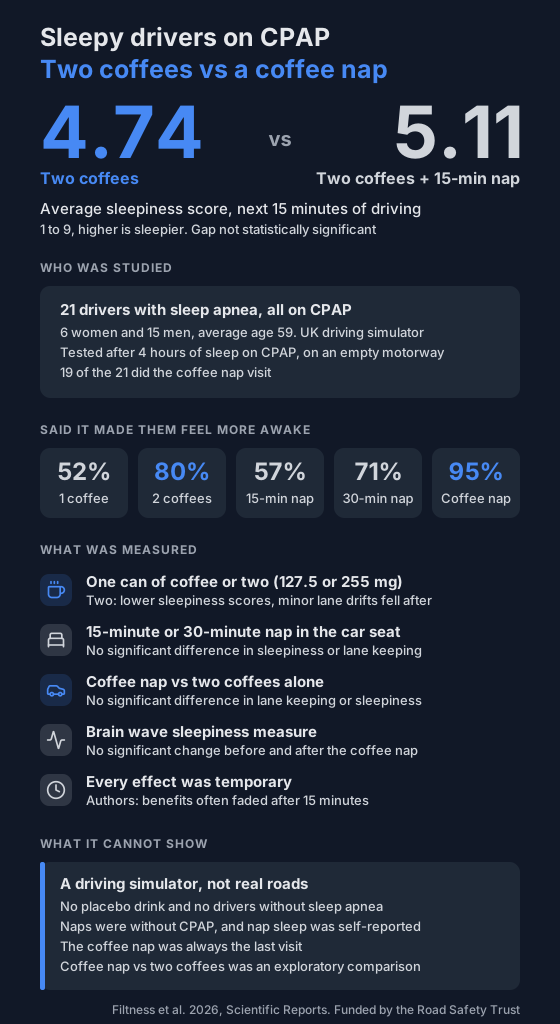
A 2026 simulator study put 21 short-slept drivers on CPAP through coffee, naps and a coffee nap. Two cans of coffee did more than one, and adding a 15-minute nap made no statistically significant difference.
The usual advice for a sleepy driver is to stop, drink a coffee and take a short nap. That advice comes from studies of healthy people without a sleep disorder.
A study published in 2026 tested it on drivers with sleep apnea who use CPAP. Two cans of coffee did more than one. Adding a nap on top of the two cans made no statistically significant difference.
Who was in the study?
- 21 drivers with obstructive sleep apnea, all on CPAP. 6 were women and 15 were men.
- Ages ran from 33 to 83, with an average of 59.
- They'd had sleep apnea for between 6 months and 31 years.
- They were recruited through a sleep apnea patient association in Leicester, UK.
26 people started. Five withdrew, two of them because the simulator made them feel sick.
How was it tested?
The plan was six visits to a driving simulator at Loughborough University.
- Visit 1: a 45-minute drive after their usual night of sleep.
- The other five visits: a drive after a night cut to 4 hours, still on CPAP.
On the short-sleep visits they drove for 30 minutes, stopped for one of five things, then drove for another 45 minutes:
- One 250 ml can of iced coffee (127.5 mg of caffeine).
- Two cans (255 mg).
- A 15-minute chance to nap in the driver's seat.
- A 30-minute chance to nap in the driver's seat.
- Two cans followed by a 15-minute nap.
The road was a three-lane motorway with no other traffic. The researchers recorded:
- A sleepiness score from 1 (extremely alert) to 9 (can't stay awake), asked every 5 minutes.
- How much the car wandered in its lane, and how often it left it.
- Brain waves, as a second measure of sleepiness.
The short nights worked as planned. People slept about 430 minutes before the first visit and 217 to 229 minutes before the others.
Did two coffees beat one?
Yes, on two of the measures.
- Sleepiness score. It was lower with two cans than with one. From the 15 minutes before the coffee to the 15 minutes after, it fell by about 0.9 points with one can and 1.4 with two.
- Minor lane drifts. These fell in the 15 minutes after two cans. They didn't after one. Across the whole drive, the count didn't differ significantly between the doses.
- Major lane departures. These fell after the break with either dose.
- Lane wandering and brain waves. No significant difference between the doses.
52% said one can made them feel more awake. 80% said two did.
Was a 30-minute nap better than 15?
No.
- Sleepiness scores fell by about 0.9 points after the 15-minute nap and 0.8 after the 30-minute one.
- There was no significant difference between the two nap lengths in lane wandering or lane departures overall.
- 62% said they fell asleep in the 15-minute nap, and 80% in the 30-minute one.
The naps were taken without CPAP. The authors say that may be one reason the naps did less than they do in studies of healthy adults. They also raise grogginess after waking as a possible reason, but the study didn't record sleep during the naps, so it can't confirm that.
So what did the coffee nap add?
The researchers built it from the two earlier results: two cans, then a 15-minute nap. 19 of the 21 people did this visit.
- Sleepiness scores before and after the coffee nap were not significantly different.
- Lane wandering went from 0.38 m before to 0.35 m after, in an exploratory comparison. The authors say to read exploratory results with caution.
- Lane departures and brain waves showed no significant change.
Then they compared the 15 minutes after the coffee nap with the 15 minutes after two cans alone.
- Sleepiness score: 5.11 after the coffee nap, 4.74 after two cans. That gap was not statistically significant.
- Lane wandering, lane departures and brain waves: no significant difference.
People rated it well anyway. 95% said the coffee nap made them feel more awake, and 53% said they fell asleep during the nap.
The authors conclude that for drivers on CPAP, a coffee nap is unlikely to be a practical gain over two coffees alone. They say official advice to use a coffee nap may not suit drivers with sleep apnea.
How long did any of it last?
Not long.
- Sleepiness scores and lane drifts rose again later in the 45-minute drive.
- The authors say benefits often faded after 15 minutes.
- They say none of the options can replace a good night's sleep before driving.
After a short night, people felt sleepier and drove worse the longer they stayed at the wheel.
What can't it tell you?
- Real roads. It was a simulator. The authors say sleepiness and driving errors are likely to be greater there than on a real road.
- Whether coffee beats nothing. There was no placebo drink and no break without coffee or a nap.
- How this compares with other drivers. Nobody without sleep apnea was tested. That comparison rests on earlier studies.
- Your dose. Everyone got the same cans, whatever their body size or coffee habit.
- A fair test of the coffee nap. It was always the last visit, and its comparison with two cans was exploratory. The authors ask for a proper head-to-head study.
- Much precision. 21 people is a small group, and some brain wave and simulator recordings were lost to equipment faults.
The study was funded by the Road Safety Trust in the UK. The authors declared no competing interests.
What can you do with this?
This study started from a short night. Its own conclusion is that a full night's sleep is the thing none of the options replaced.
If you're on CPAP and still sleepy in the day, tell your doctor. The paper notes that UK drivers who have sleep apnea with excessive sleepiness must tell the DVLA and not drive.
If you record your nights, you can see how short ones look next to full ones. Here's what a study found about short sleep, heart rate and oxygen, and how to track your oxygen alongside CPAP.
Not a medical device. Does not diagnose, treat or prevent any condition. Discuss results and changes with a clinician.
References
- Filtness AJ, Miller KA, Maynard S, Asmal A, Kerwin T, Hall A, Anund A. Optimising the caffeine nap for counteracting driver sleepiness in CPAP treated obstructive sleep apnoea patients. Scientific Reports. 2026;16(1):14380. doi:10.1038/s41598-026-42894-1