Social Jetlag in 5 Million Fitbit Nights
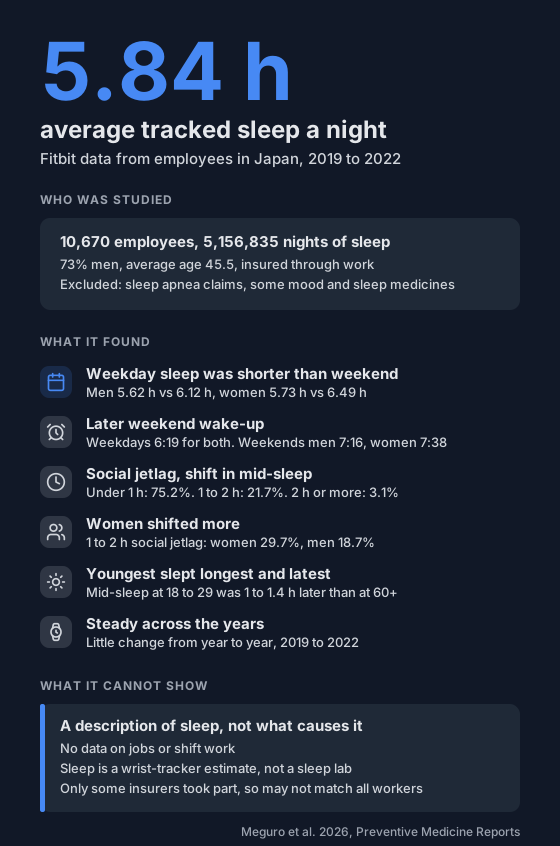
A 2026 study of 5.2 million Fitbit nights from 10,670 employees in Japan found 5.84 hours of tracked sleep a night on average, 0.5 to 0.8 hours less on weekdays than at weekends, and more social jetlag in women.
Japan often comes up as one of the shortest-sleeping countries. Most of those figures come from surveys, where people tell you how long they think they slept.
A study published in 2026 used Fitbit data instead. It covered over 5 million nights from employees in Japan between April 2019 and March 2022.
Who was in the study?
- 10,670 employees insured through work-based health insurance groups in Japan.
- 72.6% were men, and the average age was 45.5 (range 18 to 71).
- Their Fitbit sleep data came through a health app linked to their insurance records.
- Together they logged 5,156,835 main sleeps, a median of 421 nights each.
People with an insurance claim for sleep apnea, or a prescription for anti-anxiety medicines, sleeping pills or antidepressants, were left out. So were people having medical care during pregnancy or after birth.
How long did they sleep?
5.84 hours a night on average, counting only the time the tracker scored as asleep.
- Men: 5.79 hours.
- Women: 5.98 hours, about 10 minutes more.
- The sleep period, from falling asleep to final waking, was 6.73 hours, because it includes time awake in the night.
- On average they fell asleep at 23:54 and woke at 6:39.
The authors say this is shorter than survey-based figures for Japan, such as the OECD's. They put that partly down to the data source, since people tend to overestimate their sleep in surveys.
How different were weekends?
Weekday sleep was shorter than weekend sleep in every age group, for men and women.
- Men: 5.62 hours on weekdays, 6.12 at weekends.
- Women: 5.73 hours on weekdays, 6.49 at weekends.
Most of the gap came from waking later. Both men and women woke at about 6:19 on weekdays. At weekends, men woke at 7:16 and women at 7:38. Falling-asleep time moved by much less, about 19 minutes for men and 24 for women.
What is social jetlag?
It's the shift in the middle point of your sleep between weekdays and weekends. If you sleep 11 pm to 6 am on weekdays and 1 am to 8 am on Saturday, your midpoint moves by 2 hours.
In this study:
- Under 1 hour: 75.2%.
- 1 to 2 hours: 21.7%.
- 2 hours or more: 3.1%.
Did women and men differ?
Yes, modestly.
- 29.7% of women had 1 to 2 hours of social jetlag, against 18.7% of men.
- 2 hours or more was similar: 3.6% of women, 3.0% of men.
- Women's weekend sleep gain was about 15 minutes bigger than men's.
The authors suggest biological and social factors, such as work schedules and housework and caregiving, which fall more on women in Japan. The study didn't measure any of these.
What about age?
- The youngest group, 18 to 29, slept the longest, by about 0.3 to 0.6 hours compared with those 50 and over.
- They also slept later: mid-sleep at 18 to 29 was about 1.4 hours later than at 60 to 73 in men, and about 1 hour later in women.
- In men over 40, sleep length barely changed with age.
- In women, sleep kept getting shorter into their 50s.
Sleep length changed little across the three years, which included the start of COVID-19.
What can't it tell you?
- Cause. It's a descriptive study. It shows patterns, not why they happen.
- Jobs. There was no data on occupation or shift work.
- The measurement. Sleep was a Fitbit estimate, not a sleep lab recording, and the Fitbit model wasn't known.
- Who took part. People with sleep apnea claims or on those medicines were left out, most were men, and only some insurers took part.
- Enough nights. Only people who logged enough weekday and weekend nights were kept, about half of the 20,886 people the study started with.
- Data source. Two of the four authors are affiliated with JMDC, the company whose health app and claims database supplied the data. The paper declares no competing interests.
- Averages. Each person's nights were averaged over the whole period, which hides night-to-night swings.
The authors made many comparisons without correcting for multiple testing, and call the findings exploratory.
For how well wrist trackers measure sleep, see how valid smartwatch numbers are. People with sleep apnea can misjudge their own sleep time too. See misjudging how long you slept.
What can you do with this?
If your weekday and weekend nights look different, your averages will depend on which nights you record. When you track overnight oxygen, include both, and see how many nights to record.
A wearable study linked shorter sleep with a higher resting heart rate. See short sleep, heart rate and overnight oxygen.
Not a medical device. Does not diagnose, treat or prevent any condition. Discuss results and changes with a clinician.
References
- Meguro K, Endo F, Kuchiba A, Tsuno K. Sleep duration, sleep-wake schedules, and social jetlag among corporate employees in Japan: Age- and gender-based comparisons of wearable device data (2019-2022). Preventive Medicine Reports. 2026;71:103639. doi:10.1016/j.pmedr.2026.103639