Oxygen Dips and Surgery Complications
A 2026 French cohort of 2,286 adults with sleep apnea found that bigger overnight oxygen dips went with more heart and circulation problems and deaths in the 30 days after major non-heart, non-chest surgery.
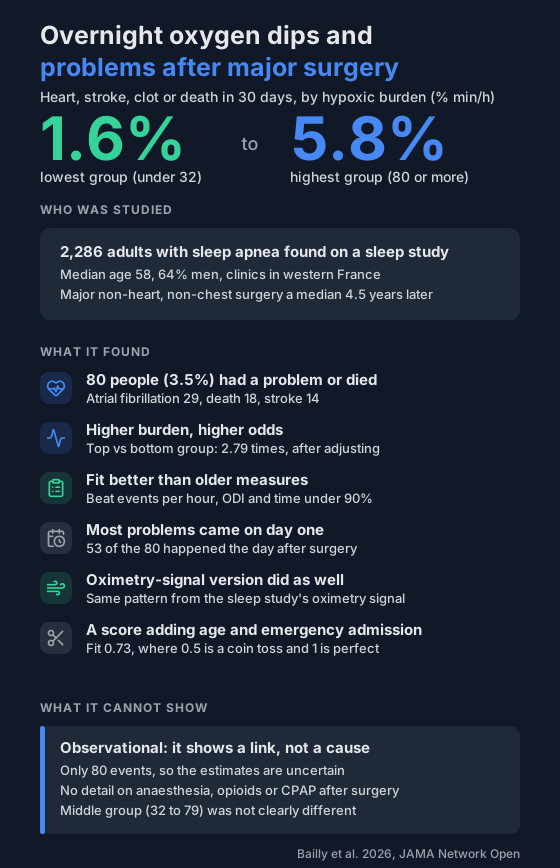
Sleep apnea is thought to add risk around surgery, because anaesthetics and painkillers relax the airway. Large database studies have given mixed answers, and the usual breathing-events-per-hour number doesn't capture how deep or long the oxygen dips are. A 2026 study from France asked whether a measure that does capture them lines up with problems after an operation.
The measure is called hypoxic burden. It's the area under the oxygen dips linked to breathing events, divided by sleep or recording time. Bigger and longer dips, and more of them, give a bigger number. It's reported in % min/h.
Who was in the study?
- 2,286 adults from the Pays de la Loire Sleep Cohort in western France.
- All had sleep apnea found on a sleep study between 2007 and 2018, with at least 5 breathing events per hour.
- Median age 58, and 64% were men.
- They then had major non-heart, non-chest surgery, a median of 4.5 years after the sleep study.
- The most common types were orthopaedic and digestive, 803 people each (35%).
- 10% were urgent, shortly after an emergency admission.
- Outcomes came from the French national administrative health care database.
What did it measure?
The main outcome was any of these within 30 days of surgery: stroke, atrial fibrillation, heart failure, heart attack, blood clot in a vein, or death from any cause. Hypoxic burden came from the sleep study done years before the surgery. The authors also tested a simplified version worked out automatically from the sleep study's pulse oximetry signal alone.
What did it find?
80 people (3.5%) had at least one of those outcomes. Atrial fibrillation was the most common (29), then death (18), stroke (14), heart failure (12), blood clot (12) and heart attack (7). Those counts add up to 92, so some people must have had more than one, though the paper doesn't say so. 53 of the 80 happened on the first day after surgery.
The rate climbed with hypoxic burden:
- Under 32 % min/h: 1.6% (12 events).
- 80 % min/h or more: 5.8% (44 events).
After adjusting for age, sex, heart disease history, COPD, smoking and emergency admission:
- 32 to under 80: the odds were 1.76 times the lowest group, but the range (0.86 to 3.59) includes no difference, so this wasn't statistically significant.
- 80 or more: the odds were 2.79 times the lowest group (1.42 to 5.49).
People who had a problem were also older (median 63.5 against 58), more likely to have been admitted as an emergency (34% against 10%) and more likely to have heart failure on record (20% against 5%).
Did it beat the usual measures?
The authors compared hypoxic burden with breathing events per hour, the 3% oxygen desaturation index (ODI) and the share of the night under 90% oxygen (T90). All of them went with the outcome before adjusting, and all but T90 still did after adjusting. Hypoxic burden fit the data best in each of the three models they tried. The simplified oximetry version performed about the same.
For how ODI and the newer dip measures compare, see new oxygen dip measures vs ODI. Another cohort linked hypoxic burden to blood pressure: hypoxic burden and new high blood pressure.
What about the risk score?
The authors built a score from age, emergency admission and hypoxic burden, using 70% of the group, and tested it on the other 30%.
- It scored 0.73 on a scale where 0.5 is a coin toss and 1 is perfect.
- At the best cut-off, it flagged 56% of the people who had a problem and cleared 77% of those who didn't.
- Because problems were rare, only 4% to 20% of those flagged actually had one, depending on the cut-off.
- At every cut-off, 96% or more of those cleared did not.
The authors say it works better for ruling people out than ruling them in. It was only tested inside this one cohort, not in a separate group of patients.
What about CPAP?
CPAP use was taken from device downloads over the follow-up period. The link between hypoxic burden and problems was statistically significant in people with no CPAP or low use, but not in those who used it 4 hours or more a night. The test for a difference between the groups wasn't significant. The authors say this shouldn't be read as showing CPAP lowers the chance of problems, because people who stick with CPAP tend to differ in other ways. They also lacked precise data on CPAP use in the recovery room and the 30 days after surgery.
What can't it show?
- Cause. It's an observational cohort. It shows which patients had more problems, not that the oxygen dips caused them.
- Precision. Only 80 people had an outcome, so the numbers carry a lot of uncertainty. The authors call for larger studies.
- What happened in theatre and after. The authors had no detail on anaesthesia and no data on opioid use.
- How outcomes were found. They came from medical codes in an administrative database, which can misclassify events.
- Cut-offs. The authors note there are no agreed hypoxic burden thresholds. The 32 and 80 groups were used to make the graphs easier to read.
- Other groups. Everyone came from sleep clinics in one region of France and already had sleep apnea.
- Scoring. The main analysis used sleep studies scored by hand.
- Funding and fees. The cohort was funded by a grant from a regional respiratory research institute (IRSR-PL), which had no role in the study. Several authors reported fees from device or drug companies, most of them outside this study.
The authors' conclusion is that it's still unknown whether acting on hypoxic burden changes risk.
What can you do with this?
Hypoxic burden needs a scored sleep study, or a processing step that most oximeters don't include. A home oximeter shows the oxygen dips as the device reports them, like ODI and T90. See what ODI can and can't tell you and home oximetry against a sleep study.
If you have sleep apnea, or your overnight recordings show repeated oxygen dips, and an operation is planned, mention it to the surgical and anaesthetic team. You can share your oximeter data with your doctor. Wondering whether to raise it at all? The sleep apnea risk check takes about a minute.
Not a medical device. Does not diagnose, treat or prevent any condition. Discuss results and changes with a clinician.
References
- Bailly S, Sabil A, Blanchard M, Kerbrat S, Goupil F, Thomas A, Thereaux J, Fuchs B, Couturaud F, Jaber S, Jaffuel D, Trzepizur W, Gagnadoux F. Sleep Apnea-Specific Hypoxic Burden and Postoperative Outcomes of Major Noncardiothoracic Surgery. JAMA Network Open. 2026;9(2):e260006. doi:10.1001/jamanetworkopen.2026.0006