Overnight Oximetry in Tanzania: HIV Study
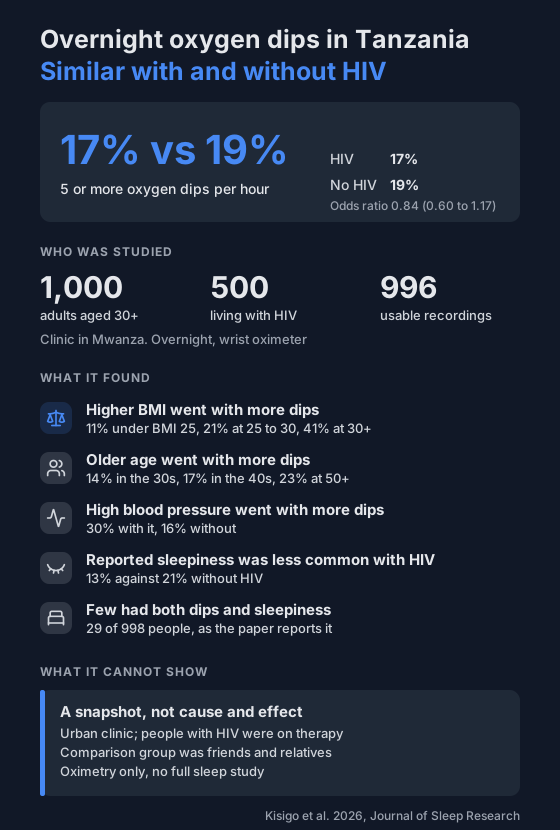
A 2026 study had 1,000 adults in Tanzania wear an overnight oximeter. Having 5 or more oxygen dips an hour was about as common with HIV (17%) as without it (19%). Reported sleepiness was lower with HIV.
Most studies comparing sleep apnea in people with and without HIV come from high-income countries, and the authors call their results inconclusive. This 2026 study used overnight oximetry in Mwanza, Tanzania. The authors say it's the first large study of its kind from East Africa.
Its main question was whether HIV status was linked to sleep apnea, which the authors defined by overnight oxygen dips. In this group there was no evidence of a link.
Who was in the study?
- 1,000 adults aged 30 or over, recruited from an HIV outpatient clinic at Bugando Medical Centre in Mwanza.
- 500 were living with HIV and had been on antiretroviral therapy for at least 180 days.
- 500 did not have HIV. They were close friends or relatives of clinic patients, called "supporters" here.
- 70% were women.
- Median age was 46 with HIV and 43 without.
- More than half had a BMI in the typical range (54%).
- Overweight was 21% with HIV and 26% without, and obesity was 13% and 14%.
How was it measured?
- Each person wore a Nonin WristOx2 wrist oximeter overnight.
- A dip counted when SpO2 fell at least 4% below its local baseline for at least 10 seconds.
- Dips per hour is the oxygen desaturation index, or ODI.
- The study defined "sleep apnea" as an ODI of 5 or more.
- A recording needed at least 3 hours of good data. 99% passed (996 of 1,000).
- Sleepiness came from the Epworth Sleepiness Scale, translated into Kiswahili. A score of 11 or more counted as excessive daytime sleepiness.
What did they find?
- 17% of people with HIV and 19% of people without had 5 or more dips an hour.
- After adjusting for age, sex, alcohol and smoking, the odds ratio was 0.84 (95% CI 0.60 to 1.17). The authors found no evidence of a link.
- Adding BMI to the adjustment gave similar results.
- Overall, 17.6% had 5 or more dips an hour.
Sleepiness did differ by HIV status:
- 13% of people with HIV scored 11 or more, against 21% of people without HIV.
- The adjusted odds ratio was 0.58 (95% CI 0.41 to 0.83).
- It was also linked with depression (adjusted odds ratio 1.99), being married or living with a partner (1.64) and alcohol (1.57).
- Few people had both frequent dips and high sleepiness: 29 of 998 as the paper reports it, though 996 recordings passed the checks.
That's a link in one group, not evidence that HIV protects against sleepiness. The limits below explain why the authors are cautious about it.
What went with more oxygen dips?
Across the whole group:
- BMI. 11% of people under BMI 25 had 5 or more dips an hour, 21% at 25 to 30, and 41% at 30 or over. Adjusted odds ratios were 2.20 and 6.48 against the under-25 group.
- Age. 14% in the 30s, 17% in the 40s and 23% at 50 and over.
- High blood pressure. 30% with it and 16% without (adjusted odds ratio 2.03).
- Depression. Some evidence of a link (adjusted odds ratio 1.73, 95% CI 1.02 to 2.91). Depression meant a PHQ-9 score of 10 or more.
- Alcohol. Some evidence only, and the interval included 1 (adjusted odds ratio 1.38, 95% CI 0.97 to 1.96).
- No clear link with sex, education, marital status, wealth, smoking, diabetes or kidney disease.
A few links seemed to differ by HIV status. Alcohol went with more dips in people with HIV but not in people without, and there was weak evidence of the same kind for high blood pressure. Depression went with more sleepiness in people with HIV but not in people without. The study wasn't powered to test these, so the authors say to read them with caution.
How does that compare with other studies?
- The authors note two studies in West Africa that found 40.2% to 43.3%. They suggest the gap could come from a younger group with less obesity.
- A UK study called POPPY also found no HIV difference (7% against 8%).
- Two US analyses of men used full sleep studies and reached conflicting results. Their rates were much higher. The authors suggest the different test, all-male groups and higher BMI as possible reasons.
Oximetry and full sleep studies don't count events the same way, so rates from one can't be set directly against the other. See home oximetry vs a sleep study.
What can't it tell you?
- Cause. It's a cross-sectional study of baseline data from an ongoing cohort. No direction or cause can be read from it.
- Selection. People were recruited from interested clinic attenders, which can skew who takes part.
- The comparison group. The authors say friends and relatives of patients may be more prone to sleepiness than the general population, which could make HIV look protective. They also suggest regular health education at the clinic may play a part.
- Who it covers. An urban clinic, with people whose HIV was well controlled (median CD4 count 716). It may not apply to rural adults or untreated HIV.
- The sleepiness score. Language or cultural differences may have led to under-reporting. The authors say that could explain why so few people had both dips and sleepiness. Or many people may truly have dips without sleepiness.
- The oximeter. It can't separate blocked-airway events from central ones, and it uses time in bed rather than sleep time. The authors say that could have led to underestimating sleep apnea. They also say dark skin might have slightly overestimated it, though they cite evidence that this device performs better in dark-pigmented people.
- Confounding. Age was adjusted in three wide bands, so some age effect may remain. The authors say that's unlikely to matter much, as age was similar in both groups.
- Odds ratios. Both outcomes were common, so the authors warn against reading odds ratios as risk ratios.
What can you do with this?
The study says nothing about whether any one person's dips matter. It does show how the numbers vary across a population, with BMI, age and blood pressure the clearest links. For a different group, see the obesity and sleep apnea cohort study.
The cut-off of 5 an hour is how this study defined sleep apnea, not a result for you. If you wear an oximeter, your ODI is also dips per hour, but it may count 3% or 4% drops, so check which before comparing it with anything here. You can share your data with your doctor. If you snore loudly, someone has seen you stop breathing, or you're very tired by day, see a doctor. For the signs, read snoring vs sleep apnea.
Not a medical device. Does not diagnose, treat or prevent any condition. Discuss results and changes with a clinician.
References
- Kisigo GA, Issarow B, Fadhil S, Ruselu G, Fabian P, Garbindi A, Peck RN, Baisley K, Kapiga S, Krieger AC. Prevalence of Sleep Apnea and Sleepiness in Adults With and Without HIV in Mwanza, Tanzania: Baseline Results From an Ongoing Cohort Study. Journal of Sleep Research. 2026;35(3):e70233. doi:10.1111/jsr.70233