How Common Is Sleep Apnea in Lung Fibrosis?
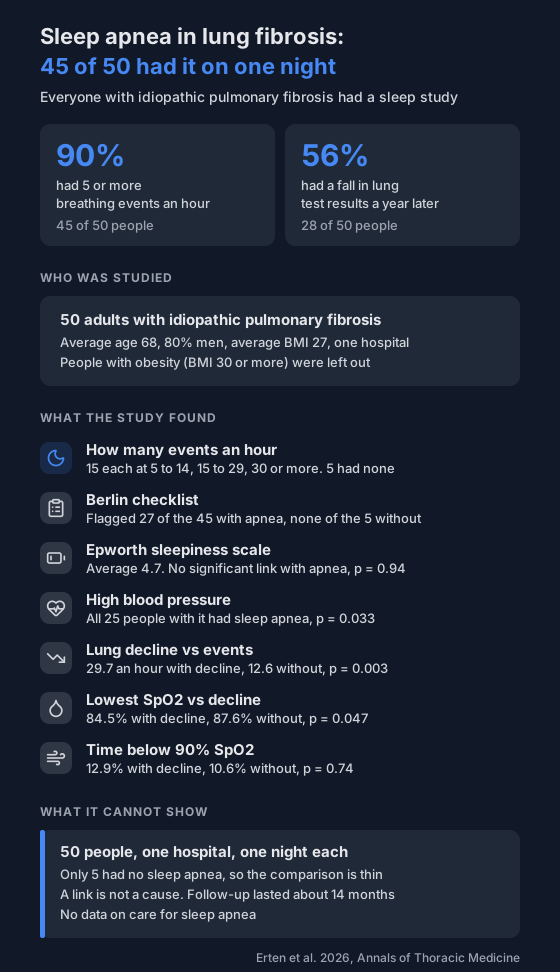
A 2026 study gave an overnight sleep study to 50 adults with idiopathic pulmonary fibrosis in Türkiye. 45 had sleep apnea, and those whose lung tests fell over a year had more events per hour.
Idiopathic pulmonary fibrosis is a long-term lung disease where the lung tissue scars and stiffens. Breathlessness and tiredness are common, so poor sleep can easily be put down to the lungs alone.
A 2026 prospective cohort study from a hospital in Türkiye gave every one of 50 people with the condition an overnight sleep study, then followed their lung tests for a year. It also asked how well two well-known checklists, the Berlin Questionnaire and the Epworth Sleepiness Scale, pointed to sleep apnea.
Who was in the study?
- 50 adults with idiopathic pulmonary fibrosis at one tertiary hospital, recruited one after another from the outpatient clinic.
- Average age 67.8, and 80% were men.
- 88% had smoked at some point.
- Average BMI was 27.1. People with obesity (BMI 30 or more) were left out on purpose, because weight is a strong driver of sleep apnea.
- 96% were on an antifibrotic drug for the lung disease.
- Also left out: people on long-term oxygen, with heart failure, on sleep medication or with earlier care for sleep apnea.
How many had sleep apnea?
The sleep study counted breathing events per hour, and the study defined sleep apnea as 5 or more.
- 45 of 50 (90%) met that, with a 95% confidence interval of 78.2% to 96.7%.
- 15 people each (30%) had 5 to 14 events an hour, 15 to 29, and 30 or more.
- So 30 of 50 people (60%) had 15 or more events an hour.
- The authors describe this as about two-thirds, which matches 30 of the 45 with sleep apnea rather than all 50.
- People with sleep apnea were more likely to have high blood pressure (all 25 who had it), and to be breathless (67% against 40%).
- Cough went the other way. All 5 without sleep apnea had it, against 53% of those with.
- Age, sex, BMI and smoking did not differ significantly between the two groups.
The authors note that earlier studies in the same condition put the share anywhere from 45% to 90%.
How well did the two checklists do?
- Berlin Questionnaire. 27 people (54%) came out as high risk. All 27 had sleep apnea. It missed 18 of the 45 who had it, and none of the 5 without sleep apnea was flagged (p < 0.001).
- Epworth Sleepiness Scale. The average score was 4.7. Only 9 people (18%) scored as excessively sleepy, 7 of them with sleep apnea and 2 without. The study found no significant link with sleep apnea (p = 0.94).
The authors read this as Berlin being the more useful of the two for deciding who should get a sleep study in this condition. They suggest daytime sleepiness is less marked in this condition, and that tiredness and breathlessness tend to get put down to the lung disease. Only 5 people had no sleep apnea, so these numbers are rough.
There's a sleep apnea risk check here, with our own questions.
What about lung function a year later?
The study measured lung function at the start and after one year. It counted a fall of 10% or more in forced vital capacity (the amount of air you can breathe out), or 15% or more in gas transfer (how well oxygen crosses the lung), as the disease progressing.
- 28 of 50 (56%) met that.
- Average follow-up was 14.5 months.
- Those 28 had more breathing events per hour: 29.7 against 12.6 (p = 0.003).
- They also had a longer longest pause: 52.9 seconds against 33.6 (p = 0.004).
- The study also reports a bigger lung decline in people with 15 or more events an hour than in those with fewer or none (p = 0.030).
- No one died during follow-up. One person with 30 or more events an hour had a sudden worsening of their lung disease.
In a regression analysis, events per hour (p = 0.044) and events per hour outside REM sleep (p = 0.039) were linked to the lung decline. The other sleep measures, including ODI, were not (p > 0.05). The authors call this analysis exploratory and say it needs confirming in larger studies.
What did overnight oxygen show?
The sleep study recorded SpO2 from a finger probe. The paper gives these only split by whether lung function fell, not for all 50 together.
| Measure | Lung decline (28) | No decline (22) | p |
|---|---|---|---|
| ODI (drops per hour) | 23.3 | 11.0 | 0.012 |
| Lowest SpO2 | 84.5% | 87.6% | 0.047 |
| Average SpO2 | 93.6% | 94.3% | 0.37 |
| Time below 90% SpO2 | 12.9% | 10.6% | 0.74 |
So the number of oxygen drops and the lowest reading differed. The average level and the time spent below 90% did not differ significantly. Time below 90% varied widely between people in both groups. To see how these are measured, read about ODI and how ODI tracks breathing events.
What can't this study show?
The authors list the limits themselves.
- Small. 50 people at one hospital. They did no sample size calculation, and their own check put the power at 69.8%.
- A link, not a cause. People with more events an hour also had a bigger fall in lung tests. The study can't say which drives which. The authors note the lung disease could itself make sleep breathing worse, and that disease stage may still explain some of it.
- Only 5 without sleep apnea. That made the group comparisons and the regression less reliable.
- One night. A single sleep study, and people were recruited at different points after their lung disease was first found.
- Some people missing. Those who declined the sleep study or had unusable recordings were left out, which may skew the group.
- Short follow-up. Long-term survival could not be assessed.
- No look at care. Whether people went on CPAP afterwards, and whether it changed anything, was not tracked.
What can you take from it?
- In this group of 50 people with lung fibrosis, sleep apnea was very common.
- Here, daytime sleepiness scores didn't line up with sleep apnea.
- An overnight SpO2 log shows how many dips you have and how low they go. Here's how to share it with a doctor.
For other lung and heart conditions, see sleep apnea in pulmonary hypertension and lung function and overnight oxygen.
Not a medical device. Does not diagnose, treat or prevent any condition. Discuss results and changes with a clinician.
References
- Erten HÇ, Cömert SS, Güngör GA, Yilmaz E, Havan A, Kiral N. Prevalence and prognostic significance of obstructive sleep apnea in patients with idiopathic pulmonary fibrosis: A prospective cohort study. Annals of Thoracic Medicine. 2026;21(4):185-192. doi:10.4103/atm.atm_84_26