Lung Function and Overnight Oxygen: A Study
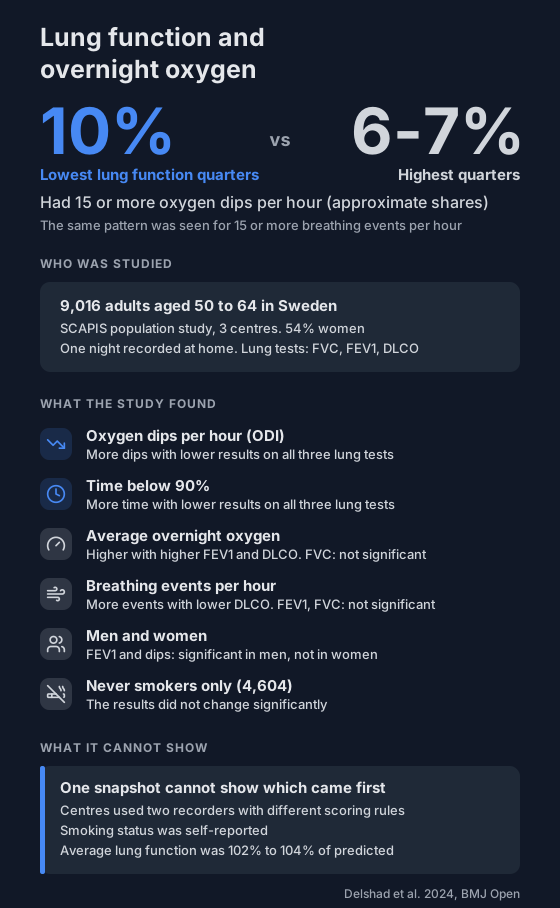
A Swedish study of 9,016 adults aged 50 to 64 found that lower lung function went with more overnight oxygen dips and more time below 90%, but mostly not with more breathing events.
Overnight oxygen dips are usually explained by pauses in breathing. A Swedish study from 2024 looked at something else that might go with them: how well your lungs work during the day.
It found that people with lower lung function had more dips and spent more time below 90%. The number of breathing pauses mostly didn't follow the same pattern.
Who was studied?
- 9,016 adults aged 50 to 64, picked at random from the Swedish population for a study called SCAPIS.
- 54% were women. The average age was 58 and the average BMI was 27.
- They came from three centres: Gothenburg, Uppsala and Umeå.
- Each wore a small recorder at home for one night. It tracked airflow through the nose and oxygen from a finger sensor.
- Recordings with less than 4 hours of airflow or oxygen data were left out.
What lung tests did they have?
Three:
- FVC. How much air you can blow out after a full breath in.
- FEV1. How much of it you can blow out in the first second.
- DLCO. How well gas moves from the lungs into the blood.
FVC and FEV1 were measured 15 minutes after a dose of an inhaler that opens the airways.
What did it find?
The researchers compared each lung test with four overnight measures. They adjusted for age, waist size and smoking. They ran the analysis separately for men and women at each centre, then pooled the results.
- Oxygen dips per hour (ODI). Lower results on all three lung tests went with more dips. A dip here meant a fall of at least 4 points.
- Time below 90%. Lower results on all three lung tests went with a bigger share of the recording below 90%.
- Average overnight oxygen. Higher FEV1 and higher DLCO went with a higher average. The link with FVC was not statistically significant.
- Breathing events per hour. Lower DLCO went with more events. FVC and FEV1 showed no statistically significant link.
The researchers also split people into quarters by each lung test result, taken as a percentage of the predicted value. About 10% of people in the lowest quarters had 15 or more dips per hour, against 6 to 7% in the highest quarters. Those figures come from a supplementary chart and the paper gives them as approximate. It says the same pattern was seen for 15 or more breathing events per hour, although the main analysis found no statistically significant link between FVC or FEV1 and breathing events.
When they repeated the analysis in the 4,604 people who had never smoked, the results did not change significantly. The paper does not show that data.
New to these measures? See what ODI is and what T90 is.
Was it the same for men and women?
Mostly, with a few differences:
- The link between FEV1 and oxygen dips was statistically significant in men but not in women.
- In women, a higher FEV1 went with more breathing events per hour. In men it didn't.
- The link between FVC and average overnight oxygen was significant in women but not in men.
- For time below 90%, the paper's results section reports no sex differences. Its discussion section says the link was stronger in women.
For the FEV1 and breathing events result in women, the authors offer body fat distribution as an explanation and call it speculative. They also say hormonal differences could influence both lung function and breathing events during sleep.
What do the authors make of it?
- Lower lung function was tied more clearly to the oxygen measures than to the count of breathing events.
- They say a high dip count relative to the number of breathing events should raise the question of lung function.
- They suggest clinicians may need to consider checking for sleep disorders in people with reduced lung function, and the other way round.
- One possible mechanism they give: with lower DLCO, blood oxygen may sit lower to begin with, so a smaller change in breathing is enough to register as a dip. They call this speculation.
What can't it show?
- Cause. Everything was measured once. The study can't say whether lower lung function leads to more dips.
- Size of the effect. The paper reports the links as regression coefficients, with the dip and event counts on a log scale. It does not give them as a number of extra dips per hour.
- Different equipment. Gothenburg used a different recorder from Uppsala and Umeå, with different scoring rules. Average ODI was 3.0 in Gothenburg and 7.3 in Uppsala. For Umeå the paper prints 8.1 in its table and 7.8 in its text. The authors analysed each centre separately and then pooled the results. They note that some results for FVC, FEV1 and average oxygen differed between centres.
- Smoking. It was self-reported, which the authors say may be subject to bias.
- Who was studied. A population sample aged 50 to 64 in Sweden, not a patient group. Average lung function was 102% to 104% of the predicted value.
What can you do with this?
- If you track your overnight oxygen, look at ODI and time below 90% together. They measure different things.
- If your recordings show a lot of dips or time below 90%, that's worth raising with your doctor. This study suggests breathing pauses aren't the only thing that goes with them.
- Take the numbers with you. Here's how to share your recordings.
A home oximeter recording is not a sleep study and not a lung function test.
Not a medical device. Does not diagnose, treat or prevent any condition. Discuss results and changes with a clinician.
References
- Delshad B, Ljunggren M, Zhou XW, Theorell-Haglöw J, Janson C, Zou D, Hedner J, Grote L, Blomberg A, Franklin K, Sahlin C, Malinovschi A, Lindberg E. Obstructive sleep apnoea and lung function, and their association with nocturnal hypoxemia: results from the Swedish CArdioPulmonary bioimage Study (SCAPIS) - a cross-sectional study. BMJ Open. 2024;14(11):e086596. doi:10.1136/bmjopen-2024-086596