Sleep Apnea in Pulmonary Hypertension
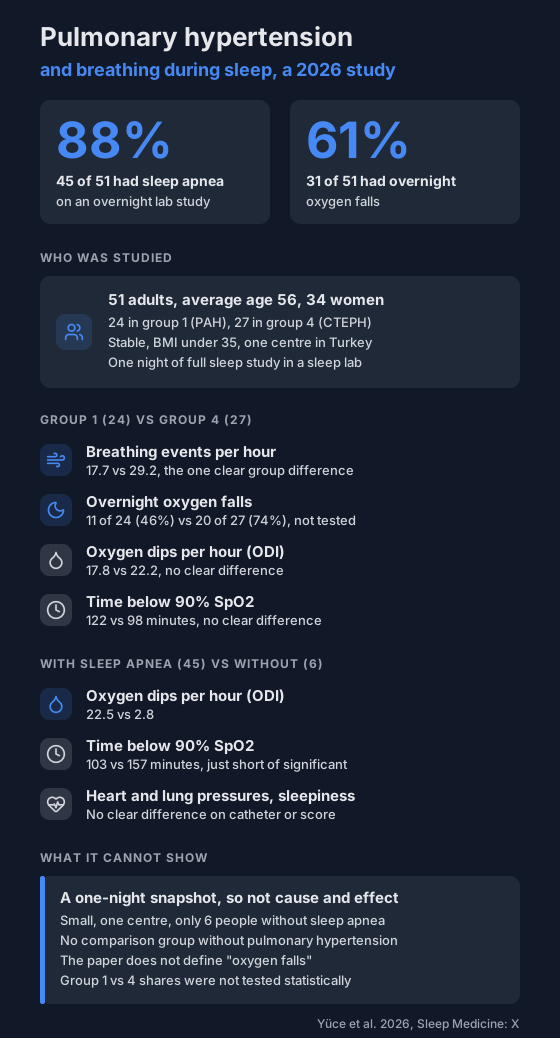
A 2026 study gave a full sleep study to 51 adults with group 1 or group 4 pulmonary hypertension in Turkey. 45 had sleep apnea and 31 had overnight oxygen falls.
Pulmonary hypertension means high blood pressure in the arteries of the lungs, which strains the right side of the heart. Low oxygen at night is already known to be common in it. A 2026 study from Turkey asked a narrower question: how many of these people also have sleep apnea, and does it differ between two types?
Nearly 9 in 10 did.
Who was studied?
- 51 adults with stable pulmonary hypertension, seen at one university hospital in Van, Turkey, from November 2022.
- Average age 56. 34 were women and 17 men.
- 24 had group 1, pulmonary arterial hypertension (PAH): 12 with no known cause, 10 linked to a heart defect from birth and 2 to scleroderma.
- 27 had group 4, chronic thromboembolic pulmonary hypertension (CTEPH), caused by old blood clots in the lungs.
- Nobody had a previous sleep apnea finding. People with a BMI of 35 or more, or with marked lung disease on breathing tests, were left out.
- Everyone had one night of full sleep study (polysomnography) in a sleep lab, plus blood tests, a 6-minute walk and a heart catheter to measure pressures.
What did it find?
- Sleep apnea: 45 of 51 (88%) had obstructive sleep apnea. Of those 45, 25 were in the highest grade, 11 in the middle grade and 9 in the lowest.
- Overnight oxygen falls: 31 of 51 (61%). The paper doesn't say what cutoff it used for this.
- SpO2 below 90%: the authors say every patient spent some of the night below 90%. Average overnight SpO2 was about 83% in both groups.
- Group 1 vs group 4:
- Breathing events per hour: 17.7 vs 29.2. This was the only sleep measure that differed clearly between the groups.
- Sleep apnea: 20 of 24 vs 25 of 27. The paper didn't test this difference.
- Overnight oxygen falls: 11 of 24 (46%) vs 20 of 27 (74%). This wasn't tested either.
- ODI: 17.8 vs 22.2 dips per hour, no clear difference.
- Time below 90% SpO2: 122 vs 98 minutes, no clear difference.
- With vs without sleep apnea (45 vs 6):
- ODI: 22.5 vs 2.8 dips per hour.
- BMI: 29.6 vs 23.4.
- Time below 90%: 103 vs 157 minutes, which fell just short of statistical significance.
- Sleep efficiency was lower with sleep apnea, 83% vs 95%.
- Daytime sleepiness scores were about the same, around 12 in both. 20 of the 45 scored 10 or more.
- Lung and heart pressures from the catheter, and blood tests, showed no clear differences.
- Walking: in group 4, people with sleep apnea walked less in 6 minutes, 352 vs 580 metres. Only 2 people in group 4 didn't have sleep apnea. In group 1 the gap ran the other way, 363 vs 270 metres, and wasn't statistically significant.
So the oxygen dip count went with sleep apnea, but time below 90% didn't.
For what these measures count, see what ODI is and what T90 is.
What do the authors suggest?
They cite 2022 European guidelines that, in their summary, recommend oxygen at night in pulmonary hypertension. They argue that when sleep apnea is also present, oxygen alone may not be enough, and a breathing machine may be needed as well. So they suggest a full sleep study as a routine part of care in this group. This study didn't test any of those approaches.
What can't it show?
- It's a one-night snapshot, so it can't show whether sleep apnea makes pulmonary hypertension worse or the other way round.
- It's small and from one centre. Only 6 people didn't have sleep apnea, which the authors say left little power to find differences.
- There was no comparison group without pulmonary hypertension.
- The rule for "oxygen falls" isn't defined, and the group 1 vs group 4 shares weren't tested statistically.
- People with a BMI of 35 or more were left out, and only groups 1 and 4 were included.
- A few numbers in the paper are hard to square, such as a lower arousal count in people with sleep apnea.
- It had no external funding. The authors reported no competing interests.
A related study found sleep apnea in about 7 in 10 people soon after a blood clot in the lung. For a night at altitude with this condition, see pulmonary hypertension at 2,500 m.
What can you do with it?
- If you have pulmonary hypertension and track your overnight oxygen, ODI and time below 90% are the measures this study reported.
- A fingertip oximeter can show how those numbers look across nights, but it's not a sleep study and can't tell sleep apnea apart from other causes of low oxygen.
- If you snore, stop breathing in your sleep or your overnight numbers look low, raise it with your pulmonary hypertension team. Sleepiness scores were similar with and without sleep apnea here, so sleepiness alone didn't tell the two apart.
- You can try the sleep apnea risk check, which always ends at "worth discussing with a doctor".
Not a medical device. Does not diagnose, treat or prevent any condition. Discuss results and changes with a clinician.
References
- Yüce K, Aşkar S, Aşkar M. Sleep-disordered breathing in patients with group 1 and group 4 pulmonary hypertension. Sleep Medicine: X. 2026;12:100200. doi:10.1016/j.sleepx.2026.100200