Sleep Apnea After a Lung Blood Clot
A 2026 study of 45 people with a confirmed blood clot in the lung found that about 7 in 10 met the 5 events per hour cutoff on a portable sleep test taken within two weeks, and many had none of the usual clot risk factors.
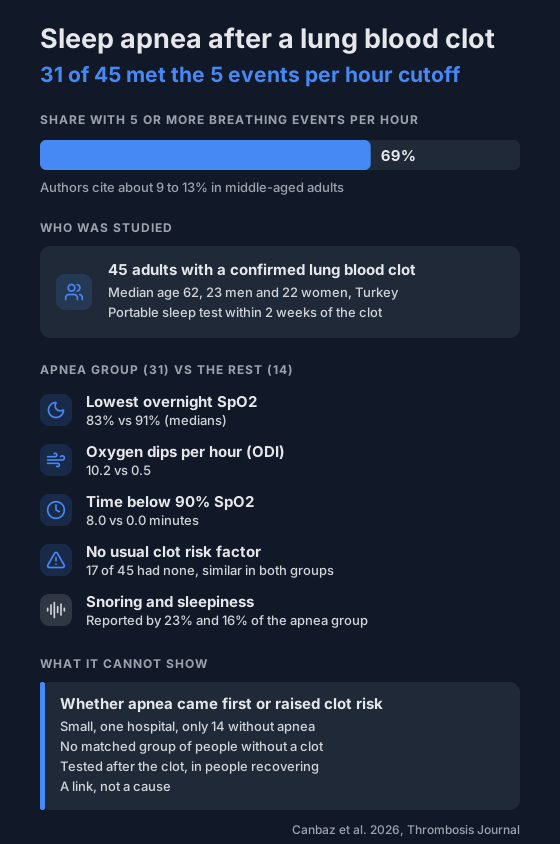
A blood clot in the lung (pulmonary embolism) often has a known trigger, like recent surgery, a long spell in bed or cancer. Some don't. A 2026 study from a hospital in Turkey gave a sleep test to people with a confirmed clot and asked how many also had sleep apnea.
About 7 in 10 met the cutoff. Many of them had none of the usual clot risk factors.
Who was studied?
- 45 adults with a new, confirmed lung clot, seen at one chest hospital in İzmir, Turkey. 23 were men and 22 were women, with a median age of 62.
- The clot was confirmed by a CT scan, a lung scan, or both.
- Anyone already known to have sleep apnea, or with a previous sleep study, was excluded. Five people were left out because their recordings weren't usable.
- All were stable. None needed intensive care or clot-dissolving drugs, and heart ultrasound showed typical right-heart function in everyone.
- The data were collected from 2010 to 2013 and analysed later.
What was measured?
- A portable sleep test (WatchPAT 200) within two weeks of the clot, in hospital or at home after discharge. It records finger pulse signals, oxygen saturation, heart rate and movement.
- A specialist scored it. The study counted 5 or more breathing events per hour as sleep apnea.
- Admission blood tests, daytime SpO2, heart ultrasound, BMI, and a standard list of clot risk factors (the Wells criteria).
- Snoring, witnessed pauses and daytime sleepiness, by standard questions.
What did it find?
- How many: 31 of 45 (69%) met the cutoff. By events per hour, 11 had 5 to 14, 12 had 15 to 29 and 8 had 30 or more. The authors compare this with about 9 to 13% in middle-aged adults.
- Overnight oxygen: the 31 people at or above the cutoff compared with the other 14 (medians):
- Lowest SpO2: 83% vs 91%.
- ODI: 10.2 vs 0.5 events per hour.
- Time below 90% SpO2: 8.0 vs 0.0 minutes.
- Average overnight SpO2: 94% vs 95%, not a statistically significant difference.
- Clot risk factors: 17 of 45 (38%) had none of the Wells criteria. The share was similar in both groups (39% vs 36%). Recent surgery, time in bed, signs of a leg clot and the other listed factors didn't differ significantly either.
- Symptoms: among the 31, snoring was reported by 23%, daytime sleepiness by 16% and witnessed pauses by one person. These were not significantly different from the other 14.
- BMI: higher in the first group, 31.2 vs 27.3. Age and sex didn't differ significantly.
- Blood tests: urea (BUN) was higher in the first group, 36.0 vs 19.5 mg/dL. D-dimer, troponin and NT-proBNP did not differ significantly.
- Diabetes: 39% vs 7%, which fell short of statistical significance (p = 0.071).
- Correlations: across all 45, more events per hour went with older age (r = 0.36) and a lower lowest SpO2 (r = -0.75).
So in this group, symptoms and the usual clot risk factors did not separate people who met the cutoff from those who didn't. Apart from BMI and urea, the clear differences were in the overnight oxygen measures.
What does it suggest?
The authors point out that the group at or above the cutoff didn't carry more of the usual clot risk factors. They suggest repeated drops in oxygen overnight are a plausible way sleep apnea could raise clotting tendency, but they did not measure that. They also cite other work in which CPAP lowered markers of blood vessel lining dysfunction, platelet activation and stress-nerve activity. From that, they suggest finding and managing sleep apnea after a clot might lower the chance of another one, but this study did not test it. They call for larger studies with matched comparison groups, and for work on whether targeted sleep testing after a clot is useful and worth the cost.
What can't it show?
- It can't show cause. The sleep test was done after the clot, so apnea may have come first, or may be unrelated.
- It's small and from one hospital. Only 14 people were below the cutoff, so many comparisons had little power to find differences.
- There was no group of people without a clot, so the 69% is set against general-population figures from other studies.
- No adjustment for BMI, diabetes or other factors was done, because the numbers were too small.
- The people were recovering from an acute illness and all had low-to-intermediate risk clots. The authors argue this didn't distort the test, but it can't be ruled out.
- The device estimates breathing events from pulse signals rather than airflow, and the data are from 2010 to 2013.
- It had no external funding. The authors reported no competing interests.
For how portable tests compare with full studies, see home sleep tests in primary care. For oximetry measures like ODI, see home oximetry ODI vs a sleep study. Another reminder that symptoms miss a lot: most sleep apnea isn't linked to obesity.
What can you do with it?
This is one small study, so it doesn't change what you should do about a clot or about sleep.
- If you track overnight oxygen, ODI, lowest SpO2 and time below 90% are the same measures this study compared between groups.
- A tracker can show how those numbers look across your nights, but it is not a sleep study.
- If you've had a clot, or you're recovering from one, and you snore, stop breathing in your sleep or feel very sleepy, mention it to your clinician. Symptoms were rare in this group, so a lack of them doesn't say much either way.
- You can try the sleep apnea risk check, which always ends at "worth discussing with a doctor".
Not a medical device. Does not diagnose, treat or prevent any condition. Discuss results and changes with a clinician.
References
- Canbaz M, Uçar ZZ, Karasu I, Tatar D, Erbaycu AE. Prevalence of obstructive sleep apnea syndrome in patients with pulmonary embolism: a prospective observational study. Thrombosis Journal. 2026;24(1):94. doi:10.1186/s12959-026-00895-0