Most People With Sleep Apnea Aren't Obese
A 2025 pooled analysis of 12,860 adults in four community studies found 68.5% of those with sleep apnea were not obese, and 23.5% had a BMI under 25. It was part-funded by Apnimed.
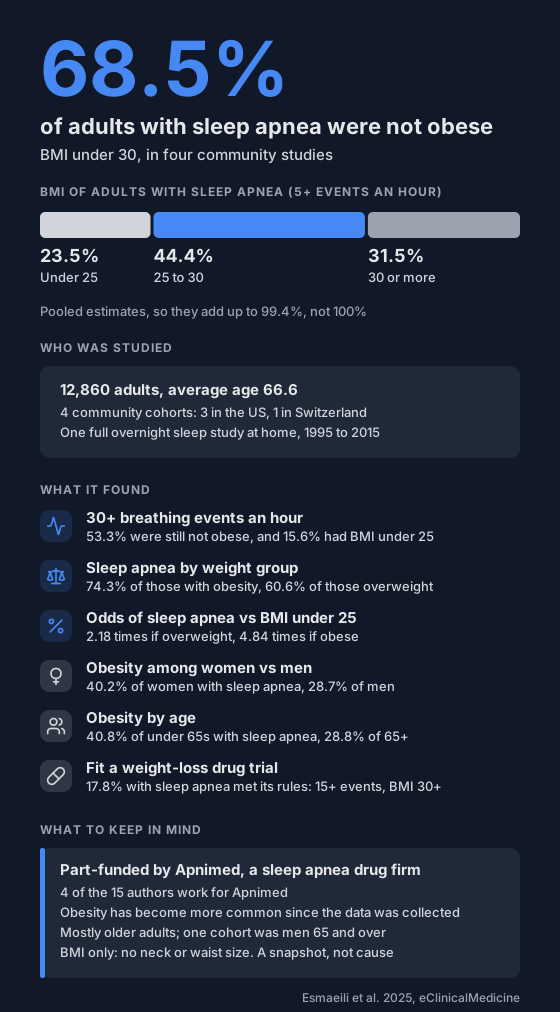
Sleep apnea is usually pictured as a problem of people who are very overweight. A 2025 analysis of four community studies says most people who have it aren't obese.
In 12,860 adults, 68.5% of those with sleep apnea had a BMI under 30.
Who was studied?
- 12,860 adults from four community studies: three in the US and one in Lausanne, Switzerland.
- Their average age was 66.6. One of the four studies took only men aged 65 and over.
- Everyone had one full overnight sleep study at home, between 1995 and 2015.
- Sleep apnea meant 5 or more breathing events an hour, counting only partial events that came with an oxygen dip of at least 4%.
- Weight groups were by BMI: under 25, 25 to 30 (overweight) and 30 or more (obese).
These were community studies, not sleep clinic patients. People were taking part in long-running health research.
What did it find?
7,222 of the 12,860 (56.2%) had sleep apnea by that definition. Among them, the pooled estimates were:
- 31.5% obese.
- 44.4% overweight.
- 23.5% with a BMI under 25.
The pattern held for higher event counts. At 15 or more events an hour, 61.4% were not obese. At 30 or more, 53.3% were not obese, and 15.6% had a BMI under 25.
So does weight still matter?
Yes. Turned the other way round, sleep apnea was common in the heavier groups:
- 74.3% of adults with obesity had it.
- 60.6% of overweight adults had it.
- After allowing for age, sex and race, the odds of having it were 2.18 times as high when overweight and 4.84 times as high when obese, against a BMI under 25.
So extra weight goes with a much higher chance of sleep apnea. But because there are more people outside the obese group, most people with sleep apnea are outside it too.
Did it differ for women and younger adults?
Among people with sleep apnea, obesity was more common in:
- Women: 40.2%, against 28.7% of men.
- Under 65s: 40.8%, against 28.8% of those 65 and over.
The authors suggest weight may play a bigger part in sleep apnea for women and younger adults.
It ran the other way among people with obesity. Sleep apnea was more common in men (81.3%, against 63.7% of women) and in those 65 and over (78.2%, against 67.6% of under 65s). For more on how sleep apnea differs by age and sex, see sleep apnea by age and sex.
What about weight-loss drugs?
The authors point to the SURMOUNT-OSA trial of tirzepatide, a weight-loss drug, which cut breathing events per hour by 48% to 56% in people with obesity. That trial only took people with 15 or more events an hour and a BMI of 30 or more. In this analysis, 17.8% of people with sleep apnea met both.
The paper also notes that CPAP does not appear to lead to weight loss. For the tirzepatide results in more detail, see early weight loss on tirzepatide.
What doesn't it tell you?
- Independence. The study was partly funded by an unrestricted grant from Apnimed, a company developing drugs for sleep apnea. Four of the 15 authors work for Apnimed, and several others have consulted for it or other sleep companies. The paper says the funder had no role in the design, analysis or writing.
- Today's numbers. The data was collected between 1995 and 2015. Obesity has become more common since, so the shares may be different now.
- Everyone. Most people were middle-aged or older, one study was only older men, and the authors say not all racial and ethnic groups were well represented. One US study also took in more people with symptoms than the general public.
- Body shape. BMI was the only weight measure. Neck and waist size may matter more for sleep apnea, and weren't analysed.
- Cause. It's a snapshot of who had what, not a test of what causes sleep apnea.
- Clinics. People who go to a sleep clinic with symptoms may be heavier than this community sample.
What can you do with this?
Not being obese doesn't rule out sleep apnea. If you snore loudly, someone has seen you stop breathing in your sleep, or you're exhausted during the day, see a doctor, whatever your weight. For the other signs, read snoring vs sleep apnea and sleep apnea without sleepiness.
The sleep apnea risk check takes about a minute and helps you decide whether to talk to a doctor.
An overnight oximeter can't tell you whether you have sleep apnea. It records what your oxygen and pulse did, and you can share that with your doctor.
Not a medical device. Does not diagnose, treat or prevent any condition. Discuss results and changes with a clinician.
References
- Esmaeili N, Gell L, Imler T, Hajipour M, Taranto-Montemurro L, Messineo L, Stone KL, Sands SA, Ayas N, Yee J, Cronin J, Heinzer R, Wellman A, Redline S, et al. The relationship between obesity and obstructive sleep apnea in four community-based cohorts: an individual participant data meta-analysis of 12,860 adults. eClinicalMedicine. 2025;83:103221. doi:10.1016/j.eclinm.2025.103221