Quetiapine, Sleep Apnea and Next-Day Driving
A 2026 crossover trial gave 15 adults with sleep apnea and broken sleep 50 mg of quetiapine for one night. Breathing events fell from 27 to 20 an hour with no significant change in overnight oxygen, but next-morning reaction time and simulated driving got worse.
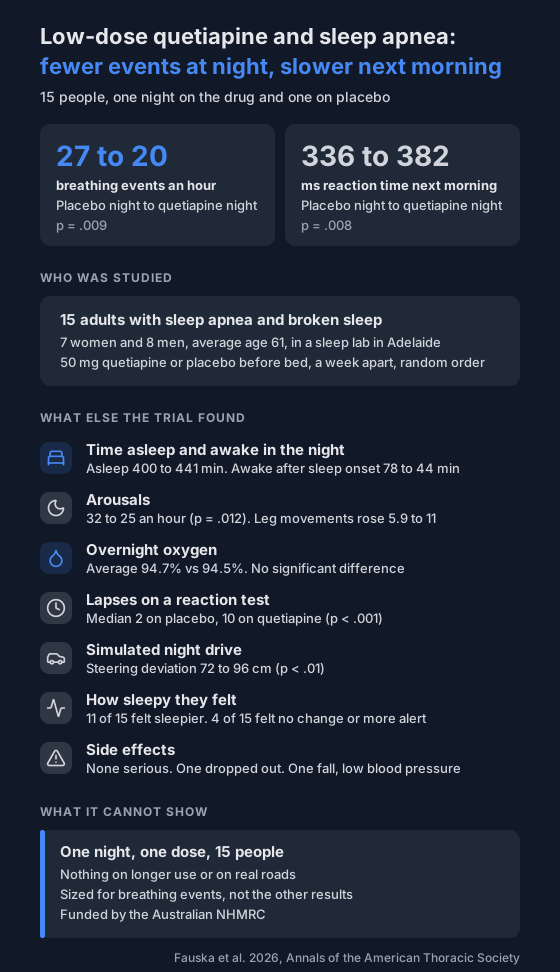
Quetiapine is an antipsychotic, but it is now prescribed off-label more often than for its approved uses, mainly for poor sleep and anxiety. Many people with undiagnosed sleep apnea report broken sleep, so the authors expect some of them end up on it. A 2026 trial asked what a single low dose does to breathing, sleep and the next morning in people with sleep apnea.
It found fewer breathing events and more sleep, with no significant change in overnight oxygen. It also found slower reactions and worse simulated driving the next morning.
Who was studied?
- 15 adults who completed the trial, 7 women and 8 men, average age 61. 16 were enrolled, and one withdrew on the first night after an adverse event.
- All had sleep apnea (5 or more breathing events an hour) and trouble staying asleep, on an insomnia questionnaire.
- Average breathing events an hour on the placebo night were 27. Average BMI was 28.
- They were recruited in Adelaide, Australia. The paper doesn't say how many of them used CPAP.
- People with psychiatric conditions, other drugs likely to interact, or a lowest overnight oxygen below 75% on their qualifying study were left out.
What was the design?
- Double-blind, randomised, placebo-controlled crossover. Each person had both nights, about a week apart, in random order.
- 50 mg of quetiapine or placebo just before lights out, then an 8-hour sleep opportunity in a lab with full polysomnography.
- Within 30 minutes of waking, a 30-minute night-time driving simulator, then a 10-minute reaction test (the psychomotor vigilance task).
- Breathing events an hour was the main outcome. Everything else was secondary.
What happened overnight?
- Breathing events: 27 on placebo, 20 on quetiapine (p = .009). On the back they went from 48 to 33 an hour. The drop was in non-REM sleep. In REM sleep it was 30.7 vs 27.8, not significant.
- Sleep: time asleep went from 400 to 441 minutes in the results table (p < .001). The figure legend gives 440. Time awake after falling asleep went from 78 to 44 minutes. Sleep efficiency went from 80% to 87%.
- Arousals: 32 an hour on placebo, 25 on quetiapine (p = .012).
- Oxygen: average SpO2 was 94.7% vs 94.5% (p = .38). The average lowest reading was 85.7% vs 86.7%, and the 3% desaturation index was 15 vs 13 an hour. None of these differences was statistically significant.
- Sleep stages: no significant change in the share of each stage.
- Leg movements: periodic leg movements went from 5.9 to 11 an hour (p = .03).
The authors think quetiapine's sedating effect raised the level of disturbance needed to wake someone, and that fewer arousals went with fewer events. Their estimates of the underlying causes of apnea did not differ between nights, but they say those estimates were indirect and the sample small.
What happened the next morning?
- Reaction time: each person's median reaction time averaged 336 ms after placebo and 382 ms after quetiapine (p = .008).
- Lapses: a lapse is a reaction slower than 500 ms. The median was 2 after placebo and 10 after quetiapine. The rate was about 3.2 times higher (95% CI 1.9 to 5.4).
- Steering deviation: 72 cm after placebo, 96 cm after quetiapine (p < .01). The authors note that healthy controls in earlier studies on the same simulator averaged 37 cm.
- Crashes: 55 after quetiapine vs 27 after placebo. That was not statistically significant (p = .105, 95% CI for the rate ratio 0.87 to 4.37).
- Feeling sleepy: the Karolinska Sleepiness Scale went from 5 to 7 (p < .001). 11 of 15 felt sleepier on the quetiapine morning. 2 felt no different and 2 felt more alert. The 2 who felt more alert still did worse on the reaction and driving tests. The authors read this as about 1 in 4 people either not noticing or wrongly believing they were less sleepy.
The driving and reaction tests took place about 8.5 to 9.5 hours after the dose. The authors say people with sleep apnea and broken sleep should be cautioned against driving or other safety-critical tasks for at least 9.5 hours after taking it. That is their conclusion, and it comes from a single dose in 15 people.
What about side effects?
- No serious adverse events.
- The results text says 5 participants had non-serious events related to quetiapine, and that all settled within 48 hours. Two needed a medical check.
- The discussion says about a third of participants had some event on the quetiapine night.
- The adverse event table lists 6 participants on the quetiapine night, and its note says all events settled by the next day except one person whose sleepiness lasted 2 days.
- The events in that table include a fall with a blood pressure drop to 62/41 mm Hg, two cases of low blood pressure on standing, restless legs, anxiety and a panic attack, and trouble waking after 8 hours.
- On the placebo night, 3 participants had events: nausea, limb pain and tingling in the face.
- The study was not powered for side effects.
What can't it show?
- It's one night at one dose, 50 mg, in people who weren't taking quetiapine. Longer use, or the 25 to 100 mg doses used in practice, may differ.
- The authors say next-day effects may change with regular use, but earlier real-world data suggest they may not get better in established users of sedating antipsychotics.
- 15 people. The trial was sized to pick up a change in breathing events, so the other results are less certain.
- A driving simulator and a reaction test, not real roads.
- The authors cite earlier research linking low-dose quetiapine in older adults to more deaths, dementia and falls than another sleep drug, and long-term use to weight gain and metabolic effects. This trial did not measure those.
- The authors conclude that larger, longer studies are needed before any clinical use of quetiapine for poor sleep in people with sleep apnea.
- Funded by an Australian NHMRC grant. The senior author reports grants and advisory roles with sleep and drug companies outside this work.
What can you do with it?
This is a trial result, not advice on any medicine. Talk to a prescriber before any change to a sleep medicine.
If you track your nights, some of what this trial measured is on your oximeter report.
- The trial's oxygen measures, average SpO2, lowest reading and the 3% desaturation index, are the kind your overnight report shows.
- Breathing events an hour come from a sleep study, not an oximeter.
- Next-day alertness isn't on your oximeter. In this trial, 4 of 15 people felt no sleepier on the quetiapine morning, and the 2 who felt more alert still did worse on the tests.
For another evening substance and overnight oxygen, see alcohol and overnight oxygen. For sleepiness behind the wheel, see coffee, naps and sleepy drivers and still sleepy on CPAP.
Not a medical device. Does not diagnose, treat or prevent any condition. Discuss results and changes with a clinician.
References
- Fauska C, Bastiampillai T, Rawson G, Toson B, Vakulin A, Adams R, Wittert G, Loffler KA, Eckert DJ. Quetiapine modestly improves sleep and breathing but impairs next-day performance in people with obstructive sleep apnea and difficulty maintaining sleep: a randomized controlled trial. Annals of the American Thoracic Society. 2026;23(10):1532-1542. doi:10.1093/annalsats/aaoag092