Home Sleep Test in Primary Care: A 2026 Study
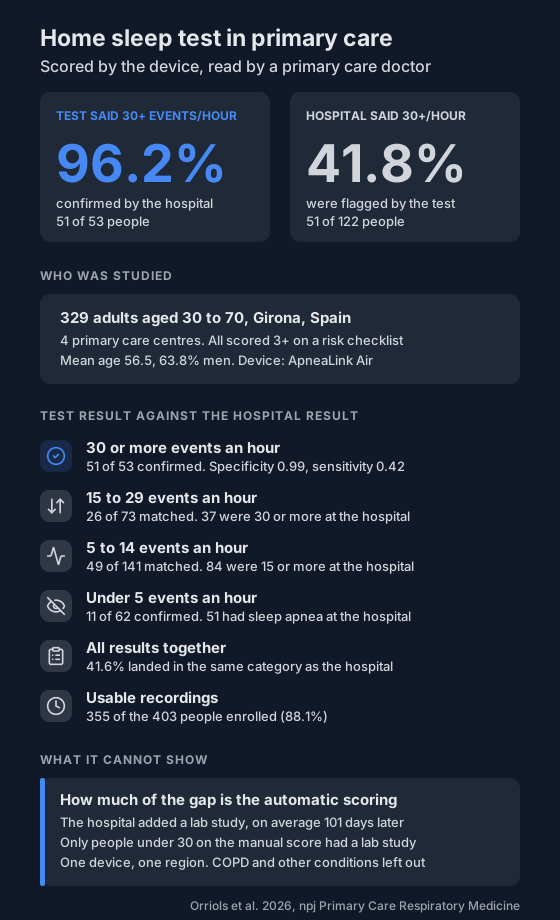
A 2026 study had primary care doctors read an automatically scored home sleep test for 329 adults. Results of 30 or more events an hour held up at the hospital 96.2% of the time. Lower results often didn't.
A home sleep test is usually scored by hand by a sleep specialist. Some kits also score themselves, which means a primary care doctor could read the result without a hospital visit.
A 2026 cross-sectional study from Spain tested how far that result can be trusted. A high count held up almost every time. A low count often didn't.
Who was in the study?
- Adults aged 30 to 70 who came to one of 4 primary care centres in Girona, Spain, for any reason, between April 2016 and November 2020.
- They were picked at random from the day's appointment list, not because they had sleep complaints.
- To get in, they had to score 3 or more on a sleep apnea risk checklist.
- 2,599 people were assessed and 403 were enrolled.
- 355 (88.1%) gave a usable recording, and 329 completed the hospital side and were compared.
- Mean age was 56.5, 63.8% were men and mean BMI was 30.1.
- People with COPD, serious heart or kidney failure, opioid use and several other conditions were left out.
How did it work?
- A nurse at the centre showed each person how to fit the kit, an ApneaLink Air, and they wore it at home for one night.
- The device scored the recording itself, and the primary care doctor read that result with no help from the hospital.
- The same recording went to a hospital sleep specialist, who scored it by hand without seeing the doctor's result.
- Anyone under 30 breathing events an hour on the hand score was booked for a full sleep lab study.
A recording counted if it had at least 4 usable hours. For how much recording a test needs, see how many hours a home sleep test needs.
What did it find at the high end?
Primary care reported 30 or more events an hour for 53 people.
- The hospital agreed for 51 of them (96.2%).
- The other 2 were in the 15 to 29 band at the hospital.
- Specificity was 0.99.
But the hospital put 122 people at 30 or more. The primary care result had flagged 51 of them (41.8%), so sensitivity was 0.42.
Where did the other 71 land in primary care?
- 37 in the 15 to 29 band.
- 30 in the 5 to 14 band.
- 4 under 5.
And the lower results?
They matched far less often.
- 15 to 29 events an hour (73 people): 26 matched the hospital, 37 were 30 or more at the hospital, and 10 were lower.
- 5 to 14 events an hour (141 people): 49 matched, 84 were 15 or more at the hospital, 6 were under 5, and 2 had central sleep apnea.
- Under 5 events an hour (62 people): the hospital agreed for 11 (17.7%). The other 51 had obstructive sleep apnea at the hospital, 21 of them at 15 or more.
Across all 329 people, 41.6% landed in the same category in both places. When the two results differed, the hospital's was usually the higher one.
The agreement score (kappa, where 1 is perfect) was 0.46 for 30 or more, 0.06 for 15 to 29 and 0.15 for 5 to 14.
Why did the hospital count more?
The paper doesn't separate the reasons, but the hospital result wasn't only a hand score of the same recording.
- 264 of the 329 people also had a sleep lab study, and it was done 101 days after the home test on average.
- The lab study's median was 18.1 events an hour, in a group that left out the people with the highest home counts.
- The home recordings' median was 10.6 scored by the device and 10.5 scored by hand, across all 355 usable recordings.
The authors put the differences between tests down to how each test measures, the device's algorithms and night-to-night variation.
What did the authors conclude?
When the automatic score shows 30 or more events an hour, hospital confirmation may be unnecessary. A lower result, or one under 5, may still need a specialist's assessment.
What can't it tell you?
- Which step caused the gap. The comparison of the device's score with the hand score alone is in a supplementary table, not the main paper.
- Other kits. One device and one software version were tested.
- Other groups. Everyone already scored at higher risk on a checklist, and 93.9% had obstructive sleep apnea at the hospital. People over 70 and people with COPD or serious heart failure weren't included.
- The full picture for everyone. The 65 people at 30 or more on the hand score didn't have a lab study.
- What happens next. The study didn't follow care or outcomes.
The authors also note that the device sometimes rejected recordings that were usable when scored by hand. They declared no competing interests.
What does this mean for your own test?
If your home sleep test came back low but you still snore loudly, wake unrefreshed or have been seen to stop breathing, tell your doctor. In this study a low automatic result was often followed by a higher one at the hospital.
For the signs to mention, see snoring vs sleep apnea. On why one night can mislead, see multi-night tracking vs one sleep study.
An overnight oximeter is not a home sleep test and can't tell you whether you have sleep apnea. It logs your oxygen and pulse, and you can share that with your doctor.
Not a medical device. Does not diagnose, treat or prevent any condition. Discuss results and changes with a clinician.
References
- Orriols R, Rojas E, Obrador A, Comas-Cufí M, Ramos R, Castellà Daga I, Espuña X, Salvans M, Marco E, Bonnin-Vilaplana M. Severe obstructive sleep apnoea can be accurately diagnosed in primary care centres. npj Primary Care Respiratory Medicine. 2026;36(1):24. doi:10.1038/s41533-026-00496-4